

Growth is one of the greatest milestones a founder can achieve. A growing customer base signals that your work is resonating, an expanding team reflects the opportunities you’ve created for others, and increasing revenue provides new possibilities for investment, innovation, and long-term impact.
Yet growth often brings an unexpected challenge.
The business that once felt straightforward suddenly becomes more difficult to lead. Decisions that were once made in minutes now require multiple conversations. As teams grow, communication becomes more complex and processes that worked well with five employees begin breaking down with fifteen. The founder who once spent most of the day serving clients or creating new opportunities now spends much of it answering questions, approving work, and solving problems.
Many founders assume this is simply the cost of success. In reality, it’s often a sign that the business has outgrown the systems that once made it successful.
Growth changes how the business operates. Every new employee, customer, and opportunity introduces additional complexity. Unless the systems supporting the business evolve alongside that growth, what once created momentum gradually becomes a source of friction.
Research from the McKinsey Global Institute illustrates this challenge. Micro, small, and medium-sized businesses account for more than 90% of businesses worldwide, yet they remain significantly less productive than larger organizations. McKinsey concludes that strengthening operating capabilities is one of the most important ways smaller businesses can improve productivity and sustain growth as complexity increases.
Growing businesses need better business systems.
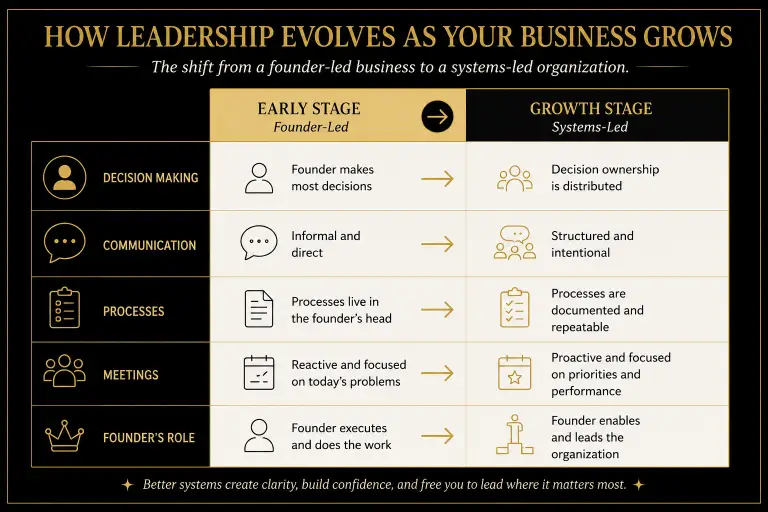
In the early stages of a business, execution creates momentum. Founders wear multiple hats because they have to. They make nearly every important decision, communicate directly with clients, solve problems as they arise, and personally ensure work meets expectations. The organization remains agile because information moves through one person.
That approach works remarkably well until the business grows beyond one person’s capacity.
As new employees join the team, responsibilities become more specialized and communication becomes less direct. New clients introduce different expectations, projects become increasingly interconnected, and decisions begin affecting multiple parts of the business rather than a single function. Leadership gradually shifts from doing the work to designing how the work gets done.
This transition is where many growing organizations struggle. The business becomes larger, but the operating model remains largely unchanged. Decisions continue flowing through the founder, approval processes become increasingly centralized, and leadership attention is consumed by coordination instead of direction.
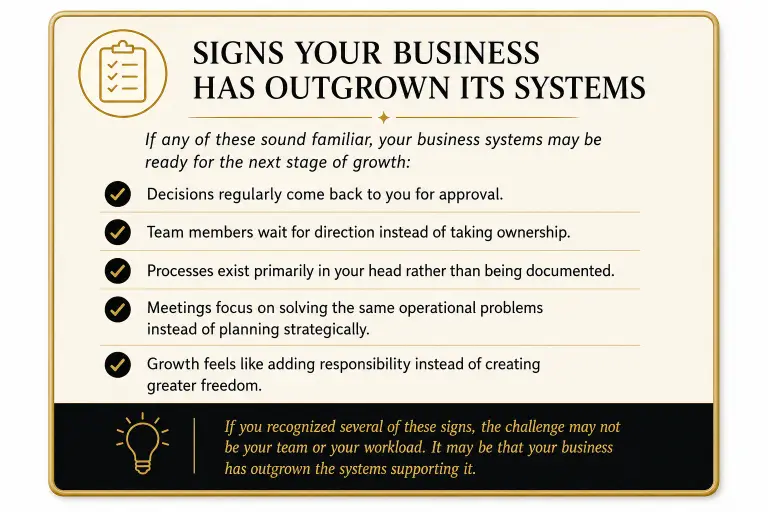
The real problem isn't delegation.
When founders begin feeling overwhelmed, delegation is usually the first recommendation they receive. Delegation is important, but it is also an incomplete solution.
Many businesses don’t struggle because work hasn’t been delegated. They struggle because ownership has never been clearly defined. Team members may receive responsibility for completing a task while still relying on the founder to answer questions, make judgment calls, resolve conflicts, or approve final decisions. The founder believes the work has been delegated, but the team experiences something very different.
Harvard Business Review has repeatedly highlighted that effective delegation depends on far more than assigning work. It requires clear expectations, decision authority, coaching, and systems that allow people to succeed independently. Without those structures, work naturally returns to the leader, reinforcing the very dependence delegation was intended to eliminate.
This is why many founders continue feeling like the bottleneck despite having capable employees. The issue isn’t usually the quality of the team, but rather that the business still depends on the founder’s judgment for work that increasingly should be supported by consistent operating systems.
Business systems create leadership capacity.
Business systems are often viewed as operational tools. I believe they’re leadership tools.
Leadership is reinforced through the routines that shape everyday work. Recurring meetings establish expectations, documented processes reduce uncertainty, and decision frameworks clarify ownership. Financial reviews provide visibility before problems become urgent, while communication rhythms reduce the need for constant follow-up. Individually, these practices may seem ordinary. Together, they create the consistency that allows organizations to grow without depending on the founder for every decision.
As that consistency becomes embedded throughout the organization, the founder’s role begins to change. Rather than answering the same questions or resolving the same issues repeatedly, leaders spend more time developing people, strengthening strategy, and guiding the business forward. Clear decision frameworks and consistent operating practices give teams the confidence to make sound decisions while keeping leadership focused on the work that creates the greatest long-term value.
That shift creates something many founders don’t initially expect: the ability to lead differently. Instead of being consumed by operational coordination, they regain the space to think strategically, invest in growth, develop their people, and focus on the responsibilities that most need their leadership.
Sustainable businesses are built through consistent leadership.
The strongest operating systems don’t simply improve efficiency. They reinforce leadership behaviors.
Gallup’s workplace research has consistently found that managers account for approximately 70% of the variance in employee engagement. While engagement is often discussed as a cultural initiative, Gallup’s findings suggest something more fundamental. Leaders influence performance by creating clarity, setting expectations, providing consistent feedback, and supporting accountability.
Strong business systems make those leadership behaviors repeatable. Rather than depending on the founder’s memory, availability, or daily involvement, the organization begins creating consistency through shared expectations and intentional operating rhythms. Teams become more confident because they understand how decisions are made, and leaders spend less time reacting because communication becomes more predictable. The business becomes increasingly capable of growing without requiring the founder to personally absorb every new responsibility.
Business systems should evolve as you grow.
One of the biggest misconceptions about building systems is that it’s a one-time project. In reality, systems should evolve alongside the business they support. As teams grow, customer expectations change, and responsibilities become more specialized, the way work moves through the organization must evolve as well.
The hiring process that worked with five employees may require refinement at twenty. Financial reviews become more sophisticated as forecasting, profitability, and cash flow play a larger role in decision-making. Leadership meetings shift from discussing day-to-day tasks toward aligning priorities, developing people, and evaluating long-term performance. Growth doesn’t simply require more systems. It requires better ones.
The businesses that continue scaling successfully understand this. Rather than treating systems as static documentation, they continually refine how decisions are made, how work flows across the organization, and where leadership attention creates the greatest value. As a result, founders spend less time coordinating the business and more time shaping its future.
When systems evolve alongside the business, growth no longer requires the founder to carry more. It creates the freedom to focus on strategy, develop leaders, and guide the organization with greater clarity and intention.
Strong systems create stronger relationships.
In my recent article, The Competitive Advantage for Founders That AI Can’t Replace, I argued that community is becoming one of the few competitive advantages technology cannot replicate. Community, however, does not emerge through good intentions alone. It develops when leaders consistently create clarity, reinforce shared expectations, and build environments where people can contribute to one another’s success.
That consistency is difficult to achieve without strong systems. Operating rhythms, clear decision ownership, and intentional communication create the conditions where trust can grow over time. In that sense, systems do far more than improve efficiency. They make leadership behaviors repeatable, transforming trust from an occasional experience into a defining characteristic of the business.
Growth shouldn't require carrying more. It should create the freedom to lead differently.
If your business is growing but you still feel like the center of every important decision, conversation, or process, it may be time to strengthen the systems supporting your next stage of growth.
Schedule a complimentary Clarity Call to explore how stronger business systems can help you scale with greater confidence, consistency, and freedom.