The Slow Power Leadership Framework®
A framework for leadership under complexity, visibility, and change.
Slow Power® strengthens the conditions beneath effective
leadership through three interconnected disciplines: Clarity,
Connection, and Conscious Momentum™. Together, they cultivate
Grounded Authority™ so decisions hold, relationships strengthen,
and progress can be sustained as complexity increases.

WHY SLOW POWER®: Leadership is operating under different conditions.
THEN
- More predictable career paths
- Clearer boundaries of authority
- Slower information cycles
- More stable operating environments
NOW
- Greater visibility and scrutiny
- Faster decisions and information
- Expanding relational demands
- Increasing complexity and AI-driven change
Slow Power® is built for what leadership requires now.
A Framework for the Conditions You Face
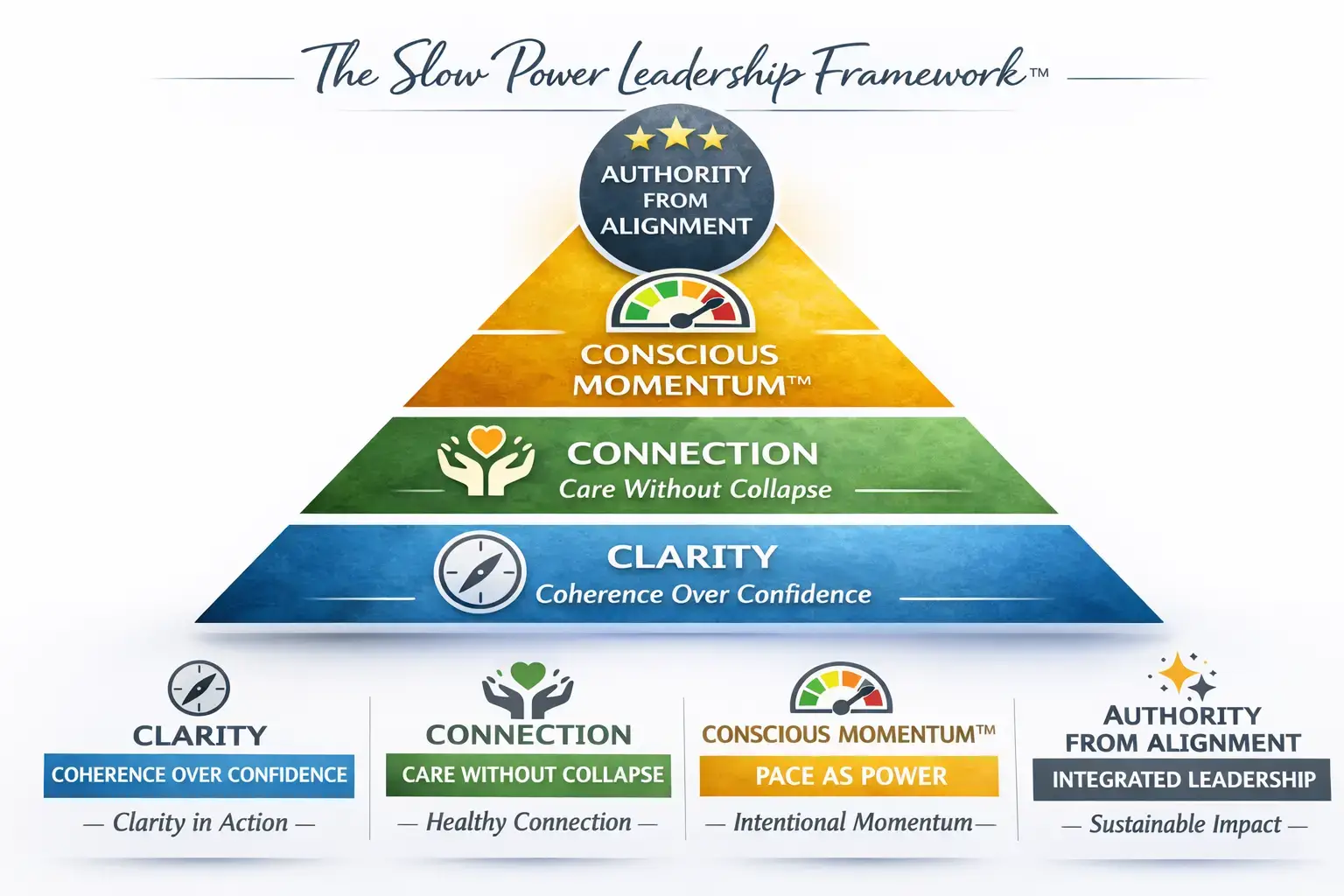
The Slow Power Leadership Framework® strengthens the conditions beneath effective leadership through three interconnected disciplines: Clarity, Connection, and Conscious Momentum™.
The framework was originally informed by observations of women navigating leadership, entrepreneurship, and career reinvention. It now extends across leaders, teams, and organizations operating with greater visibility, complexity, and consequence in the AI Age.
Together, the three disciplines cultivate Grounded Authority™: the ability to create coherence around what matters most, strengthen how people relate, and sustain meaningful progress as complexity increases.
Built as a pyramid, each discipline supports the one above it, creating a stronger foundation for leadership as responsibility and complexity grow.
THE THREE DISCIPLINES
One framework. Three interconnected disciplines.
Clarity
Create Coherence Around What Matters Most
Strengthens the self-awareness, judgment, priorities, and direction needed to make intentional choices and move forward with greater coherence.

Connection
Strengthen How People Connect, Communicate, and Collaborate
Builds the awareness, communication, trust, and relational capacity needed to create stronger relationships and alignment.
Conscious Momentum™
Create Sustainable Progress That Compounds Over Time
Strengthens the practices, rhythms, and systems that allow meaningful progress to continue without constant urgency or intervention.
RESEARCH FOUNDATIONS
The Slow Power Leadership Framework® integrates research across leadership, organizational behavior, decision-making, relationships, sustainable performance, and organizational systems.
Judgment, Decisions, & Alignment
Relationships & Human Dynamics
Sustainable Performance
Women & Leadership
Teams & Organizations
View Selected Research & Sources
Judgment, Decisions & Alignment
Arend, R. J. (2020) Strategic decision-making under ambiguity: A new problem space and a proposed optimization approach. Business Research.
Duke, A. (2018) Thinking in Bets: Making Smarter Decisions When You Don’t Have All the Facts, Portfolio. Decision-making under uncertainty and separating decision quality from outcomes.
Fischhoff, B., & Broomell, S. B. (2020) Judgment and decision making. Annual Review of Psychology.
Heifetz, R. A., Grashow, A., & Linsky, M. (2009) The Practice of Adaptive Leadership: Tools and Tactics for Changing Your Organization and the World, Harvard Business Press. Provides a practical approach to diagnosing complex challenges, distinguishing technical problems from adaptive ones, and mobilizing people to make progress when solutions are not straightforward.
Kahneman, D., Sibony, O., & Sunstein, C. R. (2021) Noise: A Flaw in Human Judgment, Brown Spark. How judgment varies within organizations and how decision processes can become more consistent.
Relationships & Human Dynamics
Brown, B. (2018) Dare to Lead: Brave Work. Tough Conversations. Whole Hearts., Random House. Examines how courage, vulnerability, trust, and difficult conversations shape stronger leadership and more connected workplace relationships.
Edmondson, A. C. (1999) Psychological safety and learning behavior in work teams. Administrative Science Quarterly.
Edmondson, A. C., & Bransby, D. P. (2023) Psychological safety comes of age: Observed themes in an established literature. Annual Review of Organizational Psychology and Organizational Behavior.
Edmondson, A. C. (2018) The Fearless Organization: Creating Psychological Safety in the Workplace for Learning, Innovation, and Growth, John Wiley & Sons. Explores how leaders can create environments where people feel able to speak up, raise concerns, ask questions, and learn from mistakes.
Stone, D., Patton, B., & Heen, S. (2023 ed.) Difficult Conversations: How to Discuss What Matters Most, Penguin Books. Provides a practical framework for navigating disagreement, emotion, identity, and competing perspectives in high-stakes conversations.
Uhl-Bien, M. (2006) Relational leadership theory: Exploring the social processes of leadership and organizing. The Leadership Quarterly.
Sustainable Performance
Bakker, A. B., Demerouti, E., & Sanz-Vergel, A. I. (2023) Job Demands–Resources Theory: Ten years later. Annual Review of Organizational Psychology and Organizational Behavior.
Hobfoll, S. E., Halbesleben, J., Neveu, J.-P., & Westman, M. (2018) Conservation of resources in the organizational context: The reality of resources and their consequences. Annual Review of Organizational Psychology and Organizational Behavior.
Newport, C. (2016) Deep Work: Rules for Focused Success in a Distracted World. Grand Central Publishing: Hachette Book Group. Examines the value of sustained, distraction-free concentration and argues for deliberately structuring work to protect attention for cognitively demanding and meaningful priorities.
Parker, S. K., Morgeson, F. P., & Johns, G. (2017) One hundred years of work design research: Looking back and looking forward. Journal of Applied Psychology.
Repenning, N. P., & Kieffer, D. (2025) There’s Got to Be a Better Way, PublicAffairs. Redesigning workflows to reduce firefighting and create more effective, sustainable ways of getting important work done.
Stulberg, B. (2021) The Practice of Groundedness: A Transformative Path to Success That Feeds, Not Crushes, Your Soul, Portfolio: Penguin Random House. Challenges relentless striving and presents principles for pursuing meaningful achievement through greater patience, presence, stability, and sustainable effort.
Women & Leadership
Babcock, L., Peyser, B., Vesterlund, L., & Weingart, L. (2022) The No Club: Putting a Stop to Women’s Dead-End Work, Simon & Schuster. Examines why women disproportionately take on work that helps organizations function but does little to advance their careers, and offers approaches for changing how that work is allocated.
Eagly, A. H., & Karau, S. J. (2002) Role congruity theory of prejudice toward female leaders. Psychological Review.
Geffner, C. J. (2023) Building a New Leadership Ladder: Transforming Male-Dominated Organizations to Support Women on the Rise, MIT Press. Argues that closing leadership gaps requires changing workplace systems and cultures, rather than simply asking women to adapt themselves to structures that were not designed with them in mind.
Ibarra, H. (2015) Act Like a Leader, Think Like a Leader, Harvard Business Review Press. Explores how leaders develop greater leadership capacity and identity through new experiences, relationships, and ways of acting rather than waiting to feel fully prepared before stepping into greater authority.
Vial, A. C., & Cowgill, C. M. (2022) Heavier lies her crown: Gendered patterns of leader emotional labor and their downstream effects. Frontiers in Psychology.
Zheng, W., Kark, R., & Meister, A. (2018) How women manage the gendered norms of leadership. Harvard Business Review.
Teams & Organizations
Ancona, D., & Bresman, H. (2023) X-Teams, Revised and Updated: How to Build Teams That Lead, Innovate, and Succeed, Harvard Business Review Press. Examines how effective teams combine strong internal coordination with active engagement across organizational boundaries.
De Dreu, C. K. W., & Weingart, L. R. (2003) Task Versus Relationship Conflict, Team Performance, and Team Member Satisfaction: A Meta-Analysis. Journal of Applied Psychology.
D’Innocenzo, L., Mathieu, J. E., & Kukenberger, M. R. (2016) A Meta-Analysis of Different Forms of Shared Leadership–Team Performance Relations. Journal of Management.
Edmondson, A. C. (2012) Teaming: How Organizations Learn, Innovate, and Compete in the Knowledge Economy, Jossey-Bass. Explores how people coordinate, learn, and collaborate effectively in dynamic work environments and across organizational boundaries.
Lencioni, P. (2002) The Five Dysfunctions of a Team: A Leadership Fable, Jossey-Bass. Presents a practitioner model of team effectiveness centered on trust, productive conflict, commitment, accountability, and attention to collective results.
Lencioni, P. M. (2022) The 6 Types of Working Genius: A Better Way to Understand Your Gifts, Your Frustrations, and Your Team, Matt Holt Books. Presents a practical framework for understanding how different forms of contribution support the flow of work, helping teams better align responsibilities, collaboration, and individual strengths.
Mathieu, J. E., Gallagher, P. T., Domingo, M. A., & Klock, E. A. (2019) Embracing Complexity: Reviewing the Past Decade of Team Effectiveness Research. Annual Review of Organizational Psychology and Organizational Behavior.
SLOW POWER® IN PRACTICE
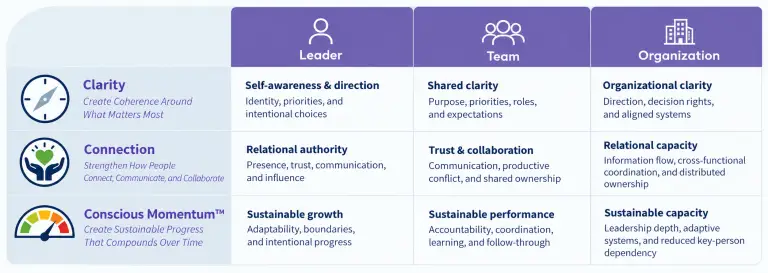
Clarity, Connection, and Conscious Momentum™ extend from individual leadership to team dynamics and organizational systems, strengthening how decisions are made, relationships function, and work moves forward.
WORK WITH SLOW POWER®
Choose the path that aligns with what you’re leading, building, or ready to strengthen.

Slow Power® Executive Coaching
This work is for women leaders navigating growth, visibility, and consistent pressure who are ready to lead at the next level without overextension or constant urgency.

Leadership and Organizational Development
Develop stronger leaders, build healthier teams, and create the conditions for clearer decisions, stronger collaboration, and sustainable performance.

Systems Business Coaching
This is an elevated partnership for women founders at various stages of business growth who are ready to build aligned systems and stronger leadership foundations.

Slow Power® Career Coaching
For women navigating career change or a new direction. Clarify what comes next, strengthen how you communicate your value, and move forward with intention.

Presence & Style Coaching
This work is for women leaders who want how they show up to reinforce the authority and impact they bring to their work. Create greater alignment across your leadership.
Where Could Slow Power® Make the Biggest Difference?
Discover where leadership capacity is strong, where it may be concentrated, and where greater capacity could be built across your organization.
Frequently Asked Questions About the Slow Power Leadership Framework®
Answers to common questions about Slow Power®, its three disciplines, and how the framework applies across leaders, teams, and organizations.
What is the Slow Power Leadership Framework®?
The Slow Power Leadership Framework® is a research-informed leadership framework designed for leadership under increasing complexity, visibility, and change. Through three interconnected disciplines, Clarity, Connection, and Conscious Momentum™, it strengthens the conditions beneath effective leadership so decisions become clearer, relationships stronger, and progress more sustainable.
Who is the Slow Power Leadership Framework® designed for?
Slow Power® was designed with particular attention to the realities women can encounter in leadership, including heightened visibility, relational expectations, and the pressure to carry more than their role requires. The framework also applies at the team and organizational level, where it can strengthen decision-making, collaboration, accountability, capacity, and ways of working.
What are the three disciplines of the Slow Power Leadership Framework®?
The framework is organized around three interconnected disciplines: Clarity strengthens the self-awareness, judgment, and priorities needed to make intentional choices and create clear direction. Connection builds the awareness, communication, trust, and relational capacity needed to strengthen relationships and create greater alignment. Conscious Momentum™ strengthens the practices, rhythms, and systems that allow meaningful progress to continue without constant urgency or intervention. Together, the three disciplines cultivate Grounded Authority™, leadership that holds as complexity increases.
How does Slow Power® apply to individual leaders?
At the individual level, Slow Power® strengthens how leaders understand themselves, exercise relational authority, and sustain meaningful progress as responsibilities and complexity increase. Clarity strengthens self-awareness, judgment, and priorities so leaders can make intentional choices and create clear direction. Connection strengthens presence, communication, trust, boundaries, and influence. Conscious Momentum™ develops the practices and rhythms that support adaptability, sustainable growth, and intentional progress over time.
How does Slow Power® apply to teams?
At the team level, the disciplines shift from individual leadership practice to collective effectiveness. Clarity creates shared understanding around purpose, priorities, roles, and expectations. Connection strengthens communication, trust, collaboration, and the ability to navigate conflict productively. Conscious Momentum™ strengthens accountability, coordination, learning, and follow-through so teams can sustain performance over time.
How does Slow Power® apply to organizations?
At the organizational level, Slow Power® strengthens the conditions that allow leadership and work to function effectively across the system. Clarity strengthens direction, decision rights, and aligned systems. Connection strengthens information flow, cross-functional coordination, and distributed ownership. Conscious Momentum™ builds leadership depth, adaptive systems, and sustainable capacity so progress does not depend on constant intervention from a few key people.
How is the Slow Power Leadership Framework® different from traditional leadership approaches?
Slow Power® shifts attention from leadership as individual performance toward the conditions that make effective leadership sustainable. It reduces reliance on constant urgency, over-functioning, and a leader’s ability to compensate for unclear direction, strained relationships, or weak systems. Instead, the framework strengthens clarity, relational capacity, and sustainable ways of working so leadership can hold as complexity increases.
What is Grounded Authority?
Grounded Authority™ is the capacity that develops when Clarity, Connection, and Conscious Momentum™ reinforce one another. It reflects the ability to act with clarity and intention, exercise authority through strong relationships rather than continual relational effort, and sustain meaningful progress without depending on constant urgency or overextension.
Is the Slow Power Leadership Framework® research-based?
Slow Power® is a proprietary, research-informed framework. Its development and application draw on established research across judgment and decision-making, relationships and human dynamics, sustainable performance, women and leadership, and teams, systems, and organizations. The framework represents Ruth Burk's synthesis and application of these bodies of research rather than a claim that Slow Power® itself has been independently validated as an empirical model.
How is Slow Power® used in coaching and organizational development?
The framework provides a common foundation across Ruth's work while adapting to the context in which it is applied. For individuals, it informs Executive Coaching, Systems Business Coaching, Career Coaching, and Presence & Style Coaching. For teams and organizations, it informs leadership development, team effectiveness, and organizational development engagements.
How does the Slow Power Leader app support the framework?
The Slow Power Leader app extends the framework between coaching sessions by helping leaders reflect on decisions, relationships, priorities, boundaries, delegation, and momentum as they occur. This creates a more continuous practice of noticing patterns and applying Clarity, Connection, and Conscious Momentum™ to day-to-day leadership.
How do I start working with Slow Power®?
Begin with a Discovery Call to explore what you are navigating. Together, we identify where greater clarity, connection, or sustainable momentum could make the greatest difference and which engagement best fits your needs. Slow Power® can be applied through individual coaching or leadership, team, and organizational development.