
Conflict is often treated as a sign that something is wrong with a team.
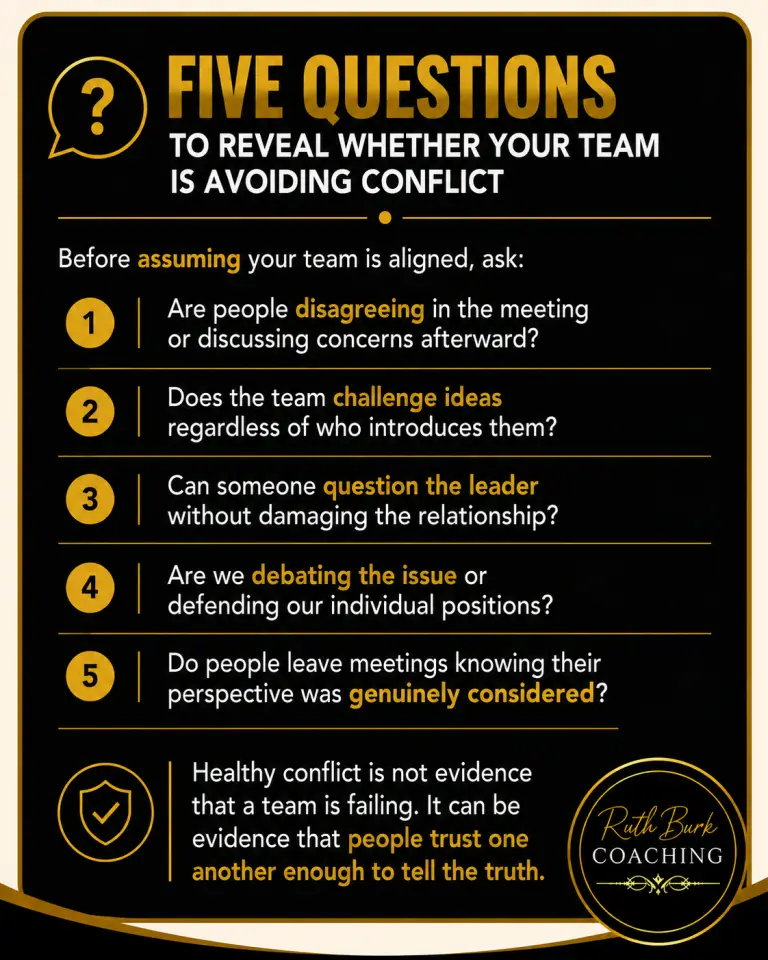
In many organizations, a meeting without disagreement is considered a good meeting. Leaders value collaboration, teams take pride in getting along, and people often learn to soften opposing viewpoints in the interest of maintaining positive working relationships. Yet an absence of visible conflict does not necessarily mean a team is aligned. Sometimes it means people have learned which conversations are safer not to have.
In Why High-Performing Teams Start With Trust, I explored why vulnerability-based trust creates the foundation for stronger team performance. When people feel comfortable admitting mistakes, asking for help, acknowledging weaknesses, and challenging one another, they become more willing to contribute honestly to the work of the team. That trust also creates the conditions for productive conflict because people can challenge ideas without assuming that disagreement threatens the relationship.
That is where the next stage of team effectiveness begins.
Patrick Lencioni’s model underlying The Five Behaviors® places productive conflict immediately after trust because teams need more than openness to perform well. They need the ability to use that openness when perspectives differ, priorities compete, and important decisions are at stake.
Healthy teams do not eliminate conflict. They develop the capacity to use it productively.
Conflict Is Not the Problem
Not all conflict strengthens a team. Personal attacks, politics, defensiveness, unresolved tension, and competition for influence can damage relationships and distract people from the work they are trying to accomplish. Productive conflict is different because the disagreement remains focused on ideas, decisions, priorities, and the work itself.
On a team capable of productive conflict, people question assumptions, identify risks, challenge recommendations, and advocate for different approaches. They may disagree strongly, but the objective is not to prove who is right. It is to make the team’s thinking stronger before a decision is made.
The Five Behaviors® describes productive conflict as debate around concepts and ideas while avoiding personal attacks. Within the model, that kind of conflict builds on vulnerability-based trust. When team members trust one another, they are better able to question assumptions, challenge ideas, and express different perspectives without assuming that disagreement threatens the relationship.
For leaders, this requires shifting the goal from agreement to honest discussion. Rather than asking how to get everyone on the same page as quickly as possible, leaders should consider whether the team has created the conditions for people to raise concerns, challenge one another, and work through differences productively.
Avoiding those conversations does not eliminate disagreement. It often pushes it somewhere else.
Avoided Conflict Often Goes Underground
Most leaders have experienced some version of this pattern. A team discusses an important decision, several people contribute, and no one raises a significant objection. The meeting ends with apparent agreement, but later the private conversations begin. Concerns surface in one-on-one calls. Someone admits what they really thought of the decision. Another person reveals reservations they never expressed when the full team was together.
The team appeared aligned, but it wasn’t.
In Why High-Performing Teams Start With Trust, I described how low trust causes people to filter information, soften disagreement, and wait to see what the leader thinks before offering a different perspective. Conflict avoidance compounds that problem because information the team needs never becomes part of the discussion. Leaders may interpret silence as agreement, and decisions move forward without being tested against the perspectives of the people responsible for executing them.
Over time, this pattern has consequences beyond uncomfortable meetings. Decisions are revisited, concerns emerge too late, people become less willing to take ownership of choices they never fully supported, and the leader may find herself repeatedly trying to create alignment that should have been built during the original conversation.
Healthy conflict brings those conversations into the room where they can actually improve the decision.
Productive Conflict Improves Decision-Making
Strong decisions rarely emerge because everyone saw the problem the same way from the beginning. They improve when people with different information, responsibilities, and perspectives are willing to challenge one another’s assumptions.
A finance leader may recognize implications that operations does not. A program director at a nonprofit may understand the needs of the community differently than the executive team. Someone close to the customer may see a risk that is invisible from the boardroom. Those differences are not obstacles to alignment. Used well, they are inputs into better judgment.
This connects directly to How Business Systems Help Teams Make Better Decisions Without Relying on the Founder. Decision frameworks can clarify ownership, establish decision criteria, and determine how information moves through an organization. But even the strongest system cannot improve a decision if people with relevant information do not feel able to challenge what the team is considering.
Systems clarify how a decision gets made. Productive conflict improves the quality of what gets considered before it is made.
That distinction becomes increasingly important as organizations gain access to more data and AI-generated recommendations. Technology can expand the number of options a team considers, but it cannot ensure that people will question an assumption, raise an uncomfortable concern, or challenge the direction preferred by the most powerful person in the room.
That remains a team capability.
Emotional Intelligence Makes Conflict More Productive
The same disagreement can unfold very differently depending on the people involved. One team becomes defensive, interrupts, withdraws, or personalizes criticism. Another asks questions, clarifies intentions, challenges ideas, and remains open to changing course as new information emerges.
The issue may be identical. The emotional capabilities available to the team are not.
This is where the work from The Leadership Behaviors That Emotional Intelligence Makes Possible carries directly into team effectiveness. Self-awareness helps people notice when defensiveness is influencing their response. Emotional regulation helps them remain engaged when a conversation becomes uncomfortable. Empathy makes it possible to understand another perspective without necessarily agreeing with it, while flexibility allows people to revise a position when stronger information emerges.
Healthy conflict therefore requires more than permission to disagree. Teams also need the capacity to disagree well.
This is one reason I see EQ-i 2.0®, Everything DiSC®, and The Five Behaviors® as complementary rather than separate approaches to leadership and team development. Emotional intelligence helps individuals understand how they respond. Everything DiSC® gives people a language for understanding behavioral and communication differences. The Five Behaviors® helps an intact team examine how those individual patterns affect the way people work together collectively.
The objective is not to eliminate differences. It is to help teams use those differences more effectively.
Conflict Creates the Conditions for Commitment
Productive conflict matters for another reason: people are more likely to commit to decisions when they believe their perspective was genuinely considered before the decision was made.
That does not mean everyone gets their preferred outcome, nor does commitment require consensus. A strong team can debate several options, disagree significantly, and still leave the room committed to one direction. What matters is that people had the opportunity to contribute honestly before the team moved forward.
Within The Five Behaviors® model, this is why Commitment follows Conflict. Teams that engage in productive debate are better positioned to create clarity and buy-in around decisions, including among people whose preferred option was not ultimately chosen.
When teams avoid conflict, however, compliance can easily be mistaken for commitment. People nod in the meeting, but because their real concerns were never discussed, they remain attached to their original positions. Decisions get revisited, execution slows, and accountability becomes more difficult because people never fully committed to the direction in the first place.
Productive conflict gives teams an opportunity to wrestle with disagreement before asking people to move forward together.
Connecting Team Coaching to Business Results
For organizations considering team coaching, the most important question is not simply whether the team will communicate better after the engagement. It is whether stronger team effectiveness will improve the way the organization operates.
When teams address concerns earlier, make decisions more effectively, follow through on commitments, and hold one another accountable, the impact can extend well beyond the quality of their meetings. Stronger team dynamics can influence execution, cross-functional collaboration, leadership capacity, and ultimately the organization’s ability to achieve its priorities.
Research provides growing evidence for this connection. A study of 506 employees across 75 teams found that peer coaching had a positive effect on individual and team outcomes, including team performance and members’ satisfaction with the team.
Research published in the Human Resource Management Journal offers another perspective. Using data from 182 knowledge workers and their managers across 60 teams, researchers found that managerial coaching skill was related to team performance through the development of shared knowledge about work processes, roles, and team dynamics when managers had a high learning-goal orientation.
More recent research has examined team coaching interventions more directly. A 2025 longitudinal study followed a 24-person team within a major bank and examined both team capabilities and quantitative business indicators over time. The researchers found improvements in team capabilities as well as market impact and key business indicators, with some improvements continuing after the coaching process concluded.
A 2026 mixed-methods study involving nine teams across three organizations provides additional evidence. Following a nondirective team coaching intervention, researchers found statistically significant improvements in conflict resolution and planning. Qualitative findings also indicated improvements in team alignment, communication, and performance evaluation.
These findings are encouraging, but the return from team coaching will look different for every organization. A nonprofit leadership team struggling with silos may define success differently than the executive team of a growing founder-led business. One organization may need faster decisions and stronger cross-functional execution, while another may need greater accountability, fewer unresolved conflicts, stronger retention, or more effective leadership through organizational change.
For a founder-led business, the return can be particularly tangible. As I explored in How Business Systems Help Teams Make Better Decisions Without Relying on the Founder, growth becomes difficult to sustain when decisions, disagreements, and accountability continually return to one person. A leadership team that develops the trust and capability to challenge ideas, make decisions, and hold one another accountable can reduce that dependence while increasing the organization’s capacity to grow.
This is why the ROI conversation should begin before a team coaching engagement, not after it. In addition to understanding how the team currently operates, the organization should identify the business outcomes it expects stronger team effectiveness to influence. Depending on the organization, those measures might include decision speed, execution against strategic priorities, peer-to-peer accountability, cross-functional collaboration, employee retention, conflict escalation, or dependence on the founder or senior leader.
The goal is not to attach an arbitrary ROI percentage to team coaching. It is to determine whether changes in how the team works together lead to meaningful improvements in how the organization performs.
Ready to Help Your Team Navigate Conflict More Productively?
Healthy teams don’t avoid disagreement. They develop the trust to speak honestly, the emotional intelligence to remain constructive, and the ability to work through different perspectives in service of stronger decisions and collective results.
If your team avoids difficult conversations, revisits decisions, or struggles to hold one another accountable, team coaching can help change those patterns. Schedule a complimentary Clarity Call to explore how The Five Behaviors® and Everything DiSC® can help your team strengthen trust, navigate conflict more productively, and improve how they work together.