

For decades, delegation has been considered one of the defining skills of effective leadership. As businesses grow, founders are encouraged to hire talented people, trust their teams, and gradually step away from work that no longer requires their direct involvement. The advice is well intentioned and, in many cases, necessary. Yet many founders discover that delegation doesn’t create the freedom they expected.
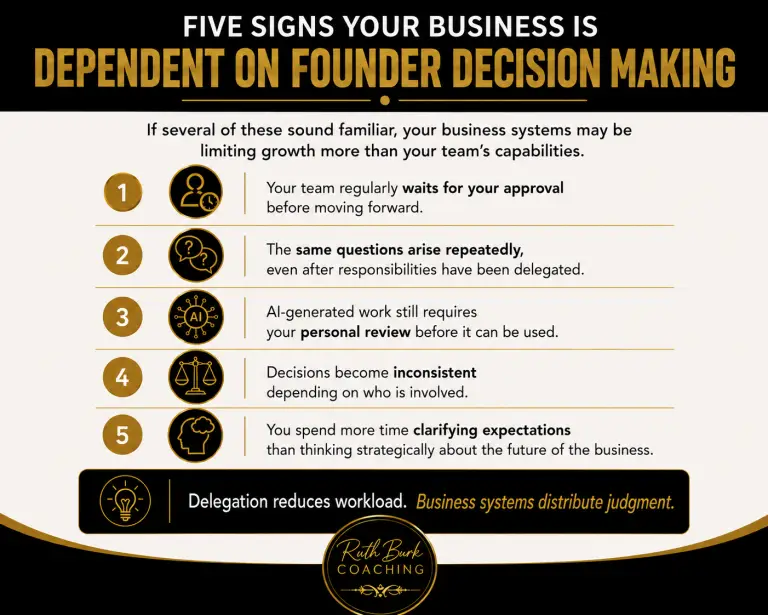
They hire capable employees, assign meaningful responsibilities, and encourage greater ownership. Despite those efforts, important decisions still find their way back to the founder. Team members continue asking questions, projects pause while waiting for approval, and meetings become increasingly focused on resolving issues that someone else was supposed to own. The business has delegated the work, but it hasn’t delegated the judgment.
Artificial intelligence is making that distinction even more important. Employees now have access to tools that can draft proposals, summarize meetings, analyze financial information, generate marketing campaigns, and automate work that once required hours of focused attention. Those capabilities increase speed and efficiency, but they also create new questions. When should AI be used? What requires human review? Who decides when an exception should be made? How do you ensure quality remains consistent across people and technology? These aren’t technology questions. They’re leadership questions.
As I discussed in my recent article, Why Growing Businesses Outgrow Their Systems (and What Successful Founders Do Next), growth introduces complexity that informal ways of working can no longer support. AI accelerates that complexity by increasing both the volume of work and the number of decisions organizations must make about how work gets done. In today’s workplace, effective delegation depends less on assigning tasks and more on creating business systems that enable people, and increasingly AI, to exercise sound judgment without depending on the founder for constant direction.
Delegation remains important, but it simply isn’t enough anymore.
Delegation Transfers Tasks. Business Systems Transfer Judgment.
In the early stages of a business or organization, founders naturally become the center of almost every important decision. They know the customers, understand the market, solve problems as they arise, and personally ensure the quality of the work. Information moves quickly because one person holds most of the organization’s knowledge. That model works remarkably well until the business begins to grow.
As new employees join the organization, responsibilities become more specialized, communication becomes less direct, and projects begin affecting multiple people instead of a single individual. AI introduces another layer of complexity by increasing the speed at which information is created and decisions must be evaluated. Leaders are no longer deciding only who should complete a task. They’re deciding which responsibilities belong to people, which can be supported by technology, and what standards should guide both.
This is where many founders and organizational leaders unintentionally become the bottleneck. The work has been delegated, but the decision-making process surrounding the work has not. That distinction may seem subtle, but it fundamentally changes how an organization operates.
Consider a simple example. An organizational leader delegates responsibility for preparing a client proposal. The task has been assigned, yet the employee still needs answers to several important questions. Should AI be used to draft the first version? Who reviews the proposal before it’s sent? What happens if the client’s request falls outside the standard scope of work? When is approval required, and when should independent judgment be exercised? Without clear answers, the work naturally returns to the founder because the decision-making process was never delegated.
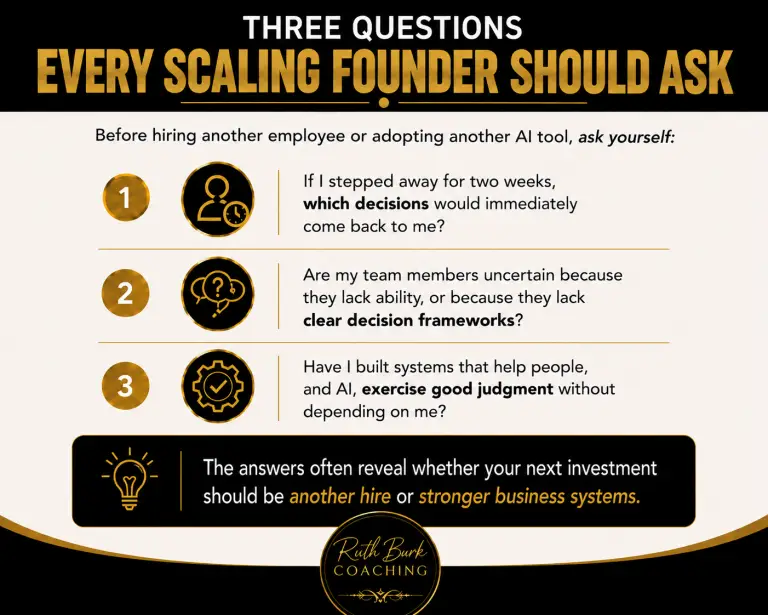
Employees aren’t asking because they lack capability. They’re asking because the business hasn’t established the decision frameworks needed to support consistent judgment.
As artificial intelligence becomes integrated into everyday work, effective delegation requires more than assigning responsibility. Leaders must also make organizational judgment explicit. Harvard Business Review recently argued that successful AI adoption depends on teaching AI how an organization makes decisions by making decision criteria, standards, and priorities visible rather than leaving them in the minds of individual leaders. The same principle applies to people. Teams need clear expectations, decision authority, coaching, and defined frameworks that help them exercise sound judgment independently.
Delegation transfers tasks. Business systems transfer judgment. That judgment becomes the foundation that allows both people and AI to contribute confidently without continually relying on the founder.
Strong business systems make that possible.
The Real Bottleneck Isn't Your Team
When founders begin feeling overwhelmed, it’s easy to assume the problem lies with the people around them. They make conclude:
- “We need stronger employees.”
- “They need to take more initiative.”
- “I’ve already delegated this. Why does it keep coming back to me?”
Sometimes those observations are accurate. More often, however, they describe the symptoms rather than the problem. Capable people are operating inside systems that leave important decisions undefined.
The questions employees ask every day often reveal where the real bottleneck exists.
- Should I approve this before sending it?
- Can I use AI to draft the first version?
- Does this situation require an exception?
- Who should be involved in this decision?
- Is this how we’ve handled similar situations before?
At first glance, these appear to be ordinary operational questions. In reality, they reveal something much deeper. They indicate that critical knowledge still resides primarily with the founder rather than within the business itself. Every unanswered question creates another dependency. Every exception requires another conversation, and every approval reinforces the belief that meaningful decisions ultimately belong to one person.
Over time, founders unintentionally become the operating system of the business. Information flows through them, priorities are clarified by them, and judgment depends on their availability. AI can certainly accelerate the production of work, but it cannot eliminate those dependencies. In many cases, it increases them by generating more information that still requires someone to evaluate quality, context, and alignment with the organization’s standards. This becomes a broader leadership issue when responsibility has been distributed but important decisions continue to flow back to one person. I explore that pattern in The Leadership Bottleneck: When Too Many Decisions Depend on You.
The result isn’t simply founder overload. It becomes an organizational constraint. Growth slows because decisions slow. Employees hesitate because expectations remain unclear, and while AI increases the speed of execution, the founder remains responsible for interpreting, approving, and connecting everything together. The organization isn’t limited by effort or capability, but rather the systems that govern how decisions move through the business.
Business Systems Create Clarity That Scales
Business systems are often described as operational tools because they improve consistency, reduce errors, and help organizations become more efficient. Those outcomes certainly matter, but they aren’t what make strong systems indispensable as organizations grow. Their greatest contribution is the clarity they create throughout the organization. When people understand what is expected of them, how decisions should be made, and where responsibility begins and ends, they move forward with greater confidence and far less dependence on the founder.
Gallup’s recent workplace research found that employees are significantly less likely than they were in previous years to strongly agree that they know what is expected of them at work. That decline has important implications for growing businesses. When expectations become unclear, people naturally seek reassurance before making decisions. Leaders respond by answering more questions, reviewing more work, and becoming increasingly involved in everyday operations. Before long, the cycle begins reinforcing itself. Employees become less confident because they lack clear guidance, while founders become increasingly overwhelmed because every decision requires their attention.
Strong business systems interrupt that cycle before it becomes the organization’s default way of operating.
They create clarity in several ways. Decision frameworks clarify ownership before uncertainty appears, while standard operating procedures reduce reliance on memory by documenting how work should move through the organization. Communication rhythms ensure important information reaches the right people at the right time, and clearly defined decision rights help employees understand when they should exercise independent judgment and when collaboration is expected. Together, these practices create an environment where good decisions become more consistent because people understand both their responsibilities and the boundaries within which they can exercise judgment.
That clarity becomes even more valuable as artificial intelligence becomes integrated into everyday work. AI can generate recommendations almost instantly, but it cannot determine whether those recommendations align with your organization’s values, customer commitments, or strategic priorities. Those judgments remain uniquely human. Strong business systems ensure people understand how to evaluate AI-generated work rather than simply accepting it because it was produced quickly.
Technology accelerates execution. Business systems guide judgment.
As a result, leaders spend less time answering routine questions and more time coaching their teams, strengthening strategy, and preparing the business for the next stage of growth. Their role shifts from supervising every decision to creating the conditions where consistently good decisions happen throughout the organization.
Business Systems Create Trust at Scale
As organizations grow, one of the most important shifts leaders make is realizing that business systems are not simply operational tools. They are leadership tools.
Processes, decision frameworks, and meeting rhythms certainly improve efficiency, but their greatest contribution is that they create consistent leadership experiences throughout the organization. Employees know what is expected of them. Managers approach similar situations in similar ways. Customers receive a more consistent experience because quality no longer depends solely on one person’s judgment or availability. That consistency becomes even more important as AI becomes integrated into everyday work.
Artificial intelligence can produce information faster than any individual. It can summarize reports, draft communications, analyze trends, and automate routine tasks in seconds. What it cannot do is determine whether those outputs reflect your organization’s values, customer promises, or long-term strategy. Those decisions still require human judgment. Business systems provide the guardrails that make those judgments consistent.
Rather than reviewing every piece of AI-generated work personally, founders establish quality standards, decision criteria, approval thresholds, and communication practices that allow both people and technology to contribute effectively. Leadership shifts away from supervising every task toward designing an environment where sound decisions become the expected outcome. This type of delegation is about embedding leadership throughout the business.
Operating Rhythms Make Leadership Repeatable
One of the biggest misconceptions about business systems is that they consist primarily of documentation. Documentation matters, but what matters even more is the rhythm with which leaders use those systems.
The organizations that continue scaling successfully create predictable opportunities to communicate priorities, review performance, coach employees, and make decisions together. Weekly leadership meetings keep priorities aligned before challenges become urgent. Monthly financial reviews provide visibility into performance before small issues become significant problems. Quarterly planning sessions reconnect day-to-day execution with long-term strategy, while regular coaching conversations strengthen employee judgment rather than simply monitoring performance. Together, these practices create an organization that becomes increasingly less dependent on the founder’s daily involvement.
Leadership becomes embedded within the operating rhythm of the business instead of residing exclusively in one individual.
Strong Systems Create Stronger Relationships
In my recent article, The Competitive Advantage for Founders That AI Can’t Replace, I argued that community is becoming one of the few competitive advantages technology cannot replicate. Community, however, does not emerge through good intentions alone. It develops when leaders consistently create clarity, reinforce shared expectations, and build environments where people can contribute to one another’s success.
Business systems make those leadership behaviors repeatable.
When expectations are clear, people collaborate more confidently because they understand where responsibility begins and ends. When decision frameworks are consistent, trust grows because employees experience fairness rather than unpredictability. When communication follows intentional rhythms, relationships strengthen because people spend less time seeking clarification and more time contributing meaningful work. This is where business systems become much more than operational infrastructure. They become the foundation for trust.
Artificial intelligence may accelerate execution, but trust still develops through repeated experiences of clarity, consistency, and accountability. Those experiences are created by leaders who intentionally design systems that reinforce sound judgment over time. Strong business systems make strong relationships sustainable.
Growth Should Create Better Leadership, Not More Supervision
For years, founders measured successful delegation by how much work they no longer had to do themselves. The AI era is changing that definition.
As technology becomes increasingly capable of producing work, leadership is becoming less about assigning tasks and more about creating the systems that guide how those tasks are evaluated, improved, and delivered. Founders who continue inserting themselves into every important decision eventually become the limiting factor in their own growth. Those who invest in stronger business systems create something far more valuable than efficiency. They create organizations capable of making sound decisions without constant oversight.
Growth shouldn’t require carrying more. It should create the freedom to lead differently.
If your business or organization is growing and you still feel like the center of every important decision, conversation, or process, it may be time to strengthen the systems supporting your next stage of growth.
Schedule a complimentary Clarity Call to explore how stronger business systems can help you build greater ownership, reduce founder dependence, and create sustainable growth.