

A capable leader can become remarkably good at keeping things moving. A team member brings you an unclear situation, and you help determine the best path forward. A project reaches an impasse, and you know enough about the organization to resolve it. Someone needs an answer quickly, and asking you is faster than working through the uncertainty themselves.
Each interaction makes sense on its own. The decision gets made, the problem gets resolved, and the work moves forward. But over time, a pattern can develop. More decisions begin traveling through you. Questions that could be resolved elsewhere find their way to your desk. Work moves quickly when you are available and slows when you are not. Even responsibilities you have delegated have a way of returning when something becomes complicated.
At some point, the issue is no longer simply that you have a lot to do. Too many decisions depend on you.
That is a leadership bottleneck, and it does not necessarily develop because a leader is controlling or unwilling to delegate. Often, capable leaders become the place decisions go precisely because they are good at resolving ambiguity, connecting information, anticipating consequences, and moving people forward when the answer is not obvious. The challenge is recognizing when the organization has begun depending on that capability too much.
A Leadership Bottleneck Is Not Just a Workload Problem
When leaders feel overloaded, the natural response is often to ask, What can I delegate? That can be useful, but it may not reveal the real problem. You can delegate a significant amount of work and still remain at the center of nearly every meaningful decision.
For instance, a team member may own a project but return to you whenever priorities conflict. Someone may be responsible for a client relationship but seek approval when the situation falls outside the usual process. A manager may technically have authority but hesitate to make a consequential call without checking with you first. In each case, the work has moved, but the judgment has not.
Research on organizational decision-making supports the importance of this distinction. McKinsey has found that growing organizational complexity can make accountability less clear and make it more difficult to delegate decisions cleanly. Its research recommends distinguishing among different types of decisions and making decision authority explicit rather than allowing unnecessary decisions to move through additional layers of leadership.
This dynamic can become particularly visible in growing businesses. As I explored in How Business Systems Help Teams Make Better Decisions Without Relying on the Founder, handing off work does not necessarily remove the founder or leader from the center of how the organization operates. Systems also have to support people in making decisions without continually returning to one person.
A more revealing question becomes: Which decisions genuinely require my judgment, and which have simply learned to travel through me?
How Decisions Learn to Travel Upward
In my work with leaders and founders, one of the patterns I pay attention to is not simply how many decisions a leader is making, but which decisions repeatedly find their way back to them.
Leadership bottlenecks rarely appear because someone formally decided every important question should go to one person. They develop through repeated interactions. Imagine a director whose team encounters an unusual client problem. She has seen something similar before, so the team asks for her advice, and she quickly identifies the best response. The next time a complicated situation arises, they ask again. Eventually, asking becomes easier than deciding.
The leader may experience these interactions as being responsive and supportive, while the team experiences them as the normal way uncertainty gets resolved. Neither side intentionally created dependency, but the organization has learned something: when the answer is unclear, bring the decision back to the leader.
The same pattern can develop when leaders routinely step back into projects when execution becomes uncertain, answer questions that could have been worked through elsewhere, or resolve disagreements rather than helping the people involved determine what should happen next. Each intervention solves an immediate problem, but repeated often enough, it can create a larger one.
People may begin waiting for the leader’s opinion before offering their own. Meetings end with someone needing to “check with” the leader. Work slows when that person is unavailable. What the leader experiences as increasing demands on their attention may reflect something more consequential for the organization: a narrowing of where judgment can happen.
Look at the Decisions That Keep Coming Back
One way to recognize a leadership bottleneck is to stop looking only at how much work you have and examine how decisions move through your role.
This is one reason real decisions are the curriculum in my Clarity Catalyst coaching work. Rather than discussing leadership judgment only in theory, leaders examine decisions as they happen so we can identify patterns in how they evaluate options, respond to pressure, communicate direction, and establish decision ownership.
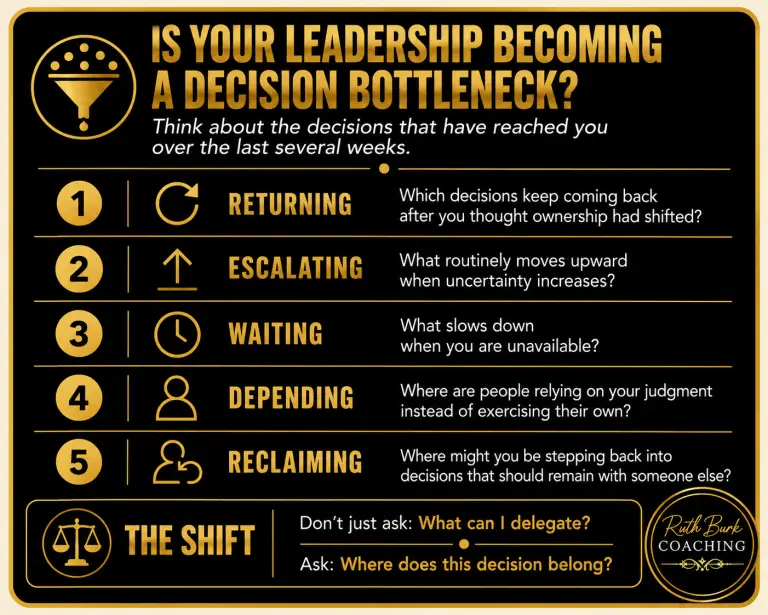
Consider the decisions that have reached you over the last several weeks:
- Which decisions consistently remain with you longer than necessary?
- Which decisions return for clarification or get reopened?
- Where does responsibility naturally flow toward you?
- Which decisions consume disproportionate mental or emotional energy?
These questions can reveal something an ordinary workload review does not. Perhaps people understand what they are responsible for but not what they have authority to decide. Maybe you delegated an outcome without defining the boundaries within which someone can act. Or your team may know who owns the work but not what criteria should guide the difficult choices within it.
What looks like a delegation problem may actually be a decision clarity problem.
Delegating Work Is Not the Same as Distributing Judgment
Telling someone, “You own this,” does not necessarily create meaningful ownership. People also need enough clarity to exercise judgment. That includes understanding the desired outcome, the decisions they are authorized to make, the constraints they need to respect, when consultation is appropriate, and what genuinely requires escalation.
This is consistent with research on delegated decision-making. McKinsey has found that placing appropriate decisions with people closer to the work can improve speed and execution, but that doing so effectively requires clarity around decision rights, accountability, and escalation. Research on empowering leadership also points to generally positive relationships with employee motivation, attitudes, resources, and performance, while showing that simply increasing autonomy is not automatically effective in every situation.
That nuance matters. Empowerment without clarity can simply create a different kind of uncertainty.
The same problem can occur when a leader tells people to “use your judgment” but repeatedly changes their decisions without explaining the principles or priorities behind those choices. If independent judgment repeatedly leads to correction while escalation reliably produces the approved answer, asking first becomes the safer strategy.
Reducing that dependency requires leaders to make more of their decision architecture visible. What matters most in this decision? What trade-offs are acceptable? What is non-negotiable? Who has authority to make the call? What genuinely needs to come back to me?
Clarifying those questions does more than make one decision easier. It gives other people a stronger foundation for making the next one.
The Cost Is More Than Your Time
The obvious cost of having too many decisions depend on you is capacity. Every unnecessary decision that reaches a senior leader competes with work that may genuinely require that person’s perspective: thinking strategically, anticipating risk, allocating resources, developing people, and determining where the organization needs to go next.
But there is another cost. When meaningful judgment repeatedly moves upward, people have fewer opportunities to evaluate incomplete information, weigh competing priorities, make appropriate trade-offs, and learn from the consequences of their decisions.
A difficult cycle can emerge: the leader continues stepping in because others do not appear ready, while others have fewer opportunities to become ready because the leader continues stepping in. Eventually, the organization becomes increasingly dependent on the very leadership capability it needs to distribute.
Your Judgment Should Become More Selective as You Lead
Some decisions genuinely belong with the leader. Choices involving significant organizational risk, strategic direction, resource allocation, competing stakeholder interests, or consequences across multiple functions may require senior-level judgment. The problem is when those decisions sit alongside dozens of others that have traveled upward because ownership is unclear or everyone has simply become accustomed to asking the leader. As responsibility increases, the goal is not to demonstrate that you can handle more decisions. It is to become increasingly discerning about which decisions deserve your judgment.
That distinction becomes even more important as AI makes information, analysis, and recommendations easier to produce. As I explored in The Leadership Decisions AI Should Never Make, technology can support analysis and surface possibilities, but leaders remain responsible for decisions that require judgment about people, values, risk, and organizational consequences. McKinsey similarly notes that technology and data can improve the inputs available to decision-makers without eliminating the need to determine what kind of decision is actually being made.
Leaders may therefore have more information available to them than ever before, while their attention and judgment remain finite. A useful question becomes: Where does my judgment create the greatest leadership value? Sometimes the most consequential decision a leader can make is deciding that a particular decision should no longer depend on them.
From Decision-Maker to Decision Architect
Changing this pattern does not require a leader to withdraw. It requires a different kind of involvement.
When someone brings you a problem, notice whether you immediately begin solving it. Before providing the answer, you might ask:
- What decision do you think needs to be made?
- What factors are you weighing?
- What would you recommend?
- What part of this actually requires my involvement?
The purpose is to distinguish between helping someone think and quietly taking the decision back.
Over time, that distinction changes how leadership moves through an organization. More decisions can be made closer to the relevant information, people have greater opportunities to develop judgment, and leaders preserve their attention for the choices where their perspective is genuinely consequential. The leader is still responsible, but the organization is no longer dependent on that leader being the answer to every uncertainty. That is leadership that can extend beyond the leader.
Ready to Strengthen Your Leadership Judgment?
Strengthening your leadership judgment is about becoming more intentional about where your judgment is needed, how decisions move through your role, and where greater ownership can develop around you.
In Clarity Catalyst™, I work with leaders using their actual decisions as the curriculum. Together, we examine recurring judgment patterns, clarify decision criteria and leadership priorities, and determine where responsibility or attention may need to shift. The work culminates in a personalized 90-Day Leadership Focus & Direction Plan that translates those insights into everyday leadership practice.
If you are ready to understand where too many decisions may be depending on you, and where your judgment can create greater value, schedule a complimentary Clarity Call to explore how coaching can support you.