

Artificial intelligence is changing how organizations operate.
It summarizes meetings, drafts proposals, analyzes customer data, identifies patterns across thousands of records, and generates recommendations in seconds. Every month, new tools promise to help organizations move faster, reduce costs, and improve decision-making. Many of those promises are becoming reality.
As AI becomes more capable, however, a different leadership challenge is beginning to emerge. The question is no longer whether organizations should use artificial intelligence. Increasingly, the more important question is which decisions leaders should never delegate to it.
This question sits at the center of nearly every leadership conversation I’ve been exploring over the past year. In The Competitive Advantage for Founders That AI Can’t Replace, I argued that as technology becomes more accessible, lasting competitive advantage shifts away from information and toward the uniquely human capabilities of community, trust, and relationships. Technology can increase efficiency, but it cannot create the human conditions that allow organizations to thrive.
That same principle applies to leadership.
Every technological advancement changes the work people perform. Email changed communication. Cloud computing changed collaboration. Artificial intelligence is changing how organizations gather information, evaluate options, and execute work. Yet despite those advances, some leadership responsibilities become more valuable, not less.
Deloitte’s 2026 Global Human Capital Trends report reaches a similar conclusion. Rather than asking whether AI will replace people, the report encourages organizations to intentionally design how humans and AI work together while preserving accountability, judgment, and organizational purpose. AI doesn’t eliminate leadership. It changes where leaders create value.
The future of leadership may depend less on having the fastest answers and more on knowing which decisions should always remain human.
Leadership Begins Where Information Ends
Artificial intelligence is remarkably good at producing information. It can compare alternatives, summarize research, identify trends, and generate recommendations faster than any individual. Those capabilities improve the quality of available information and often reduce the time required to reach a decision. Information, however, has never been the same thing as leadership.
Leadership begins where information ends. It requires making decisions when values compete, priorities conflict, and certainty is unavailable. It requires understanding context, anticipating unintended consequences, and accepting responsibility for outcomes that no algorithm can fully predict.
This idea builds directly on another theme I’ve explored throughout the Slow Power Journal. In How Business Systems Help Teams Make Better Decisions Without Relying on the Founder, I argued that business systems distribute judgment throughout an organization. Decision frameworks, operating rhythms, and clearly defined decision rights reduce dependence on one individual while creating greater consistency across teams.
Artificial intelligence makes those systems even more important. Without clear decision frameworks, AI simply produces more information that still depends on the leader for interpretation. Technology accelerates execution, business systems guide judgment, but leadership remains responsible for deciding what ultimately happens.
The most effective leaders won’t be the ones who use AI for everything. They’ll be the ones who know where technology strengthens decision-making and where human judgment must remain at the center.
Strong Leaders Know What Not to Delegate to AI
The conversation surrounding artificial intelligence often focuses on automation.
- What tasks can technology perform?
- What processes can be streamlined?
- How much time can be saved?
Those are worthwhile questions, but they overlook something more fundamental. Leadership has never been defined by the number of tasks a leader completes personally. It has always been defined by the quality of the decisions that shape the organization. Some decisions should absolutely be informed by artificial intelligence, while others should never stop belonging to a leader.
The organizations that benefit most from artificial intelligence won’t be those that automate the greatest number of decisions. Rather, they’ll be the ones that become intentional about which decisions remain unmistakably human. Those decisions shape every organization, regardless of industry, size, or technology. They also reveal where leadership continues to create its greatest value.
Defining Organizational Direction
Every organization is moving toward something, whether that direction has been intentionally chosen or not. One of leadership’s most important responsibilities is deciding where the organization is headed and why that destination matters.
Artificial intelligence can analyze market trends, forecast demand, compare competitors, and model financial outcomes with remarkable speed. Those insights help leaders make more informed decisions, but they cannot determine the future an organization wants to create. Questions such as whether to prioritize growth over stability, innovation over efficiency, or short-term results over long-term relationships require leaders to weigh competing priorities that extend beyond data alone.
Direction begins with judgment. It reflects an organization’s mission, values, and vision for the future. Technology can illuminate possible paths, but leaders remain responsible for choosing which path aligns with the purpose they hope to achieve.
Hiring, Developing and Leading People
Few leadership decisions have a greater long-term impact than the decisions leaders make about people. Hiring the right talent, developing future leaders, coaching performance, and planning for succession shape an organization’s culture long after individual projects have been completed.
Artificial intelligence can evaluate resumes, summarize performance data, identify skill gaps, and even recommend learning opportunities. Those capabilities provide valuable insights, but they cannot fully understand a person’s potential, motivation, resilience, or ability to contribute to a team over time.
People are more than data points. They grow through relationships, feedback, and experiences that often cannot be measured by algorithms alone. Effective leaders recognize qualities such as curiosity, integrity, adaptability, and emotional maturity because they understand that leadership is ultimately about helping people succeed, not simply optimizing performance metrics.
Technology can strengthen decisions about people, but it should never replace the responsibility leaders have to make them thoughtfully.
Exercizing Ethical Judgment
Some leadership decisions cannot be optimized. Customer exceptions, competing stakeholder interests, privacy concerns, and difficult trade-offs rarely produce one objectively correct answer. Instead, they require leaders to balance fairness, accountability, organizational values, and long-term consequences.
The OECD’s work on artificial intelligence governance emphasizes meaningful human oversight, transparency, and accountability whenever AI influences significant decisions affecting people. Those principles extend well beyond regulatory compliance. They reinforce a fundamental leadership responsibility: ensuring that important decisions remain understandable, explainable, and aligned with the organization’s values.
Artificial intelligence can identify options, evaluate risks, and estimate likely outcomes. Only leaders can determine which option reflects the kind of organization they want to build.
Building Organizational Culture Through Leadership
Culture is not created through mission statements or company values displayed on a website. It develops through the everyday decisions leaders make and the behaviors they consistently reinforce. Employees learn what truly matters by observing how leaders respond under pressure, recognize performance, resolve disagreements, communicate expectations, and support one another through challenges. Those repeated experiences shape trust far more powerfully than written policies.
In The Competitive Advantage for Founders That AI Can’t Replace, I argued that community is becoming one of the few competitive advantages technology cannot replicate. Community develops when leaders consistently create clarity, reinforce shared expectations, and build environments where people feel trusted to contribute.
Artificial intelligence cannot create those experiences because culture is fundamentally relational. Leadership creates culture one decision, one conversation, and one interaction at a time.
Setting Long-Term Strategy
Perhaps the most important responsibility leaders should never delegate is deciding where the organization is going.
Artificial intelligence is becoming an increasingly valuable strategic partner. It can identify market trends, analyze competitors, evaluate financial scenarios, and forecast likely outcomes based on available data. Those capabilities help leaders understand what is happening and what is likely to happen next.
Strategy, however, has never been about predicting the future. It is about choosing one.
Every meaningful strategy requires leaders to make decisions in the presence of uncertainty. Should the organization pursue growth or strengthen its existing capabilities? Should it invest in emerging opportunities or deepen its current market position? Should it optimize for short-term performance or build for long-term resilience? These decisions cannot be answered through historical data alone because they require leaders to define the future they want to create, not simply forecast the future that appears most probable.
The World Economic Forum’s Future of Jobs Report 2025 reinforces this shift. As artificial intelligence transforms work, employers increasingly value capabilities such as analytical thinking, leadership, resilience, systems thinking, curiosity, and lifelong learning. These capabilities enable leaders to interpret complexity, navigate uncertainty, and adapt as conditions change. They complement artificial intelligence rather than compete with it.
Artificial intelligence can help leaders understand the landscape before them. Leadership determines which direction is worth pursuing.
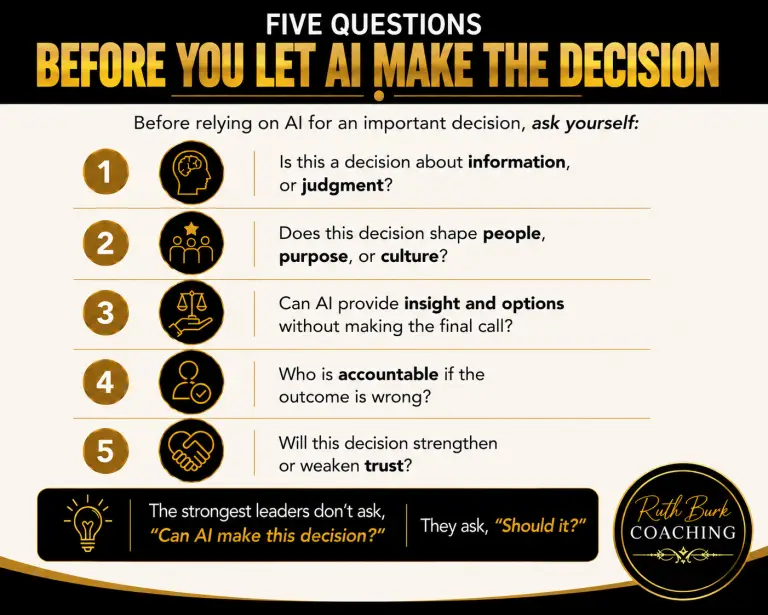
Leadership Is Becoming More Human, Not Less
Artificial intelligence is changing the work of leadership, but not in the way many people expected.
For years, conversations about AI focused on automation. The assumption was that as technology became more capable, leaders would simply have fewer decisions to make. In reality, the opposite is happening. AI is reducing the time required to gather information, analyze alternatives, and generate recommendations, but it is increasing the importance of deciding what those recommendations mean for the organization.
That shift changes the role of the leader. The challenge is not only determining which decisions should remain human. Leaders also need to determine which decisions genuinely require their own involvement. I explore that distinction in The Leadership Bottleneck: When Too Many Decisions Depend on You.
This is part of a broader transition in how leaders create value as organizations grow. In Why Growing Businesses Outgrow Their Systems, I argued that sustainable growth requires founders to spend less time coordinating work and more time leading the business. Artificial intelligence reinforces that transition. As technology assumes more routine work, leaders gain greater capacity to focus on the decisions that define purpose, shape culture, develop people, and establish strategic direction.
The organizations that thrive won’t simply be the ones that adopt artificial intelligence most quickly. They’ll be the ones that become intentional about where technology contributes and where leadership must remain unmistakably human.
Artificial intelligence can process information at extraordinary speed, but it cannot accept responsibility for the future an organization chooses to create. That responsibility has always belonged to leaders, and I believe it always will.
Artificial intelligence will continue changing how work gets done. The question is whether your leadership systems are evolving alongside it.
If you’re ready to build an organization where people understand what decisions belong to them, where AI supports rather than replaces judgment, and where leadership creates clarity instead of dependency, schedule a complimentary Clarity Call to explore how stronger decision frameworks can prepare your organization for its next stage of growth.