

Accountability is easy to support in principle.
Most leaders want people to take ownership, follow through on commitments, and address performance issues before they become larger problems. Yet accountability often becomes much harder when it requires one colleague to tell another that a deadline was missed, an agreed behavior is affecting the team, or a commitment has not been honored.
That discomfort helps explain why accountability so often travels upward.
A team member notices a problem but says nothing. The issue continues until the manager, founder, CEO, or executive director eventually steps in. Over time, the leader becomes responsible not only for setting expectations, but also for monitoring whether everyone else is meeting them. That may create individual accountability to the leader, but does not necessarily create accountability within the team.
In Why Team Commitment Doesn’t Require Consensus, I explored why teams need enough clarity and buy-in to move forward once a decision has been made. That commitment creates the foundation for the next behavior in The Five Behaviors® model: Accountability. Once people know what the team has agreed to do, they can begin holding one another responsible for doing it. That is where accountability becomes a shared responsibility rather than another responsibility belonging primarily to the person at the top.
Accountability Begins With Clear Commitments
Teams cannot hold one another accountable to expectations that were never clearly established.
A vague agreement to “improve communication” gives colleagues little basis for addressing a behavior that continues to create problems. A clearly defined commitment to share project risks before a weekly leadership meeting is different. So is an agreement that every department will provide required information by a specific date or that leadership-team decisions will be communicated consistently across the organization. The expectation is visible, and so is the gap when someone does not meet it.
This is one reason Accountability follows Commitment in The Five Behaviors® model. Teams are better positioned to hold one another accountable when they have already committed to a clear plan of action and understand what is expected of them. That progression builds on the behaviors that come before it: Trust makes honest conversations possible, productive conflict allows different perspectives to be considered, and Commitment creates clarity around the direction the team has chosen. Accountability then becomes the way team members help one another follow through on what they have agreed to do.
Strong Teams Don't Leave Accountability Entirely to the Leader
Many teams operate with a familiar accountability structure: team members are accountable upward.
The department head monitors employees. The executive director monitors department heads. The CEO monitors executives. In a founder-led company, accountability may ultimately converge on the founder.
Formal managerial accountability has an important role. Leaders are responsible for performance, expectations, difficult personnel decisions, and consequences that peers may neither have the authority nor the responsibility to impose. But strong teams add another form of accountability: team members become accountable to one another.
That distinction has been recognized in team-effectiveness research for decades. In their influential Harvard Business Review article The Discipline of Teams, Jon Katzenbach and Douglas Smith argued that mutual accountability is one of the characteristics that distinguishes a real team from a working group. Their work connects mutual accountability to the shared purpose, goals, and working approach team members develop together.
More recent research provides additional evidence.
A multi-method study presented through the Academy of Management examined what researcher Faaiza Rashid called authorized peer pressure a form of mutual accountability in which team members effectively give one another permission to challenge their progress. The research included 157 interviews and 101 hours of observation, followed by survey data from 220 people across 45 teams in five organizations. Authorized peer pressure was positively associated with team performance even after accounting for performance pressure and structural team conditions.
That idea of permission is particularly important.
People may recognize that a colleague is not following through and still hesitate to say anything because they are unsure whether it is their place. On teams with stronger mutual accountability, it is their place because everyone has a stake in the commitments the team has made.
Accountability Is Not the Same as Confrontation
Accountability is often associated with what happens after something goes wrong. A target is missed, a commitment isn’t met, or performance falls short, and the leader steps in to address it. Over time, this can create the impression that accountability is primarily about consequences and that enforcing it is the leader’s responsibility.
But accountability does not have to begin after a problem has already occurred. Effective peer accountability often happens earlier, when team members are willing to check in, raise concerns, and address potential gaps before they become larger issues. It can sound like:
- We agreed to have this ready by Friday. Are we still on track?
- You committed to raising concerns in the meeting, but this is the second time I’ve heard them afterward. What’s getting in the way?
- Our team agreed that this was the priority. Has something changed?
These conversations do not have to begin with accusation. They can begin with curiosity while still addressing the gap directly.
Research published in the Journal of Business Ethics reinforces the relational nature of team accountability. Virginia Stewart, Deirdre Snyder, and Chia-Yu Kou developed and tested a measure of collective team accountability, including validation with senior leaders in a multinational pharmaceutical company. Their subsequent study followed 65 teams over three months and found that team accountability was associated with greater subsequent effort, team viability, and later team commitment. Importantly, accountability did not independently predict subsequent task performance after prior performance was taken into account, a useful reminder that accountability is not a simple performance cure-all.
Accountability works within a larger team system. That is precisely why trust, conflict, and commitment come before it.
The Leader's Response Teaches the Team Who Owns Accountability
Leaders can unintentionally weaken peer accountability even while asking for more of it.
Consider what happens when one executive approaches the CEO because another executive has not followed through on an agreed commitment. The CEO can immediately take over:
- I’ll talk to her.
Or the CEO can ask:
- Have you talked to her about it?
Those responses teach two very different lessons. The first reinforces the leader as the primary enforcer of team commitments. The second signals that colleagues have both permission and responsibility to address issues directly when appropriate.
This does not mean leaders should refuse to intervene. Some problems involve power differences, ethical concerns, repeated performance failures, or other circumstances where escalation is entirely appropriate. But everyday failures of coordination, follow-through, and agreed team behavior do not always need to begin at the top.
For founders and executive directors in particular, this distinction can have significant implications for leadership capacity. As I explored in How Business Systems Help Teams Make Better Decisions Without Relying on the Founder, an organization remains dependent on its leader when important decisions continually return to that person. The same thing happens when every accountability conversation returns there too.
A team cannot become truly self-managing in its day-to-day work if the leader must continually police commitments between capable adults.
Avoiding Accountability Has Organizational Consequences
The consequences of weak accountability extend beyond a missed deadline or unmet commitment. When team members repeatedly fail to follow through and colleagues remain silent, the team gradually learns what its standards actually are. People who consistently deliver notice when others can contribute less without being challenged, deadlines become increasingly negotiable, and resentment can grow when stronger performers are expected to compensate for colleagues who are not following through.
The Five Behaviors® model identifies similar consequences when peers do not hold one another accountable, including missed deadlines and deliverables, differing performance standards, and losing sight of responsibilities to the team.
Over time, weak accountability can also change how people work together. Rather than addressing an issue directly with a colleague, team members may begin working around it. They copy the leader on emails, add approval steps, hold side conversations, create redundant processes, or escalate concerns that could have been resolved between colleagues.
Those workarounds may initially look like communication or process problems, but the underlying issue can be accountability. When teams do not have the conversations required to address problems directly, organizations often create additional processes to compensate for the conversations people have learned to avoid.
Accountability Requires Both Trust and Courage
Peer accountability can feel risky because relationships matter.
A team member may worry that challenging a colleague will create tension, damage the relationship, or make future collaboration more difficult. A newer executive may hesitate to question someone with greater tenure. Someone who strongly values harmony may wait far too long before raising an issue.
This is where the earlier behaviors in the model become important again.
Vulnerability-based trust helps people believe that a colleague’s challenge is not necessarily an attack. Productive conflict gives the team experience disagreeing without damaging relationships. Commitment establishes the expectation against which accountability occurs.
Emotional intelligence matters here as well.
As I explored in The Leadership Behaviors That Emotional Intelligence Makes Possible, effective leaders learn to balance accountability with empathy. Those qualities are not opposites. Accountability without empathy can become unnecessarily harsh, while empathy without accountability can allow unclear standards and persistent performance problems to continue.
The goal is not to make accountability comfortable. It is to make direct, respectful accountability normal enough that discomfort no longer prevents the conversation from happening.
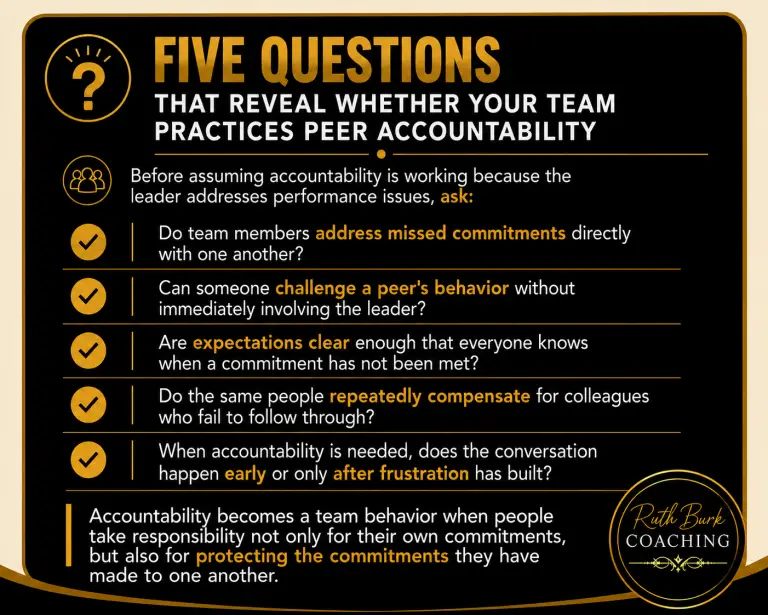
Measuring Accountability Through Team Coaching
Accountability can be difficult for teams to evaluate because leaders often see the outcomes of weak accountability without seeing the interactions that produced them. A missed deadline is visible. The earlier opportunities colleagues had to address the problem may not be.
This is one reason I use The Five Behaviors® Team Development assessment as part of team coaching. The assessment examines an intact team’s approach to Trust, Conflict, Commitment, Accountability, and Results and is powered by Everything DiSC®, which helps team members understand how individual behavioral preferences may influence the way they work together.
The assessment provides a starting point. Coaching then allows the team to look beyond whether people generally consider themselves accountable and examine what actually happens when a commitment is missed, an expectation is not met, or a colleague needs to be challenged. That exploration may raise questions such as:
- Who addresses missed commitments?
- How quickly are concerns raised?
- Which conversations consistently move upward to the leader?
- Are people equally willing to challenge every member of the team, or do hierarchy, tenure, or personality influence who can question whom?
- What happens after someone raises an accountability issue?
The answers can reveal whether accountability is genuinely shared or whether the team remains dependent on formal authority to maintain its standards. They can also help identify where weak accountability is affecting the organization’s ability to execute, collaborate, and follow through on shared priorities.
That is where accountability moves beyond individual responsibility and becomes a source of team effectiveness. Instead of relying on one person to protect the team’s standards, members begin taking shared responsibility for upholding the commitments they have made to one another.
Accountability Keeps the Team Focused on Results
Accountability is not the final behavior in The Five Behaviors® model. It creates the conditions for the final behavior: Results.
The purpose of peer accountability is to help the team stay aligned with the commitments it has made and the results it is collectively responsible for achieving. When someone raises a missed commitment or challenges a behavior that is affecting the team’s work, the conversation is ultimately about protecting what the team has agreed matters.
This is why The Five Behaviors® connects Accountability to Results. A team that has built trust, learned to engage in productive conflict, committed to decisions, and developed the willingness to hold one another accountable is better positioned to keep collective priorities from being overshadowed by individual agendas. That shared focus also distinguishes peer accountability from criticism. The goal is to help one another follow through so the team can succeed together.
And that leads to the final behavior in this series: whether team members can consistently put collective results ahead of individual priorities, status, and departmental interests.
Ready to Strengthen Accountability on Your Team?
Strong teams do not leave every difficult accountability conversation to the person at the top. They develop enough trust, clarity, and commitment for team members to address missed expectations directly and respectfully with one another.
If your team struggles with follow-through, avoids difficult conversations, or continually relies on the founder, CEO, or executive director to enforce commitments, team coaching can help uncover the patterns behind that dependence. Schedule a complimentary Clarity Call to explore how The Five Behaviors® can help your team strengthen peer accountability and improve how it works together.