
Most leadership teams say they are focused on results. They track revenue, program outcomes, client growth, operational performance, employee engagement, or other measures that matter to the organization. And the individual leaders sitting around the table may be performing exceptionally well within their own areas of responsibility.
But strong individual performance does not automatically translate into strong team performance.
The reason is that senior leaders are responsible for more than one set of results. They are accountable for the performance of their own functions while also sharing responsibility for the performance of the organization. Those responsibilities usually reinforce one another, but not always. Growth may be important while operations is already approaching capacity. A nonprofit may have an opportunity to expand programming while financial sustainability requires restraint. Marketing, finance, operations, development, and program leadership can each have legitimate priorities that compete for the same resources and attention.
The challenge, then, is not whether individual leaders are producing results. It is whether the leadership team can keep its collective results at the center when priorities compete.
That distinction brings us to the top of The Five Behaviors® pyramid: Results. The model defines this final behavior around a team’s ability to focus on collective outcomes rather than allowing individual status, recognition, or priorities to take precedence.
Results also represent the culmination of the four behaviors beneath them: Trust, Conflict, Commitment, and Accountability. A team builds the trust required to speak honestly, engages in productive conflict to consider different perspectives, commits to a direction, and holds one another accountable for following through.
The progression matters because collective results are not simply the final behavior in the model. They are the reason the other four behaviors matter.
Individual Success Does Not Always Equal Team Success
Senior leaders are responsible for the performance of their individual functions, and those responsibilities should not disappear when they join the leadership team. The challenge is recognizing when optimizing one function comes at a cost to the organization as a whole.
A department can hit its targets while creating problems elsewhere. Growth can outpace operational capacity. Efficiency measures can weaken client experience. Protecting one department’s resources can prevent the organization from investing in a more important strategic priority. Each decision may make sense within the function while producing a weaker outcome for the organization.
Research on team interdependence helps explain why this matters. A meta-analysis published in the Journal of Applied Psychology examined task and outcome interdependence and their relationships with team functioning and performance. The researchers found that task interdependence was associated with performance through task-focused team processes and collective efficacy, while outcome interdependence operated through relational processes and cohesion.
For leadership teams, this reinforces an important point: how responsibilities and outcomes are connected across the team influences how people work together to achieve them.
When the work of one function affects the success of another, leaders cannot evaluate effectiveness entirely through the performance of their own departments. The organization also needs outcomes that the leadership team recognizes as collectively its responsibility.
The Leadership Team Has to Become the First Team
Senior leaders occupy two roles at once. They lead a function, and they are members of the team responsible for leading the organization.
The tension between those roles becomes most visible when the organization faces a tradeoff. A leader may have a compelling case for additional staff, funding, technology, or another priority, while investing those resources elsewhere would create greater value for the organization.
In those moments, leadership requires more than advocating effectively for one’s own area. It requires being willing to support the decision that best advances the organization’s shared priorities. Making those tradeoffs requires leaders to believe that their colleagues are working toward the same organizational interests, even when a decision does not benefit their own function. That kind of confidence is difficult to build without the vulnerability-based trust I explored in Why High-Performing Teams Start With Trust.
That does not mean leaders stop advocating for their functions. Their expertise is necessary precisely because the leadership team needs to understand the consequences of its decisions across the organization. Advocacy should inform the decision rather than determine it.
This distinction can be especially important in growing founder-led businesses and nonprofits, where resources are often constrained and leaders wear multiple hats. The organization may not have the capacity to pursue every worthwhile opportunity at once. A strong leadership team helps determine which priorities matter most and then aligns around them. For founder-led organizations, developing that collective responsibility can also reduce the tendency for competing priorities and difficult decisions to continually return to the founder, an issue I explored in How Business Systems Help Teams Make Better Decisions Without Relying on the Founder.
The question is not whether each leader’s priorities matter. It is whether the team can determine what matters most.
Collective Results Depend on the Behaviors Beneath Them
Results sit at the top of The Five Behaviors® pyramid because they reflect, in part, what has been happening throughout the team.
Performance measures typically show leaders an outcome after it has occurred. A missed target, delayed initiative, lost opportunity, or stalled strategic priority becomes visible on a dashboard, but the conditions contributing to that result may have developed much earlier. A concern was not raised. A decision lacked genuine commitment. An agreed action was not completed, and no one addressed it. By the time the result becomes visible, those team dynamics may have been affecting execution for weeks or even months.
This is why responding to disappointing performance only by revising targets, adding metrics, changing processes, or increasing pressure can miss part of the problem. Those actions may be appropriate, but leaders also need to ask what was happening within the team as it worked toward the result.
Performance data tells leaders where the team ended up. Examining the behaviors beneath the result can help them understand how it got there.
Collective Results Change How Teams Work Together
A collective focus requires more than announcing an organizational goal. Team members need to understand what they are collectively trying to accomplish and recognize that achieving it depends, at least in part, on one another.
Research on cooperative goals offers useful insight into what can happen when that shared orientation exists. A meta-analytic investigation drawing on 104 primary studies found that cooperative goals were associated with more open-minded discussion, which in turn was associated with outcomes including performance, creativity, relationships, and commitment. Competitive and independent goals were associated with less open-minded discussion and lower organizational effectiveness.
Research on collective efficacy, a group’s shared belief in its ability to organize and execute the actions necessary to accomplish a task, adds another dimension. A Journal of Applied Psychology meta-analysis synthesized 96 studies representing 6,128 groups and more than 31,000 individuals and found a significant positive relationship between collective efficacy and group performance. That relationship became stronger as task interdependence increased.
These findings are particularly relevant to leadership teams because senior-level work rarely stays within neat functional boundaries. A decision made in one area can create consequences throughout the organization. Collective results give leaders a common reference point for navigating those interdependencies. Instead of collaboration being something one department does to help another, it becomes part of accomplishing an outcome the leadership team owns together.
When Collective Results Require a Tradeoff
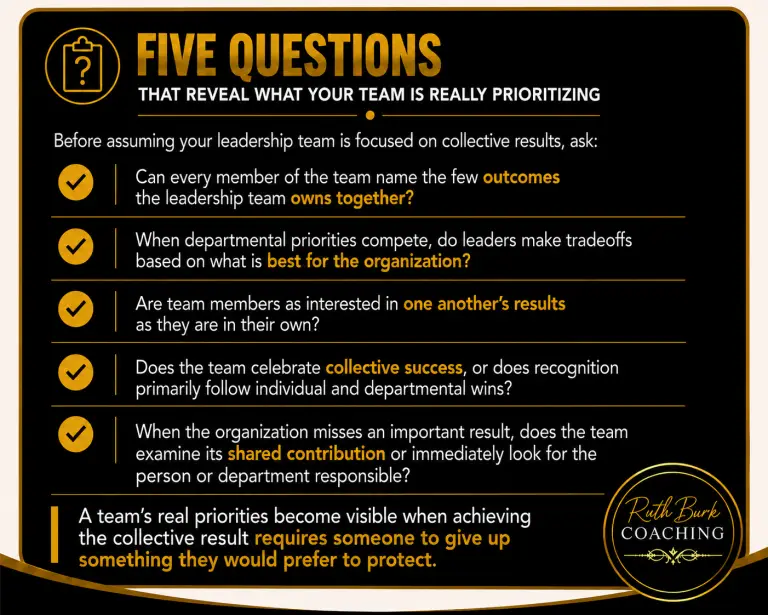
The clearest test of a team’s focus on collective results often comes when achieving one requires someone to give something up.
A leader may need to lend a strong employee to another initiative, delay a preferred project, relinquish resources, or support a decision that benefits the organization while making the work of their own function more difficult. Those moments reveal whether collective results are truly the priority or simply something the team supports when there is no individual or departmental cost attached. They also demonstrate why collective results need to be clear enough to guide decisions. Broad aspirations such as “grow the organization,” “increase impact,” or “improve culture” may be worthwhile, but they do not necessarily tell leaders how to choose between competing priorities.
The measures themselves will differ by organization. A nonprofit leadership team may share responsibility for program impact, donor retention, financial sustainability, employee retention, or progress toward a strategic initiative. A growing women-owned business may focus on profitable growth, client retention, delivery capacity, or reducing the organization’s dependence on the founder. What matters is that the leadership team knows which outcomes it owns together and can tell whether those outcomes are improving.
Collective focus does not require leaders to care less about their individual responsibilities. It requires them to understand those responsibilities in service of something larger.
Measuring a Team's Focus on Results Through Coaching
Results may appear easier to evaluate than the other behaviors because organizations already measure performance. Revenue, retention, fundraising, client outcomes, deadlines, growth, and strategic milestones all produce visible data.
What those measures do not necessarily reveal is whether the leadership team is functioning around collective results.
This is one reason I use The Five Behaviors® Team Development assessment as part of team coaching. The assessment examines an intact team’s approach to Trust, Conflict, Commitment, Accountability, and Results, providing a structured starting point for understanding how those behaviors interact. The Results dimension creates an opportunity to look beyond individual performance and explore whether the team is maintaining its attention on shared outcomes.
Coaching can then connect what the assessment reveals to the way the leadership team actually operates. That exploration may raise questions such as:
- What results does this leadership team own collectively?
- Where do departmental priorities compete with organizational priorities?
- What happens when achieving a shared result requires one leader to make a tradeoff?
- Which measures receive the most attention in leadership meetings?
- When results fall short, does the team respond collectively or retreat into functional silos?
The answers can reveal whether leaders are simply reporting individual performance around the same table or genuinely operating as a team with shared responsibility for organizational outcomes.
That distinction has practical consequences. When functional priorities continually compete, resources can become fragmented, cross-functional problems can remain unresolved, and the organization may struggle to translate strategy into coordinated action. Shared outcomes give the leadership team a common reference point for making decisions, allocating resources, and evaluating progress.
That is where collective results become more than a measure of team performance. They become a way of aligning leadership attention, decisions, and accountability around what the organization most needs the team to accomplish together.
Ready to Help Your Team Focus on What Matters Most?
A leadership team can contain talented people and still struggle when individual priorities, departmental goals, or organizational silos compete with what the team needs to accomplish together.
Team coaching creates an opportunity to examine not only the results your team is achieving, but also the behaviors influencing those results. As a certified practitioner, I use The Five Behaviors® Team Development to help intact teams understand how they work together, identify patterns that may be limiting effectiveness, and strengthen the behaviors required for collective performance.
If your leadership team is ready to create greater alignment around shared organizational outcomes, schedule a complimentary Clarity Call to explore how team coaching can support the work.