

Being available to the people you lead is generally a leadership strength. Employees need opportunities to raise concerns, ask questions, seek perspective, and bring forward problems that genuinely require leadership involvement. Strong relationships are often built through exactly this kind of access.
But a different pattern can develop when your team depends on you for more than leadership-level judgment. You become the person people turn to when priorities are unclear, colleagues disagree, a customer situation becomes difficult, or someone simply wants reassurance before moving forward. Each interaction may be entirely reasonable. Taken together, however, they can create an organization in which your involvement has quietly become part of how ordinary uncertainty gets resolved.
The problem is not that you are too supportive, but rather that support can gradually begin substituting for capacity elsewhere in the organization. This distinction matters because the answer is not simply to step back. Instead, the goal is to be involved where your leadership matters most.
When Your Team Depends on You, Competence Can Hide the Pattern
Dependence on a leader does not always develop because someone refuses to delegate or wants to maintain control. In many organizations, almost the opposite is true. A highly capable leader sees a problem, understands the context, and knows how to move it forward. Helping is often faster than allowing the issue to remain unresolved.
Consider two department heads who disagree about how to allocate a shared resource. They bring the disagreement to the executive overseeing both functions. She understands the competing priorities, helps them reach a decision, and everyone returns to work. The intervention was useful.
A month later, another disagreement emerges. They return to her.
Nothing about either interaction necessarily looks dysfunctional. The problem becomes visible in the pattern. The executive has not simply helped resolve two disagreements. She has gradually become part of the operating relationship between the two leaders. The organization solved each immediate problem without necessarily increasing its ability to solve the next one.
This is one reason leader dependence can be difficult to recognize. The leader’s competence can mask it. The organization continues to function because problems are being resolved. What is less visible is how much of that functioning continues to require the same person’s judgment, context, or involvement.
Research on organizational decision-making suggests that this pattern can persist even when leaders believe they have delegated. McKinsey has described decisions that “boomerang” back to senior leaders because employees continue seeking guidance or informal approval rather than exercising the authority that was ostensibly transferred. Their research points to an important distinction: assigning responsibility is not enough. People also need clear roles, appropriate authority, capabilities, and coaching if they are expected to exercise judgment without continually returning decisions upward.
The broader research on empowering leadership reinforces that point. A meta-analysis of 105 independent samples found that empowering leadership was positively associated with individual and team performance, organizational citizenship behavior, and creativity, with psychological empowerment helping explain several of those relationships. Research on shared leadership similarly suggests that leadership capacity does not have to remain concentrated in the formal leader for teams to function effectively.
The implication is not that every organization should decentralize everything. Some decisions and problems appropriately belong with senior leadership. The more important question is whether each intervention simply resolves today’s issue or also leaves greater capacity behind for the next one.
Support and Substitution Are Not the Same Thing
Leaders should help people. They should provide context, coach through difficult situations, remove barriers, clarify priorities, and step into problems that genuinely require their authority. The question is what remains with the other person after that help is provided.
Support increases someone’s ability to handle the next situation. Substitution repeatedly handles the situation for them.
The difference can be subtle. A manager brings you a difficult employee conversation, and you help her think through what she wants to communicate, what outcome she is trying to create, and how she might respond if the conversation becomes difficult. She still owns the conversation. That is different from becoming the person who repeatedly determines what she should say, how she should say it, and what she should do next.
The same distinction appears in decision-making. Someone asks for your perspective on an unfamiliar situation. You help identify the relevant considerations and clarify where their authority begins and ends. That can strengthen judgment. But if every unfamiliar situation comes back to you for a final answer, the organization may be delegating tasks without developing the judgment required to carry them.
The useful leadership question is therefore not simply: Did I help?
It is: What should remain with this person after I help?
Your Response Teaches People What to Bring You
Every time someone brings uncertainty to a leader, the response does more than resolve the immediate issue. It also communicates something about where responsibility for that kind of issue belongs.
Imagine that a manager asks what she should do about a customer exception. Giving her the answer may take five minutes. Asking what she has considered, what she recommends, what trade-offs she sees, and where she specifically needs your involvement may take longer.
But the two conversations teach different things.
The first can teach that uncertainty belongs with the leader. The second can begin teaching that uncertainty is something the manager is expected to work through before escalating. Neither response is universally correct. Some customer situations carry financial, legal, reputational, or strategic implications that genuinely require senior leadership judgment.
The important point is that repeated responses create expectations.
The same pattern can develop around conflict. If two colleagues learn that unresolved tension eventually results in the leader stepping in, the leader can unintentionally become part of their conflict-management process. If a team learns that missed commitments are addressed primarily when the leader notices them, accountability can gradually become accountability to the leader rather than accountability within the team.
The individual interaction matters. The pattern it teaches matters more.
Delegating Work Does Not Necessarily Transfer Capacity
Delegation is often presented as the obvious answer when a team depends on you too much. Sometimes it is. But moving work and moving capacity are not always the same thing.
A project can be delegated while every meaningful exception still returns to the executive. A manager can technically own a function while needing approval whenever circumstances fall outside an established pattern. A client relationship can be handed to another person while the client continues to trust only the founder or senior leader. Responsibility has moved on paper while some of the underlying authority, judgment or relational trust has not.
This distinction is particularly important because it explains why leaders sometimes delegate extensively and still feel that everything eventually comes back to them.
The more useful question becomes: What still depends on me after the work has been delegated?
The work may have moved while decision authority remains concentrated with the leader. Critical organizational context may still reside primarily with one person, cross-functional relationships may depend on the leader to keep them working, or the judgment behind recurring decisions may never have been translated into principles others can apply. In other cases, responsibility has transferred but trust has not.
Looking at what continually returns to the leader can reveal which underlying capacities have not yet transferred.
What Happens When You Are Unavailable?
One of the clearest ways to see leader dependence is to notice what happens when the leader is absent.
This does not require disappearing for a month. Consider what happens during a vacation, an off-site, several days of concentrated strategic work, or even a calendar that temporarily makes you less accessible than usual.
What stops that should not have needed to stop?
Do routine decisions wait? Do disagreements remain unresolved? Do customer issues accumulate? Does cross-functional work slow because people are waiting for you to align competing priorities? Do people postpone action because they are unsure what you would want them to do?
Some pauses are appropriate. Certain decisions should wait for the person who holds the relevant authority or bears responsibility for the consequences. The goal is not to create an organization that never needs its leaders.
But absence can expose where leadership involvement has become structurally necessary for work that should have been able to continue.
This is also where decision rights become important. McKinsey’s work on organizational decision-making emphasizes the importance of clarifying who has decision authority, who provides input, and when an issue genuinely requires escalation. Without that clarity, decisions can continue moving upward even when the relevant information and responsibility sit elsewhere in the organization.
The question is whether the organization knows the difference between an issue that genuinely requires leadership involvement and one that has simply become accustomed to receiving it.
Stronger Boundaries Will Not Solve a Structural Dependency
Boundaries matter. Leaders need to protect their attention, and constant accessibility can make it difficult to devote sufficient thought to the work that actually requires senior-level judgment.
I explored this problem in Decision Fatigue in Leadership: When Everything Competes for Your Attention. The issue is not simply the volume of decisions. When immediate questions, exceptions, approvals, and escalations continually compete with consequential work, leadership attention can become misaligned with organizational consequence.
But boundaries alone cannot correct a structural dependency.
A leader can establish office hours, stop responding immediately to messages, protect Friday mornings for strategic work, or ask people to consolidate questions. Those practices may improve working conditions. They do not necessarily change why so many questions require the leader in the first place.
If people lack decision authority, making the leader harder to reach does not give them authority. If two functions cannot resolve competing priorities without executive intervention, reducing executive availability does not repair the relationship. If important context exists primarily in one person’s head, a communication boundary does not distribute that context.
The more useful question is not simply: How can I make myself less available?
It is: Why does so much require my availability in the first place?
The Goal Is More Selective Leadership
Organizations need leaders. Senior leaders remain responsible for strategic direction, consequential trade-offs, enterprise risk, resources, people, culture, and decisions whose implications extend beyond a single role or team. Greater organizational capacity does not eliminate those responsibilities.
The distinction is whether the organization needs the leader primarily for leadership-level work, or whether it also depends on the leader for ordinary judgment, coordination, problem-solving, relational repair, and reassurance. This distinction is important as the leader’s contribution should become more selective.
Research on shared leadership helps clarify why this does not require abandoning formal leadership. A meta-analysis published in the Journal of Applied Psychology examined 42 independent samples and found a positive relationship between shared leadership and team effectiveness. Importantly, the research does not suggest that vertical leadership becomes irrelevant. Rather, leadership processes distributed among team members can contribute something additional to team functioning.
This is not an absence of leadership, but it is a different use of leadership.
As responsibility grows, the question shifts from how much a leader can personally handle to where her involvement creates the greatest value.
Strong Leadership Relationships Should Increase Capacity
The alternative to dependence is not distance.
A leader can remain highly connected to the people around her. She can listen, coach, provide perspective, offer context, and step into difficult situations when her involvement is genuinely needed. In fact, strong leadership relationships often make greater independence possible because people have enough clarity, trust, and context to exercise judgment without interpreting autonomy as abandonment.
Research on psychological empowerment is relevant here. A meta-analysis of leadership styles and psychological empowerment found that empowering, transformational, and servant leadership were positively associated with psychological empowerment. That provides a useful lens for leadership relationships because empowerment is not simply about giving people more work. It involves creating the conditions in which they experience greater competence, influence, meaning, and autonomy in carrying it.
A strong relationship should not only make it easier for someone to reach the leader. Over time, it should increase what that person is capable of carrying.
Managers develop greater confidence exercising judgment. Colleagues become better able to work through competing needs directly. Teams develop clearer expectations around accountability. People understand where their authority begins, where it ends, and what genuinely requires escalation. Important relationships become connected to the organization rather than existing solely through one individual.
This is part of what I think of as relational authority: the ability to create clarity, trust, and movement through relationships without becoming the person through whom every relationship must run.
A leader can remain highly connected without becoming the person through whom everything must connect.
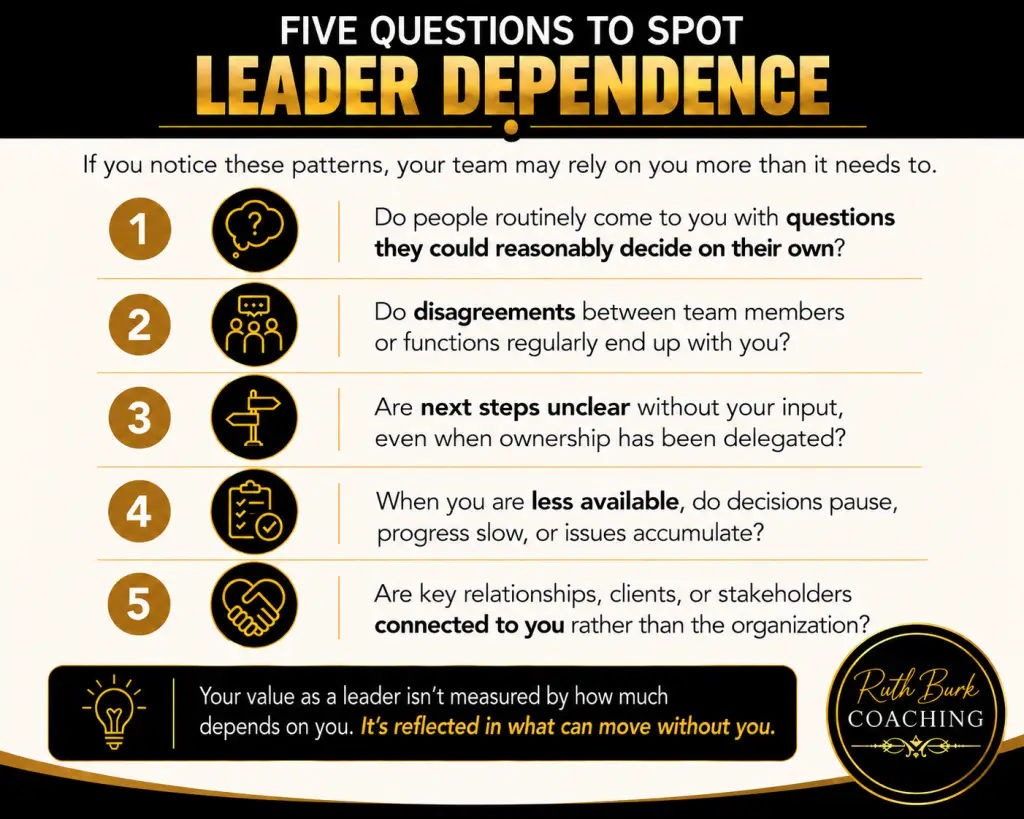
Pay Attention to What Still Depends on You
The patterns above do not automatically signal a problem. A more useful question is what they reveal about where leadership capacity currently resides. Your involvement may be adding genuine leadership value in some situations while remaining necessary in others simply because capacity has not yet developed elsewhere.
During a crisis, significant transformation, leadership transition, major strategic shift, or period of team development, greater leadership involvement may be exactly what the organization needs. The distinction is whether that reliance reflects the demands of the moment or has become part of the organization’s normal way of operating.
That is why the objective is not simply to reduce how much people rely on you. It is to become more deliberate about what should require your involvement and to build capacity around the work that should not. Over time, more judgment can reside with capable people, more relationships can withstand disagreement without intervention, decision structures can make authority clearer, and organizational context can become accessible without continually returning to the leader.
The goal is to build an organization that needs its leader for the work only the leader should be doing.
Ready to Strengthen How Leadership Moves Through Your Relationships?
In Connect Catalyst™, I work with leaders using their actual leadership relationships as the curriculum. We examine where authority is clear, where decisions or responsibilities continually return to you, how communication patterns affect ownership, and where stronger boundaries, clearer expectations, or greater relational capacity may be needed.
The objective is to become more intentional about how your relationships create clarity, accountability, and movement without requiring your continuous involvement. The work culminates in a personalized 90-Day Relational Authority Blueprint™ that translates those insights into specific relationship priorities, communication practices, boundaries, and commitments.
If you are ready to strengthen your leadership relationships while building greater capacity around you, schedule a complimentary Clarity Call.