
Organizations invest in leadership development because they want more effective managers, stronger teams, and greater organizational capacity. A 360-degree feedback assessment can help by showing leaders how their behavior is experienced by the people who work with them. But there is an important distinction between receiving feedback and becoming a more effective leader.
A manager may discover that her team experiences her communication differently than she intended. She may recognize that her involvement in routine decisions is limiting employee autonomy or that colleagues find it difficult to raise concerns with her. The feedback may be accurate, surprising, and genuinely useful, yet six months later, the same patterns may still exist.
The problem is not necessarily the quality of the assessment. It may be what happened, or failed to happen, after the results were delivered. For growing organizations, this distinction is particularly important because a relatively small number of managers may influence the working experiences of most employees.
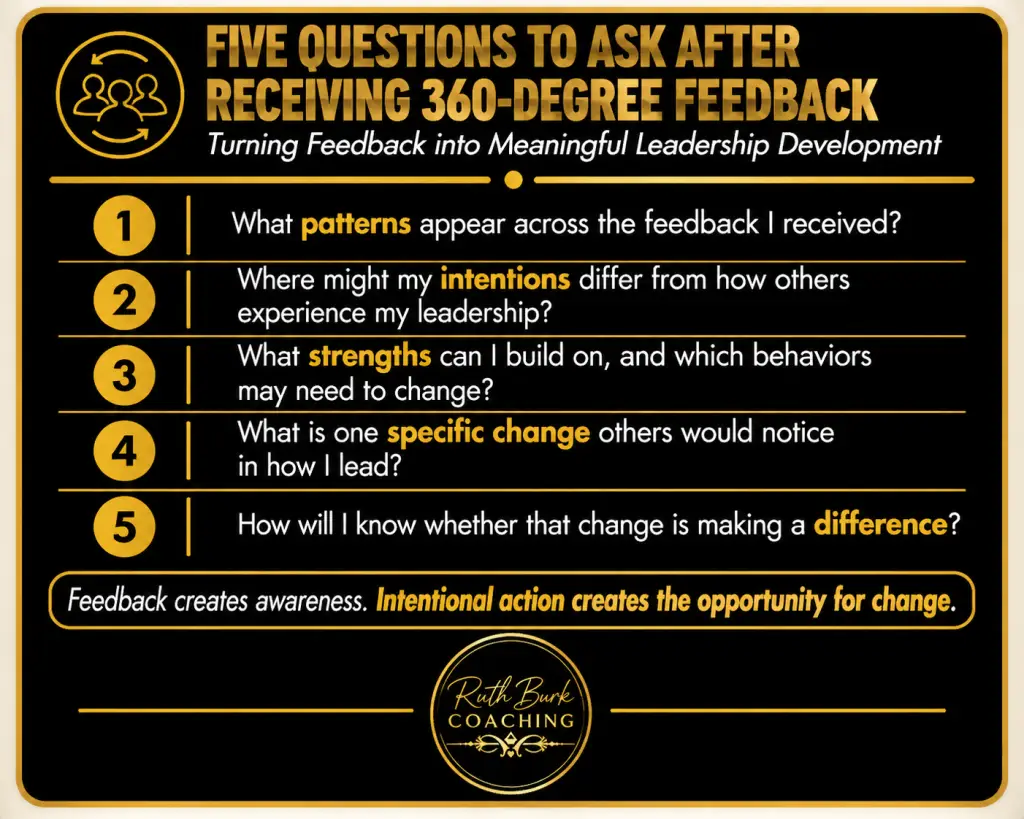
The value of 360-degree feedback is not simply what leaders discover about themselves. It is whether that understanding leads to meaningful changes in how they lead.
What 360-Degree Feedback Reveals That Traditional Reviews May Miss
A traditional performance review generally emphasizes the perspective of a supervisor. A 360-degree assessment broadens that view by gathering feedback from multiple sources, which may include direct reports, peers, supervisors, and the leader herself. This allows leaders to compare how they understand their own behavior with how others experience it.
Consider a department manager who believes she has created an environment where employees can make decisions independently. She regularly encourages initiative and tells her team that she trusts their judgment. Her supervisor sees someone who delivers results and takes responsibility for her department.
But feedback from direct reports suggests a different experience. Employees say they are encouraged to make decisions, yet frequently find those decisions questioned or revisited. Over time, they have learned to seek approval before moving forward, even when they technically have the authority to act.
The manager may be genuinely surprised. She believes she has delegated authority, while her team has learned that important decisions still depend on her agreement. Neither perspective tells the entire story, and the value lies in examining the difference between the leader’s intentions and the experiences of others.
This is where 360-degree feedback can reveal leadership patterns that ordinary performance conversations may not uncover. It can identify strengths, expose inconsistencies, and help leaders recognize how their behavior influences trust, accountability, and team effectiveness. But identifying a pattern does not automatically change it.
Why 360-Degree Feedback Alone Rarely Produces Significant Improvement
Research offers an important perspective on the limitations of multisource feedback. A meta-analysis published in Personnel Psychology by James Smither, Manuel London, and Richard Reilly examined 24 longitudinal studies of multisource feedback. The researchers found that improvements in subsequent ratings from supervisors, peers, and direct reports were generally small.
Their findings also suggested that improvement was more likely when leaders recognized a need for change, responded constructively to feedback, established appropriate development goals, and took action to improve their behavior. The research highlights an important distinction between receiving information about leadership effectiveness and developing greater leadership capability.
A leader may understand that she needs to delegate more effectively without knowing how to change the expectations, relationships, or decision-making practices that currently bring work back to her. She may recognize that employees experience her as difficult to approach but remain uncertain about which behaviors contribute to that perception. Without opportunities to examine and apply the feedback, awareness can remain disconnected from action.
This is also why organizations should be cautious about evaluating a 360-degree process primarily through participant satisfaction. A leader can find an assessment insightful without making meaningful changes afterward. The more useful question is what becomes different in the leader’s behavior because of what she learned.
What Determines Whether 360-Degree Feedback Creates Value?
The return on a 360-degree assessment depends on how feedback is collected, interpreted, and translated into development. Several conditions influence whether the process becomes a meaningful investment in leadership capability or simply another completed assessment.
A Clear Leadership Development Purpose
Organizations sometimes introduce 360-degree assessments because they want to invest in their managers or establish a more formal leadership development process. Those are reasonable objectives, but they do not necessarily clarify what the organization wants to improve.
For a growing organization, the need may involve managers who are technically capable but have limited experience leading people. It may involve department heads who struggle to coordinate priorities or senior leaders who remain involved in too many operational decisions. These are different development challenges, and each requires a different focus.
McKinsey’s article Why Leadership-Development Programs Fail emphasizes the importance of connecting leadership development to organizational context and measuring changes in leadership performance over time. The authors caution against relying primarily on participant reactions as evidence of effectiveness. That principle applies directly to 360-degree feedback because the assessment should support a defined development objective rather than become an activity undertaken simply because leadership development is considered important.
Trust in the Feedback Process
A 360-degree assessment depends on people being willing to share their experiences candidly. In smaller organizations, that can be complicated because employees may work closely with the leader being assessed, reporting relationships may overlap, and departments may contain only a few people. Individuals may worry that their comments will be recognizable, particularly when providing feedback about a sensitive leadership behavior.
If employees believe their responses could negatively affect their working relationships, they may soften their feedback or avoid raising important concerns. Organizations therefore need to establish appropriate confidentiality safeguards, explain how results will be used, and clarify who will have access to individual reports. They should also avoid promising anonymity when the size or structure of respondent groups cannot adequately protect it.
Organizations must distinguish between feedback intended for development and assessments used for formal employment decisions. When employees or leaders are uncertain about how information will be used, the process can become more about managing impressions than supporting development. Trust is one of the conditions that makes useful feedback possible.
Coaching to Interpret and Apply the Results
Feedback can challenge a leader’s understanding of herself. A manager who values collaboration may discover that colleagues experience her as controlling, while a leader who believes she is supportive may learn that employees feel uncomfortable disagreeing with her. The immediate response may be to explain, defend, or question the feedback, particularly when it challenges an important part of the leader’s professional identity.
This difference between leadership intentions and the experiences of others is something I explored in my earlier article, The Leadership Blind Spot: How Your Natural Style Affects the People Around You. The behaviors leaders rely on most naturally may not always produce the effects they intend, making outside perspectives especially valuable for understanding their leadership impact.
A professional coach can help the leader explore recurring patterns, consider different interpretations, and identify what may be within her ability to change. The purpose is not to persuade the leader to accept every rating as accurate, but to examine what the combined feedback may reveal about her leadership practices and their effects on others.
A study published in Personnel Psychology involving 1,361 senior managers found that participants who worked with an executive coach after receiving multisource feedback were more likely to establish specific development goals and seek improvement suggestions from supervisors. They also demonstrated somewhat greater improvement in subsequent feedback ratings, although the measured advantage was small. Coaching does not guarantee improvement, but it can provide a structured opportunity to turn feedback into reflection, goals, and action.
Observable Changes in Leadership Behavior
Consider the manager whose employees believe that decisions continually return to her for approval. A development goal such as “delegate more effectively” may be directionally correct, but it does not identify what needs to change. A more useful conversation would examine why employees continue seeking approval and what the manager may be doing to reinforce that pattern.
Are decision boundaries unclear? Does the manager frequently reverse decisions, or are employees uncertain about the risks they are authorized to accept? Do they have the information and skills needed to exercise independent judgment? Each possibility suggests a different development response.
The manager might establish clearer decision rights, agree on escalation criteria, or begin asking employees for their recommendations rather than immediately providing answers. These are observable changes that can be practiced and evaluated. The same principle applies to communication, conflict management, employee development, and collaboration.
Leadership development becomes more meaningful when broad intentions are translated into specific behaviors that others can experience. It also creates a clearer basis for determining whether the development effort is producing meaningful results.
Follow-Through Beyond the Assessment
One of the most easily overlooked aspects of 360-degree feedback is the role of follow-up conversations. In a Harvard Business Review article, For Your 360-Degree Feedback to Be Effective, You Need to Discuss It, executive coach Brenda Steinberg emphasizes the importance of discussing feedback with colleagues rather than treating the report as a private development exercise.
Leadership behavior is experienced through everyday interactions. If employees experience a manager as dismissive during meetings, improvement cannot be demonstrated solely through the manager’s private reflection. It must eventually become visible in how she listens, responds, and involves others.
Follow-up conversations can help leaders test their understanding of feedback without asking employees to defend their original responses. A leader might explain that she is working on involving team members earlier in decisions and ask what would make that participation more meaningful. Over time, colleagues can provide additional perspective on whether the intended changes are becoming evident.
Without this continued engagement, the assessment may become an isolated event rather than the beginning of a development process. Meaningful improvement requires opportunities to practice new behaviors, receive feedback, and adjust as circumstances change.
Measuring the ROI of 360-Degree Feedback in Growing Organizations
The financial return on 360-degree feedback is difficult to isolate because leadership effectiveness influences many organizational outcomes. Employee retention, productivity, engagement, and performance are also affected by compensation, workload, business conditions, and organizational systems. It would therefore be misleading to assume that every improvement following an assessment resulted from the feedback process.
However, difficulty calculating a precise return does not mean the investment lacks measurable value. Research by Leanne Atwater and Joan Brett, published in Group & Organization Management, examined 145 leaders and their colleagues. The study found that improvements in certain leadership behavior ratings following 360-degree feedback were associated with greater employee engagement and satisfaction, as well as reduced intentions to leave.
These findings do not establish that 360-degree feedback alone caused those outcomes. They do suggest that changes in leadership behavior can be meaningfully connected to employee experiences, which are important considerations when evaluating leadership development.
For an organization with 75 employees, consider the potential effects of strengthening the leadership practices of six department managers. Clearer expectations may reduce repeated clarification and unnecessary escalation, while better feedback practices may help employees address performance concerns earlier. Stronger collaboration between managers may also improve coordination across departments, reducing delays caused by unresolved disagreements.
These changes may be valuable even when their individual financial contributions cannot be calculated precisely. The organization can begin evaluating results by identifying what it wants to observe before the assessment takes place and selecting measures that reflect its actual development priorities.
Are managers demonstrating greater consistency in communication? Are employees experiencing clearer decision authority, and are recurring collaboration problems becoming easier to resolve? Follow-up feedback, employee surveys, development milestones, and relevant operational measures can help organizations examine whether progress is occurring.
The objective is not to prove that every improvement resulted from one intervention. It is to establish reasonable evidence that leadership development is producing the changes the organization intended.
How 360-Degree Feedback Strengthens Organizational Capacity
As a leadership and business coach, I see 360-degree feedback as an opportunity to examine more than an individual leader’s strengths and development needs. It can also reveal how leadership behaviors influence the functioning of the organization, including how decisions are made, how relationships operate, and how effectively teams coordinate their work.
This connects with my Slow Power Leadership Framework®, which examines leadership through three disciplines: Clarity, Connection, and Conscious Momentum™. Clarity involves strengthening judgment, priorities, and decision-making authority, while Connection concerns the relationships and communication practices that support effective leadership. Conscious Momentum™ focuses on the conditions that allow progress to continue without constant leadership intervention.
A manager who learns that her team depends too heavily on her approval has gained useful awareness. But the greater development opportunity is to help her establish the clarity, trust, and decision-making practices that allow employees to operate more independently. The assessment identifies a possible leadership challenge, while the development process helps determine what must change.
These connections matter because leadership development should not occur separately from the work of the organization. Improvements become more meaningful when they strengthen the team’s ability to make decisions, address problems, maintain accountability, and work effectively without unnecessary intervention.
Before Investing in 360-Degree Feedback, Consider What Happens Next
A 360-degree assessment can be a valuable investment, but its usefulness depends on how the organization prepares for it and what happens afterward. Before introducing the process, leaders should consider what capabilities they most need to strengthen, how participants will be supported in understanding their results, and which behaviors they expect to change.
They should also consider how employees will experience those changes and how the organization will determine whether progress has occurred. These questions help distinguish an assessment initiative from a leadership development strategy, particularly when resources for formal development programs are limited.
For organizations with 50+ employees, the opportunity is not necessarily to create a large or complicated development program. It is to be intentional about strengthening the leadership capabilities that most directly affect how the organization functions. A carefully designed assessment can identify important patterns, coaching can help leaders translate those insights into meaningful development goals, and continued feedback can help turn those goals into sustained practices.
The real value of 360-degree feedback is the leadership capability the organization develops because of what they learn.
Ready to Strengthen Leadership Effectiveness Across Your Organization?
I work with leaders and organizations to connect leadership development with the relationships, decisions, and everyday practices that influence team effectiveness. Through 360-degree feedback and leadership coaching, we can explore how leaders are experienced by others, identify meaningful development priorities, and translate those insights into specific behavioral commitments.
If your organization is considering 360-degree feedback for its managers or leadership team, schedule a complimentary Clarity Call to explore how a structured assessment and coaching process might support your development goals.