
Experienced leaders have developed a fairly clear sense of how they lead. They know whether they tend to make decisions quickly or prefer more information, whether they communicate directly or diplomatically, and whether they naturally focus on relationships, possibilities, execution, or accuracy. Over time, those tendencies can become part of what makes a leader effective.
They can also become so familiar that we stop noticing how they shape our behavior.
A leader who values speed may experience their approach as decisive while someone else experiences it as impatient. A leader who asks detailed questions may believe they are ensuring quality while the team experiences the questions as resistance. Someone who prioritizes harmony may see themselves as collaborative while colleagues experience important concerns remaining unspoken.
None of these behaviors is inherently good or bad. Their effectiveness depends partly on the situation, the people involved, and whether the leader recognizes the impact their natural approach is having on others. That is why self-awareness matters. And gaining that self-awareness is where Everything DiSC® can become useful.
The Way You Work Feels Normal to You
One of the challenges of self-awareness is that our own behavioral preferences rarely feel like preferences. They simply feel like the way work gets done.
A leader who prefers quick decisions may wonder why someone needs more time to analyze the information. A leader who thinks aloud may interpret a quieter colleague’s processing as disengagement. Someone who values precision may become frustrated when colleagues want to move forward before every question has been answered. When those differences are not understood, people can begin assigning meaning to them.
- She isn’t decisive.
- He doesn’t listen.
- She is too cautious.
- He doesn’t care about the details.
What begins as a difference in behavioral preference can gradually become a judgment about competence, motivation, or character.
For leaders, there is an additional complication. Their behavior carries greater organizational weight because other people often have to adjust around it. For instance, a leader who avoids conflict can make difficult subjects harder for everyone else to raise, and a leader who expects extensive analysis may unintentionally teach employees not to bring forward ideas until they feel completely developed.
The question is therefore not simply, “What is my leadership style?” A more useful question is: “What does my leadership style make easier or harder for the people around me?”
Self-Awareness Includes Understanding How Others Experience You
Leadership research offers an important perspective on this distinction.
Researchers frequently study leader self-awareness through self-other agreement, or the degree to which leaders’ perceptions of their own behavior correspond with how others perceive them. A meta-analysis published in The Leadership Quarterly found that agreement between leaders’ self-ratings and observers’ ratings was generally only moderate. Put simply, leaders and the people they lead do not always experience their leadership in the same way.
Earlier research involving 2,056 managers also examined the relationship between self-other agreement and leadership effectiveness. The findings suggest a more complicated relationship than simply assuming that greater agreement always makes someone a more effective leader. What the research does reinforce is the value of looking beyond our own perception when trying to understand our leadership.
That distinction is important because self-awareness is not simply knowing how you see yourself. It also requires curiosity about whether your behavior is having the impact you intend.
Everything DiSC® Gives Leaders a Language for Examining Behavior
This is one reason I use Everything DiSC® in leadership and team coaching.
Everything DiSC® measures behavioral preferences and tendencies using the DiSC® model and provides participants with a personalized behavioral profile intended to help them better understand themselves and others. At its broadest level, the model describes four dimensions:
D – Dominance: tendencies related to directness, results, challenge, and action.
i – Influence: tendencies related to enthusiasm, relationships, collaboration, and expression.
S – Steadiness: tendencies related to support, stability, patience, and cooperation.
C – Conscientiousness: tendencies related to accuracy, quality, analysis, and expertise.
The important point is not to determine which letter someone “is.” People are more complex than four categories, and Everything DiSC® represents individuals on a circular model that reflects combinations and varying degrees of behavioral tendencies. The assessment is designed to measure preferences and tendencies, rather than declare that every person with a particular style behaves identically.
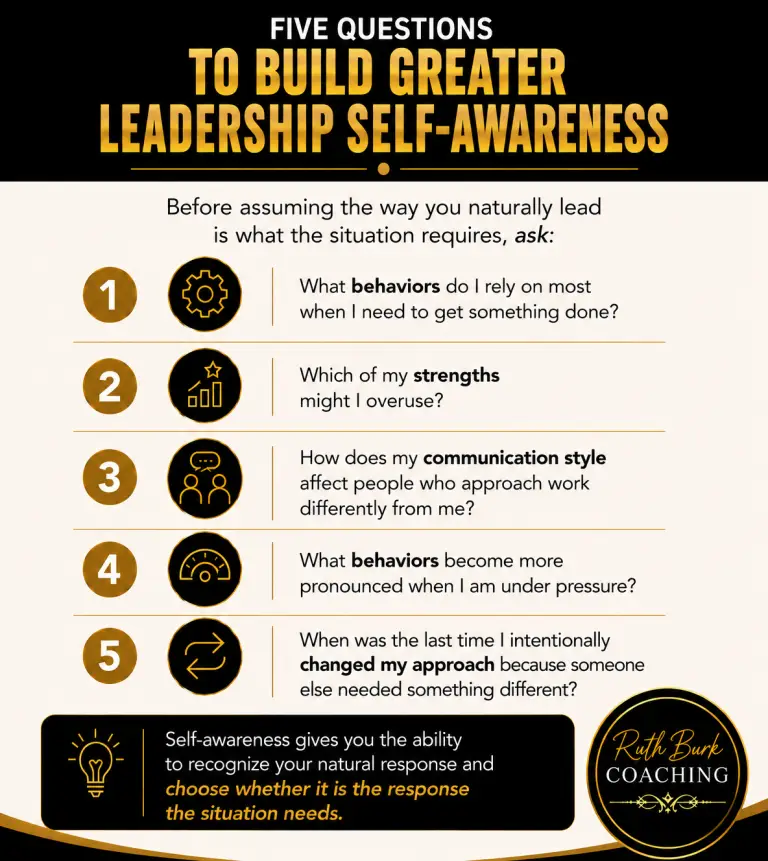
For leadership development, the more valuable conversation begins after the profile appear through reflecting on questions such as:
- Where does this tendency serve me?
- Where might I be overusing it?
- What happens when someone on my team needs something different from me?
Those questions help leaders move beyond understanding their tendencies to recognizing when a different approach may be more effective.
Understanding Your Style Is Only the Starting Point
Recognizing your behavioral tendencies can help explain why certain ways of working feel more natural than others. But the value of that awareness is not simply knowing where you fall on the Everything DiSC® map. It is being able to recognize how those preferences influence your behavior in different situations.
This becomes especially important because many of the tendencies that contribute to a leader’s effectiveness can become less effective when they are overused or applied in the wrong context. The goal is to recognize when the behavior that comes most naturally may not be what the situation requires. For example, a leader who is self-aware he/she naturally moves quickly toward action, might ask:
- Have I given the team enough time to identify risks?
Someone who prioritizes accuracy might ask:
- Do we actually need more information, or am I delaying a decision because I am uncomfortable acting without certainty?
A highly collaborative leader might consider:
- Does this decision require additional input, or does the team need me to make the call?
And someone who prefers harmony might ask:
- Is there a concern I am avoiding because I don’t want to create tension?
In each case, the leader’s natural preference has not changed. What has changed is the leader’s ability to recognize that preference and decide whether it will serve the situation.
That is where understanding your Everything DiSC® style becomes useful: not as a label for how you lead, but as information that gives you greater choice in how you respond.
Your Leadership Style Also Shapes the Team Around You
Over time, teams learn and adapt to the behavioral patterns of the people leading them.
People learn how much detail the leader expects before presenting an idea, how quickly decisions tend to be made, and whether disagreement is genuinely welcomed. They notice whether the leader prefers to talk through possibilities or arrive at the conversation with a clear recommendation. They also learn which approaches tend to receive a positive response and which require more effort to be heard.
Those patterns can gradually influence how the team operates. If a leader consistently rewards speed, people may begin bringing solutions before they have fully considered the risks. If the leader places a high value on precision, team members may hesitate to share ideas that are still developing. A highly collaborative leader may create an environment where people expect extensive involvement in decisions, while a leader who communicates very directly may unintentionally discourage colleagues who are less comfortable challenging ideas in the same way.
This does not mean the leader’s behavioral style is responsible for every team dynamic. Rather, leadership behavior helps establish the conditions to which other people adapt.
That connection is particularly important when thinking about team trust. As I explored in Why High-Performing Teams Start With Trust, the way a leader responds when someone admits a mistake, asks for help, or challenges an idea teaches people something about what is safe to say the next time. Behavioral preferences can influence those interactions in ways a leader may not immediately recognize.
Everything DiSC® gives leaders another lens for examining that impact. Instead of asking only How do I naturally prefer to work?, leaders can begin asking How might the way I naturally work affect people whose preferences are different from mine?
The goal is not to continually adjust to everyone else or abandon the behaviors that contribute to your effectiveness. It is to recognize when your natural approach is helping the team and when greater flexibility could make it easier for other people to contribute their best thinking. In this way, leadership effectiveness depends on what happens when your style meets someone else’s.
Ready to Lead With Greater Self-Awareness?
The way you naturally lead can be one of your greatest strengths, but greater self-awareness can help you recognize when a different approach would better serve the situation, the people involved, or the outcome you are trying to achieve.
As an Everything DiSC® certified practitioner, I integrate the assessment into leadership and team coaching to help leaders better understand their behavioral tendencies, recognize how those tendencies may be experienced by others, and adapt their approach without losing what makes their leadership effective.
If you are ready to better understand your leadership style and expand how you communicate, make decisions, and work with others, schedule a complimentary Clarity Call to explore how coaching can support you.