
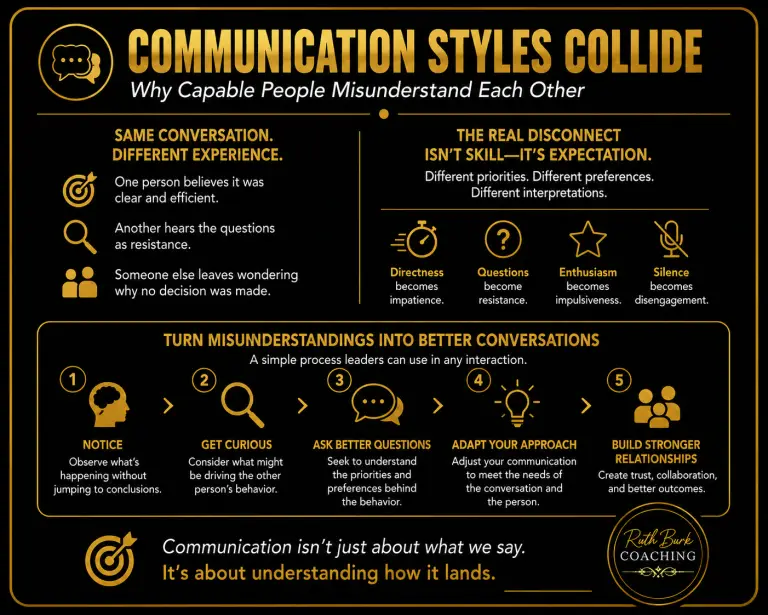
Two capable people can leave the same conversation with very different impressions of what just happened.
A discussion that feels efficient and decisive to a leader may leave a colleague wishing there had been more time to raise concerns. Detailed questions intended to strengthen a proposal may be heard as resistance. What one person experiences as effective communication can feel very different to someone with a different way of processing information and engaging in conversation.
Neither situation necessarily reflects poor communication. The disconnect may be much simpler: people have different expectations about what effective communication looks and sounds like.
People naturally differ in what they need from a conversation. Some prefer directness and brevity, while others want enough context to understand how a conclusion was reached. Some develop their thinking through discussion, while others contribute more effectively after having time to process. Even disagreement can look different: one person may challenge an idea as it emerges, while another may wait until they have considered their concerns more fully.
These differences become more difficult when we begin interpreting them as something more. Directness can be perceived as impatience, questions as resistance, enthusiasm as impulsiveness, or silence as disengagement. What began as a difference in communication preference can quickly become an assumption about the other person’s intentions.
Once that happens, we are no longer responding only to what the person said or did. We are responding to the meaning we have assigned to it, and that meaning may or may not be accurate.
Communication Is About More Than What We Intend
This gap between intention and impact is particularly important for leaders.
Research on self-other agreement has found that leaders’ perceptions of their own behavior do not always align with how others experience them. A meta-analysis published in The Leadership Quarterly found that agreement between leaders’ self-ratings and observer ratings was generally only moderate. The research reinforces an important distinction: what a leader intends to communicate and how others experience that communication are not always the same.
Considering this, when a conversation isn’t going as expected, a more useful question may be:
What might I be assuming this behavior means?
That question creates space between observation and interpretation. It also creates an opportunity to recognize that what appears to be a communication problem may actually reflect differences in behavioral preferences.
Everything DiSC® Helps Make Communication Differences Visible
This is one reason I use Everything DiSC® in leadership and team coaching.
In my article, The Leadership Blind Spot: How Your Natural Style Affects the People Around You, I explored how Everything DiSC® helps leaders recognize their behavioral preferences and consider how those tendencies may be experienced by others. Communication is one of the places where that awareness becomes particularly useful.
Everything DiSC® helps identify differences in the priorities and preferences people bring to their interactions. One person may naturally focus on getting to the point and moving the conversation forward, while another wants to make sure important details have been considered. Someone may engage by talking through possibilities and exchanging ideas, while a colleague may be more comfortable listening, reflecting, and then contributing. These differences influence not only what people communicate, but also the pace, level of detail, and type of interaction they tend to find most productive. Without a way to recognize those differences, it is easy to interpret another person’s behavior according to our own preferences.
Consider a colleague who responds to a proposal by asking several detailed questions. The person presenting the proposal may interpret those questions as opposition and begin defending the idea. But the questions may instead reflect a desire to understand the details, evaluate potential risks, or gather enough information to move forward confidently.
The same dynamic can occur in the other direction. Someone who quickly moves a conversation toward action may be trying to create momentum, while a colleague who prefers more time to consider the implications experiences the pace as pressure. Neither person necessarily intends to create friction. They are approaching the conversation with different priorities.
Everything DiSC® gives people a shared language for making those differences easier to recognize and discuss. Instead of concluding that someone is difficult, overly cautious, impatient, or disengaged, leaders can become more curious about what may be driving the behavior they are seeing. That curiosity creates room for a different kind of conversation. Rather than immediately defending the proposal in response to detailed questions, for example, the leader might ask:
What concerns you most about what you’re seeing?
The answer may reveal a risk that deserves attention, a piece of information that is missing, or simply a different way of evaluating the proposal. Either way, the leader now has more useful information about what the colleague needs from the conversation.
Communication Adaptability Expands a Leader's Range
Recognizing different communication preferences is useful. The greater opportunity is learning how to work effectively across them.
A leader who typically provides extensive context, for example, might lead with the recommendation when speaking with someone who prefers to get quickly to the central issue. Someone who thinks aloud can make it clear when they are exploring possibilities rather than giving direction. A fast decision-maker might share information in advance so colleagues who prefer more processing time can develop their thinking before the discussion. And a leader who tends to communicate disagreement diplomatically may need to state a concern more directly when subtle cues are likely to be missed.
The question is not whether one approach is better than another. It is whether the way you are communicating is helping the person in front of you engage effectively with the conversation.
A useful question becomes:
What does this person need from this conversation that may be different from what I naturally provide?
That might mean more context or less of it. It could mean time to process before responding, an opportunity to think through an idea in conversation, more explicit questions, or greater clarity about whether the discussion is exploratory or a decision has been made.
Adapting in this way does not require leaders to give up the communication strengths that have helped them succeed. A direct communicator can remain direct while providing additional context when it matters. An analytical communicator can continue asking rigorous questions while making the purpose behind them clearer. Someone who values collaboration can invite input while also being explicit about when a decision needs to be made.
The goal is not to replace your natural communication style, but to expand your range. The more approaches available to you, the better able you are to choose the one that fits the person, conversation, and situation in front of you.
Communication Differences Become More Consequential When You Lead
Different communication styles can create friction between any two people, but authority changes the dynamic. People do not necessarily experience communication from someone who controls priorities, resources, performance evaluations, or advancement in the same way they experience communication from a peer.
A senior leader, for example, may think aloud about an idea only to discover that the team has begun acting on it as though a decision had been made. A leader may genuinely welcome disagreement, yet consistently move past concerns before the people raising them have fully explained their thinking. Over time, team members learn from those interactions. They become more selective about when they speak, how they frame concerns, and which ideas they bring forward at all.
Research on employee voice reinforces the importance of these patterns. Studies examining leader behavior, psychological safety, and employees’ willingness to speak up suggest that how leaders respond to questions, ideas, and concerns can influence whether people feel comfortable raising them again. This is also part of how teams build trust. As I explored in Why High-Performing Teams Start With Trust, people learn what is safe through experience. A leader’s response to disagreement, uncertainty, mistakes, or requests for help becomes information the team carries into future conversations.
For that reason, leaders should pay attention not only to individual misunderstandings, but also to patterns in where communication friction occurs. Perhaps you routinely become impatient when someone asks for more information before moving forward. Maybe colleagues have told you they cannot always distinguish between your brainstorming and an actual decision. Or certain team members rarely challenge ideas in meetings but consistently raise concerns afterward.
Patterns like these can reveal where people may be adapting around a leader’s communication preferences, or where differences in behavioral style are preventing useful perspectives from surfacing. A few questions can help uncover what may be happening:
- Which communication behaviors tend to frustrate me most?
- What am I assuming those behaviors mean?
- What might this person be prioritizing that I am not?
- Where might others be adapting to my communication preferences more than I realize?
- What could I do differently to make it easier for this person to contribute?
Communication differences are not simply obstacles for leaders to manage. They can also broaden the thinking available to a team. The colleague who asks for more detail may identify a risk others have overlooked, while the person pushing toward action may recognize when additional discussion is no longer improving the decision. Someone who develops ideas through conversation may surface possibilities that would not otherwise emerge, while a more reflective colleague may notice implications that were missed in the moment.
The value comes from having access to those different perspectives without allowing differences in communication to obscure them. A team may feel easier to navigate when everyone communicates in similar ways, but ease does not necessarily produce better thinking. The leadership opportunity is to make it possible for people to communicate differently and still hear, challenge, and build on one another’s contributions.
Everything DiSC® gives leaders and teams a practical framework for recognizing those differences and becoming more intentional about how they work across them. Greater awareness allows a leader to distinguish between genuine disagreement and differences in approach, question assumptions about what another person’s behavior means, and adapt when a different way of communicating would help someone contribute more effectively.
The goal is not frictionless communication. Some of the most valuable conversations involve disagreement, challenge, and competing perspectives. The goal is to make sure the difficulty comes from the issue worth discussing rather than assumptions about the person discussing it.
Ready to Communicate More Effectively Across Differences?
Effective communication isn’t simply a matter of becoming more articulate or clear. It also requires recognizing that the way you naturally communicate may not be the way another person most easily receives information, contributes ideas, or expresses disagreement.
As an Everything DiSC® certified practitioner, I integrate the assessment into leadership and team coaching to help leaders better understand their communication preferences, recognize where behavioral differences may be creating unnecessary friction, and develop greater flexibility across different people and situations.
If you are ready to better understand how your communication style affects the people around you, schedule a complimentary Clarity Call to explore how coaching can support you.