

By the time a decision reaches a senior leader, the easy answers have often already been eliminated.
What remains may involve protecting an important client relationship without creating a precedent the organization cannot sustain, pursuing an attractive growth opportunity while recognizing that the organization is already operating near capacity, or improving near-term financial performance without weakening a capability the business will need several years from now. Each consideration may be legitimate. The difficulty comes from determining which should carry greater weight when they cannot all be optimized simultaneously.
This is why decision-making changes as leadership responsibility increases. Senior leaders are not simply managing a larger collection of priorities. They are increasingly responsible for resolving tensions among different forms of value, risk, obligation, and consequence across the enterprise. Making those decisions well requires more than identifying what matters. It requires a coherent basis for deciding what should govern when several important things come into conflict.
Senior Leadership Is Increasingly About Trade-Offs
Strategy is often discussed as though its purpose is to eliminate ambiguity: establish the priorities, communicate them clearly, and align the organization around them. But a clear strategy does not eliminate competing demands. In many cases, it makes the trade-offs among them more consequential.
A company committed to growth still has to determine how much operational strain it is willing to accept in pursuit of that growth. An organization investing in innovation has to decide how much uncertainty and inefficiency it will tolerate while new capabilities develop. A company committed to developing future leaders may sometimes need to accept slower execution while someone less experienced develops judgment.
Michael Porter made trade-offs central to his influential Harvard Business Review discussion of strategy. More recent HBR work on making strategic trade-offs examines a related problem: organizations often pursue multiple desirable objectives without being explicit about how much of one they are willing to sacrifice to achieve another.
This is where an apparently clear strategy can still produce inconsistent decisions. An organization can say it is investing for the long term while repeatedly allowing quarterly pressure to determine resource allocation. It can say leadership development matters while senior leaders routinely step in because doing so produces faster results. No single decision necessarily contradicts the strategy, but the accumulation of those decisions can. Strategy becomes visible through the trade-offs leadership repeatedly protects.
The Same Decision Can Be Rational in More Than One Direction
One reason senior decisions resist simple prioritization is that the competing considerations are not always directly comparable.
Consider an executive team evaluating a significant acquisition. The economics may be attractive and the strategic fit compelling. At the same time, integration capacity may be limited, cultural compatibility uncertain, and the leadership team already responsible for another major transformation. The financial, strategic, operational, and organizational cases can all be credible while pointing toward different conclusions.
The executives may not disagree about the facts so much as the weight those facts deserve. One may be focused on economic return, another on future market position, and another on whether the organization can execute without destabilizing existing operations. Senior judgment requires integrating these different forms of reasoning without pretending they can always be reduced to a common denominator.
Time further complicates the decision. Reducing investment can improve near-term financial performance while weakening a capability that will be expensive to rebuild. Carrying additional capacity can look inefficient until demand changes. Conversely, protecting a long-term investment indefinitely can become an excuse for ignoring evidence that its expected value is no longer likely to materialize.
This helps explain why reasonable executives can reach different conclusions from the same information. They may be making the decision against different clocks.
McKinsey’s research on tying short-term decisions to long-term strategy found in a survey of 617 executives and managers that only about half believed their organizations effectively aligned budgets with corporate strategy. The challenge is not simply identifying long-term priorities. It is allowing them to influence decisions when more immediate demands are competing for the same resources.
The Enterprise Has to Absorb the Decision
As leadership responsibility expands, leaders also have to consider where the consequences of a decision actually land.
A major customer may generate attractive revenue while creating disproportionate complexity for operations. A restructuring may achieve an expense target while increasing coordination demands across the remaining organization. Accelerating a transformation may improve the strategic timetable while consuming the attention of leaders simultaneously responsible for running the business.
Each decision can appear rational when evaluated against the objective it was designed to achieve. The enterprise view is different. It requires understanding what the rest of the system must absorb in order for the decision to succeed.
Those costs are not always visible at the level where the decision is made. Complexity may appear several layers lower as additional coordination, exceptions, workarounds, or competing demands. Teams may compensate for an unrealistic timeline by working longer or quietly deferring lower-profile work. For a time, the decision can appear successful precisely because other parts of the organization are absorbing its cost.
This is why capacity belongs inside the strategic decision rather than being treated solely as an execution problem afterward. People, systems, leadership attention, financial resources, and the organization’s ability to absorb change are part of the conditions that determine whether a strategy can create its intended value.
That does not mean leaders should avoid strain. Important strategies sometimes require concentrated effort and temporary imbalance. The distinction is between intentional strain and unexamined overload. In the first, leadership understands what the organization is being asked to absorb and makes corresponding choices about what will be deferred or protected. In the second, the organization itself becomes the mechanism through which leadership avoids making a trade-off.
Decision Criteria Should Expose Judgment, Not Replace It
Decision criteria can help leaders navigate this complexity, but their value is easily misunderstood. The goal is not to create a scorecard sophisticated enough to make the decision automatically.
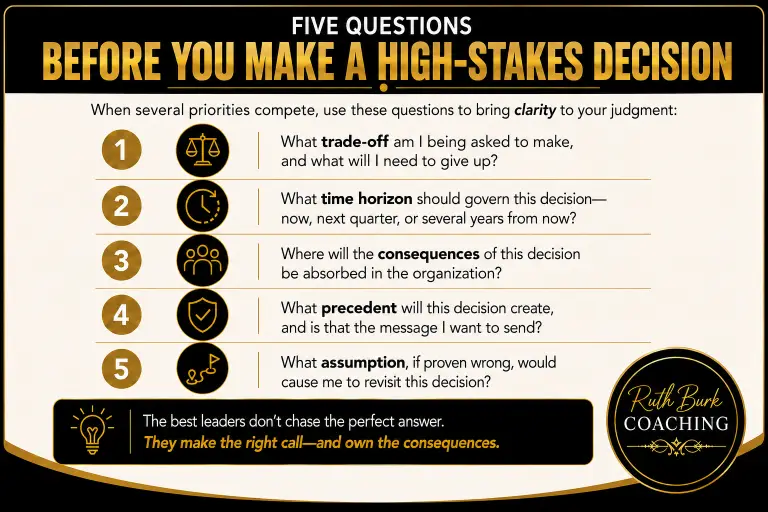
For consequential decisions, criteria are more useful when they expose where executive judgment actually differs. An executive team may initially appear divided over whether to make a major investment. A deeper discussion may reveal broad agreement about the potential upside but very different judgments about what deserves the greatest weight. One leader sees strategic positioning as decisive. Another sees execution capacity as the larger constraint. A third believes preserving financial flexibility is more important given current uncertainty.
Once those differences become visible, the team can examine the actual trade-off rather than continuing to debate competing recommendations. Strategic consequence, enterprise impact, capacity, reversibility, precedent, time horizon, and opportunity cost can provide useful lenses, but they do not produce an answer. They clarify the logic that leadership is using to reach one.
This is one reason decision criteria are central to how I think about leadership judgment. They make assumptions and trade-offs more explicit without pretending that consequential choices can be reduced to an algorithm. Decision criteria do not eliminate judgment. They reveal where judgment is occurring.
Senior Leaders Also Need Space to Examine Their Own Judgment
There is another dimension to consequential decision-making that becomes particularly important at senior levels: the leader is not separate from the decision.
Experience shapes what a leader notices, trusts, discounts, and protects. Someone who successfully navigated a previous downturn may give greater weight to financial resilience. A leader who watched an organization miss an important market shift may be especially sensitive to the cost of waiting. Someone accustomed to stepping into difficult situations may underestimate capacity constraints because they have repeatedly found a way to compensate for them.
These are not necessarily weaknesses. Pattern recognition is part of what makes experienced executives effective. But experience can provide both insight and a lens through which new circumstances are interpreted. McKinsey’s work on behavioral strategy describes how cognitive biases can influence strategic decisions even among experienced leaders and argues for deliberately improving the process through which major judgments are reached.
This is one place where executive coaching can be particularly valuable. The purpose is not for a coach to recommend which strategic option the leader should choose. It is to provide a confidential thinking environment in which the leader can examine the reasoning underneath the choice: assumptions being treated as facts, consequences receiving disproportionate weight, previous experience influencing interpretation, and perspectives that may not yet have been adequately considered.
That is different from most conversations surrounding a senior executive. Board members, colleagues, advisers, employees, and other stakeholders provide essential perspectives, but they also have legitimate relationships to the outcome. Coaching provides room for the leader to examine how they are thinking before their thinking becomes organizational action. The objective is not validation or certainty. It is greater clarity about the judgment the leader is ultimately prepared to make and own.
Pressure and AI Can Both Increase the Need for Judgment
Pressure makes this work harder because immediacy can distort the weight we give different considerations. A customer escalation may pull an important relationship to the foreground, while a missed forecast can intensify concern about near-term financial performance. News of a competitor’s move may create pressure to accelerate a decision that previously called for deliberation. The circumstances deserve attention, but their sudden visibility does not necessarily change their strategic importance.
At the same time, AI is making it possible to bring more analysis into the decision. Leaders can synthesize information, model scenarios, compare alternatives, and challenge assumptions faster than before. These capabilities can improve decision quality, but they do not resolve the underlying question of what deserves greater weight.
As I explored in The Leadership Decisions AI Should Never Make, the increasing availability of analysis does not eliminate leadership responsibility for decisions involving direction, people, values, culture, risk, and long-term consequence. AI may make the trade-off clearer. Someone still has to decide which consequences the organization is prepared to own.
This may make discernment more valuable. As generating information and alternatives becomes easier, senior leadership increasingly depends on understanding what that information means in context and when new information genuinely warrants changing course rather than simply responding to pressure.
Clarity Is Not Certainty
At senior levels, clarity cannot mean certainty. Leaders routinely make decisions without complete information, among legitimate competing interests, with consequences that cannot be fully predicted. Nor can clarity mean eliminating tension. Short-term and long-term performance, innovation and reliability, autonomy and control, and growth and resilience are tensions organizations continually navigate.
Clarity is the ability to understand the logic governing a consequential choice well enough that leadership knows what it is protecting, what it is trading, which assumptions it is relying on, and what consequences it is prepared to accept.
In The Leadership Bottleneck: When Too Many Decisions Depend on You, I explored the question of which decisions genuinely require a senior leader’s involvement and which have simply learned to travel upward. Once a decision genuinely belongs at that level, a different responsibility begins: determining what should govern the judgment.
When everything feels important, better judgment comes from understanding what deserves greater weight when the things that matter come into conflict.
Ready to Strengthen Your Leadership Judgment?
In Clarity Catalyst™, I work with leaders using their actual decisions as the curriculum. The coaching provides a confidential space to examine the competing priorities, assumptions, pressures, and consequences surrounding consequential choices while identifying patterns in how a leader exercises judgment.
The objective is not to tell a leader what decision to make. It is to strengthen the quality and coherence of the thinking behind the decisions only they can make.
The work culminates in a personalized 90-Day Leadership Focus & Direction Plan that translates those insights into decision criteria, leadership priorities, practices, and success indicators. If you are ready to become more deliberate about how you exercise judgment when the answer is not obvious, schedule a complimentary Clarity Call to explore how coaching can support you.