
The holiday season brings a familiar shift in how organizations operate. Employees take time off, schedules become less predictable, and teams work with fewer people available to answer questions, make decisions, or address unexpected problems. For many businesses, the final weeks of the year also bring additional demands as leaders work to complete projects, meet commitments, and prepare for the year ahead.
Some organizations navigate these changes with relatively little disruption. Responsibilities are clear, employees know which decisions they can make, and work continues even when key people are unavailable. Other organizations discover that seemingly routine activities become more complicated when the people who normally keep everything moving are no longer there.
A manager takes vacation, and several decisions remain unresolved until she returns. A founder steps away for a few days but continues receiving messages about matters that should be handled by the team. An employee who usually coordinates communication is absent, and colleagues realize they are unsure who owns certain responsibilities or where important information is located.
These situations may appear to be temporary inconveniences associated with holiday scheduling. But they can reveal something more consequential about how an organization operates throughout the year. For leaders, this creates an opportunity to look beyond whether the organization can manage a few weeks of reduced staffing. It raises a broader question about whether the business has developed the systems, relationships, and decision-making capacity needed to function without relying on the constant availability of particular individuals.
When Normal Operations Depend on Someone Always Being Available
In many organizations, work moves forward because experienced people know how to keep it moving. They understand which priorities matter most, who needs to be involved in particular decisions, where information can be found, and how to resolve problems when responsibilities become unclear.
Much of this knowledge develops naturally over time. A founder remembers why a certain customer agreement was structured differently. A manager knows which team members need to coordinate before a project can proceed. An experienced employee understands the informal steps required to complete a process that has never been fully documented.
These capabilities are valuable. They reflect experience, organizational knowledge, and the relationships people have developed through their work. The difficulty emerges when essential operations depend on that knowledge remaining concentrated in a few individuals.
As long as those people are available, the arrangement may appear to work well. Questions are answered, exceptions are resolved, and employees know whom to contact when something unexpected happens. The organization continues producing results, which can make the underlying dependence difficult to recognize.
Holiday absences interrupt that pattern.
When the person who normally provides answers is unavailable, the organization must rely on the knowledge, authority, and processes that exist beyond that individual. If those foundations are weak, work may slow down or stop altogether.
Consider a small business whose founder personally approves most customer exceptions. During the year, employees have become accustomed to asking her whenever a situation falls outside established procedures. The founder responds quickly, so the process rarely causes significant delays.
But when she takes a week off, employees begin postponing decisions, contacting her during vacation, or making inconsistent judgments because they are unsure what authority they have. The problem is not necessarily that the founder took time away. It is that the business has not developed a reliable way to handle those decisions without her.
The same pattern can occur in larger organizations, where dependence may be concentrated around managers, technical specialists, project coordinators, or other experienced employees.
The holiday season simply makes that dependence more visible.
What Happens When the Person Who Holds Everything Together Steps Away?
One of the less obvious forms of organizational dependence involves the people who maintain coordination across a team.
These individuals may not hold the most senior positions, but they often carry substantial responsibility for keeping work connected. They remember commitments, anticipate scheduling conflicts, follow up on unresolved questions, and notice when communication has broken down.
Their contributions may be difficult to measure because much of their work prevents problems rather than producing a clearly identifiable deliverable. When they are present, meetings happen, information reaches the right people, and potential issues are addressed before they become disruptive. Because the work continues, colleagues may not fully recognize how much coordination is taking place.
Their absence can reveal the extent of that contribution.
A team may discover that nobody knows whether a particular decision was finalized. Two departments may proceed with different assumptions because the person who usually connects their work is unavailable. A project may stall because an employee who routinely follows up on outstanding responsibilities is no longer there to do so.
These situations are not necessarily evidence that employees are unwilling or incapable of taking responsibility. They may reflect an organizational pattern in which coordination has become attached to a person rather than supported by shared expectations and practices.
When leaders respond to these disruptions by asking the same person to remain available, check messages during vacation, or prepare increasingly detailed instructions before leaving, they may solve the immediate scheduling problem without addressing the underlying dependency.
A more useful question is why the organization requires that person’s ongoing intervention in the first place.
What information is not accessible to others? Which responsibilities remain unclear? What decisions require informal coordination because no shared process exists? Where have employees become accustomed to relying on someone’s personal follow-through rather than a collective understanding of accountability?
These questions move the discussion beyond individual availability and toward the conditions that support effective teamwork.
Delegating Work Is Not the Same as Distributing Judgment
Holiday coverage often begins with a practical exercise: identifying who will handle each person’s responsibilities while they are away. A manager assigns customer accounts to a colleague. A project lead designates someone to monitor progress. A founder identifies an employee who will oversee daily operations.
These arrangements can be helpful, but assigning responsibility does not necessarily give someone the information or authority required to exercise it.
An employee may be responsible for responding to customers but lack the authority to approve reasonable exceptions. A manager may be asked to oversee a project without knowing which trade-offs can be made independently. A colleague may be responsible for maintaining operations but have no clear guidance about which issues require escalation.
In each case, the work has been assigned, but the judgment needed to carry it out remains elsewhere.
I explored this distinction in How Business Systems Help Teams Make Better Decisions Without Relying on the Founder. Delegating work does not automatically distribute the decision-making criteria, authority, or organizational knowledge needed to complete it independently. Unless those elements become part of how the business operates, important decisions may continue returning to the same individuals.
Research from McKinsey supports this concern. In its article For Smarter Decisions, Empower Your Employees, the firm examines why delegated decisions frequently return to managers despite efforts to distribute responsibility. Its analysis emphasizes that effective delegation requires clear decision authority, employee capability development, and appropriate managerial guidance. Simply telling people which decisions they can make is not sufficient.
This distinction is important because organizational independence requires more than distributing tasks. People need to understand the purpose behind decisions, the boundaries within which they can act, and the circumstances that warrant involving someone else.
Consider a manager covering for a colleague during the holidays. A customer requests a change that will affect both the delivery timeline and the project’s profitability. If the manager understands the organization’s priorities, financial boundaries, and customer commitments, she may be able to evaluate the trade-offs and make an appropriate recommendation or decision. If those expectations have never been clarified, she may have little choice but to postpone the issue or contact the person who is away.
The difference is not simply confidence. It is whether the organization has equipped the manager to exercise sound judgment.
This is also why developing team capability requires more than encouraging employees to be proactive. Leaders must consider whether employees have the context, decision rights, and support needed to take meaningful ownership. When those conditions are absent, dependence can persist even among highly capable people.
The Business Systems That Only Become Visible When They Fail
The holiday season can also reveal how much of an organization’s operations depend on informal processes.
Many businesses develop ways of working that are understood by experienced employees but rarely documented or examined. Information may be stored in individual inboxes, customer histories may reside primarily in someone’s memory, and routine decisions may depend on conversations that happen outside established workflows.
These arrangements are not always problematic. Smaller organizations, in particular, often rely on flexibility and direct communication to operate efficiently. But as a business grows, informal practices can become difficult to sustain.
When employees take time off, others may discover that they cannot access necessary information, do not understand the steps required to complete a process, or are unsure who is responsible for resolving exceptions. The immediate temptation may be to document everything.
Documentation can certainly help, but it is not always the complete solution. A detailed procedure cannot resolve unclear decision rights, competing priorities, or an expectation that one person must approve every meaningful departure from routine.
The more useful approach is to identify where the organization genuinely requires greater structure.
Which processes need to be consistent? Where does information need to be shared? Which decisions can be made closer to the work? What situations require escalation, and to whom?
The goal is not to eliminate flexibility or create a procedure for every possible circumstance. It is to establish enough clarity that employees can respond appropriately when familiar conditions change. A well-functioning system should support people in doing their work, not require them to continually compensate for what the system leaves unresolved.
What Holiday Absences Reveal About Team Relationships
Not every disruption is caused by a missing process or unclear decision authority. Sometimes the underlying issue is how people communicate and work together.
A team may rely on a particular manager to resolve disagreements because employees have not developed effective ways to address differences directly. Two departments may depend on one person to translate priorities or reconcile competing expectations. Employees may avoid raising concerns until a trusted leader is available to facilitate the conversation.
When that person takes time away, coordination becomes more difficult.
These patterns can be especially challenging to recognize because the leader’s involvement often produces positive outcomes. Disagreements are resolved, relationships remain functional, and projects continue moving.
But if the team cannot navigate ordinary differences without that person’s intervention, its effectiveness may depend more heavily on individual relationship management than anyone realizes. This is where leadership development and team effectiveness intersect.
Strong teams need more than positive relationships. They need shared expectations about communication, constructive disagreement, decision-making, and accountability. Employees should understand how to raise concerns, who needs to participate in particular decisions, and what happens when people disagree about priorities.
As I discussed in How Team Accountability Turns Commitment Into Consistent Action, team accountability becomes stronger when colleagues can address commitments, concerns, and ordinary coordination problems directly rather than relying on the leader to manage every conversation. Holiday absences can reveal whether those practices have become part of how the team works or remain dependent on one person’s involvement.
These practices do not eliminate the need for leadership involvement. Some situations genuinely require a manager’s authority or perspective, particularly when significant power differences, ethical concerns, or serious performance issues are involved. They do, however, reduce the likelihood that every uncertainty or disagreement must travel through the same individual.
A team that can communicate directly, work through appropriate disagreements, and maintain shared commitments is better equipped to operate when its leader is temporarily unavailable.
Using the Holidays as a Leadership Assessment
Rather than viewing holiday absences only as a scheduling challenge, leaders can use them as an opportunity to examine how their organizations function. This does not require deliberately withholding support or treating employees’ vacations as a test. Nor should leaders expect every operation to continue at its usual pace when staffing is intentionally reduced.
The value lies in observing which disruptions reflect expected capacity limitations and which reveal dependencies that exist throughout the year. A few questions can help guide that reflection:
Which decisions consistently wait for a particular person, and why?
Where do employees lack the information or authority needed to act?
Which responsibilities are understood by only one or two people?
What communication or coordination breaks down when someone is unavailable?
Where does work continue effectively because expectations and decision boundaries are clear?
What would make the organization better prepared for the next planned or unexpected absence?
These questions are useful beyond the holiday season. They can inform conversations about leadership development, succession planning, operational improvement, and team accountability. They can also reveal strengths worth reinforcing.
Perhaps employees successfully handled unfamiliar situations because they understood the organization’s priorities. Maybe a team maintained progress through clear communication and shared responsibility. A manager may have demonstrated stronger judgment than the leader previously recognized. These outcomes provide valuable information about where capability has developed and where additional responsibility might appropriately be distributed. The purpose is to understand what the organization has learned about its own ability to function.
A practical starting point is to identify one decision, one process, and one coordination responsibility that currently depend on a particular person. For each, consider what would need to change for someone else to manage it appropriately. The answer might involve clearer authority, better access to information, stronger communication practices, or additional coaching.
Not every dependency needs to be eliminated. The priority is to recognize which ones are necessary and which ones unnecessarily limit the organization’s capacity.
Building an Organization That Can Sustain Its Own Momentum
The ability to function when circumstances change is an important dimension of organizational resilience. In its article Building Organizational Resilience, McKinsey identifies self-sufficient teams, distributed decision-making, and adaptable leadership among the capabilities that help organizations respond to disruption.
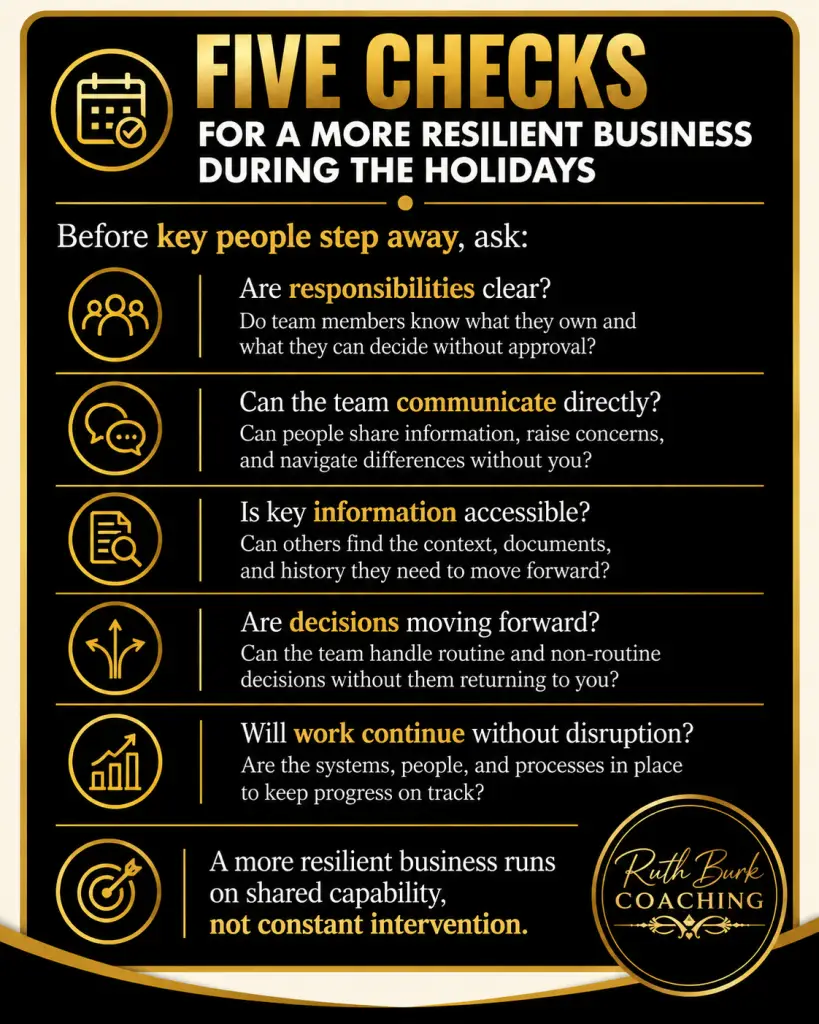
Although holiday absences are generally planned, they offer an opportunity to examine whether these capabilities exist in everyday operations. Can employees make appropriate decisions without waiting for approval? Can teams coordinate responsibilities when familiar people are unavailable? Do established systems support continued progress, or does the organization depend on individuals stepping in to keep everything moving?
These questions point to an important distinction: organizational resilience is not simply about how effectively leaders respond when problems arise. It also depends on the capabilities and working practices they develop before those problems occur.
The Slow Power Leadership Framework® provides a way to examine these conditions through three interconnected disciplines:
Clarity focuses on how responsibilities, priorities, and decision-making authority are established. When employees understand what they own and the boundaries within which they can act, they are better equipped to exercise judgment without constant approval.
Connection addresses the relationships and communication practices that support effective coordination. Teams that can share information, navigate disagreements, and maintain accountability are less dependent on a single person to keep their work aligned.
Conscious Momentum™ focuses on creating the conditions for sustainable progress. Rather than relying on repeated intervention from a few highly capable individuals, organizations develop the shared practices, follow-through, and team capability needed to keep work moving.
These disciplines reinforce one another. Clear authority is less effective without communication and coordination. Strong relationships cannot compensate indefinitely for unclear responsibilities. And sustainable progress becomes difficult when employees must continually seek direction before acting.
The objective is not to make leaders unnecessary or eliminate every dependency. It is to strengthen the organization’s capacity to operate effectively without requiring their constant involvement in decisions and activities that others could reasonably manage.
Ready to Strengthen the Systems and Teams Behind Your Business?
When a business depends on a few people to keep everything moving, growth can create new demands without strengthening the systems and capabilities needed to support it.
Through systems business coaching, leadership development, and team coaching, I work with founders and organizational leaders to clarify responsibilities, strengthen decision-making, improve how teams work together, and build more sustainable ways of operating. If you are ready to strengthen your systems while building greater capacity around you, schedule a complimentary Clarity Call.