
As the year draws to a close, you may already be thinking about what you want to accomplish next. Perhaps you’re considering new opportunities for your business, identifying priorities for your team, or reflecting on the professional and personal changes you’d like to make. The process often begins with familiar questions about what needs to improve, what you want to accomplish, and how you’ll measure success.
There is no shortage of goal-setting frameworks available to leaders, from SMART and SMARTER goals to OKRs. Each offers a structured approach to defining objectives and measuring progress. SMART goals emphasize specificity, measurability, achievability, relevance, and time-bound commitments. SMARTER variations add elements such as evaluation and revision, while OKRs connect objectives to measurable key results. Together, these approaches help translate intentions into concrete goals and actions.
Yet even a well-structured goal can fail to produce the progress you actually need. You might achieve a revenue target while becoming more involved in daily operations than ever before. You might successfully complete several strategic initiatives while your team becomes increasingly dependent on your decisions. Or you might pursue a promotion, only to discover that the next level of responsibility does not support the professional life you want to build.
These possibilities raise a question that goal-setting frameworks do not necessarily resolve: What if the difficulty is not how you structure your goals, but how you determine which goals deserve your commitment in the first place?
The Difference Between a Well-Written Goal and the Right Goal
Goal-setting frameworks are useful because they help transform broad intentions into specific commitments. A statement such as “I want to become a better leader” provides little guidance about what needs to change. A goal focused on improving delegation, strengthening team communication, or developing managers offers a clearer direction for action.
But specificity does not establish whether a goal is appropriate. You can define a measurable outcome, create a realistic timeline, and establish a detailed action plan without examining why that outcome matters or whether it addresses the underlying challenge.
Consider a business owner who enters the new year determined to increase revenue by 25 percent. She establishes quarterly targets, identifies new marketing activities, and develops a sales pipeline to support the objective. Her goal meets the usual criteria for a well-structured business goal.
What remains unexplored is whether additional revenue will resolve the problems she is experiencing. Her business may already be generating substantial sales, but profitability is inconsistent, employees depend on her for routine decisions, and customer delivery requires more of her personal involvement as demand increases. Increasing revenue without addressing these conditions could make the business more demanding rather than more sustainable.
The revenue goal is not necessarily wrong. It may be important to the company’s future, but it exists within a larger business context that deserves examination. The business owner may need to clarify whether her immediate priority is growth, profitability, operational capacity, or some combination of the three.
You may recognize a similar tension in your own goals. Perhaps you’ve identified an outcome that seems important, but you haven’t fully considered what achieving it will require or whether it will resolve the challenge you’re trying to address. A coaching conversation can help you explore that distinction before committing to a particular target.
Rather than beginning with how to increase revenue, for example, the conversation might begin with what you want your business to be capable of doing differently by the end of the year. The resulting goal may still involve growth, but it may also include strengthening business systems, developing team capability, or reducing the number of decisions that require your direct involvement.
Why Achieving More Does Not Always Mean Making Progress
Leaders are often evaluated by their ability to accomplish objectives. Completing projects, reaching performance targets, and delivering results are visible indicators of effectiveness. Over time, this can create a pattern in which progress becomes associated primarily with producing more outcomes.
The difficulty is that achievement and progress are related but not interchangeable. You may accomplish several goals while continuing to experience the same underlying challenges. In some cases, the way you achieve those goals may reinforce the very conditions you’re trying to change.
Imagine a department director who wants to improve her team’s performance. She establishes ambitious targets, increases the frequency of progress meetings, and becomes more involved in reviewing deliverables. By the end of the quarter, the team has met its objectives.
From a performance perspective, the initiative appears successful. But employees now rely on the director to resolve more problems, review more decisions, and coordinate more activities. The team has produced stronger short-term results without necessarily developing greater independence or capability.
If the director’s broader intention was to build a more effective team, the outcome deserves a closer look. The performance target was achieved, but the team may be less prepared to sustain that performance without her involvement.
This distinction is especially relevant if you’ve become accustomed to compensating for unclear responsibilities, weak systems, or gaps in team capability through your own effort. Setting increasingly ambitious goals can unintentionally reinforce that pattern when your approach to achieving them remains unchanged.
A more useful evaluation considers not only what you accomplished, but also what became stronger as a result. Did your organization develop greater capability? Were responsibilities clarified, decisions distributed appropriately, or working relationships strengthened? Can progress continue without the same level of your involvement?
These questions shift the focus from completing objectives to developing the conditions that support continued progress.
The Hidden Commitments That Compete With Our Goals
Sometimes you know what you want to accomplish but find yourself struggling to act consistently toward it. You may repeatedly postpone an important initiative, return to responsibilities you intended to delegate, or make decisions that conflict with your stated priorities. When this happens, it’s easy to assume that you need greater discipline, accountability, or motivation.
Those explanations may occasionally be appropriate, but they do not always capture what is happening. A goal can compete with other commitments that are equally important to you, even when you haven’t consciously recognized them.
You may want to delegate more responsibility while also believing that maintaining high quality requires your personal oversight. You may want to establish stronger boundaries while worrying that reduced availability will be interpreted as a lack of commitment. Or you may want to pursue a different career direction while feeling reluctant to leave behind the identity and recognition you’ve developed.
In each situation, the difficulty involves more than executing an action plan. You’re navigating competing priorities, assumptions, expectations, and sometimes deeply established beliefs about what responsible leadership requires.
Robert Kegan and Lisa Lahey explore this dynamic in their Harvard Business Review article, The Real Reason People Won’t Change. Their work examines how commitments that operate beneath a stated goal can interfere with efforts to change, even when someone genuinely wants a different outcome. The underlying issue may not be a lack of intention, but a conflict between the desired change and another commitment the person is trying to protect.
Coaching provides space to examine these tensions without immediately treating them as problems to solve. Your coach might ask what you believe could happen if you changed your behavior, what you’re trying to preserve, or what assumptions you’re making about the consequences of acting differently.
These conversations can reveal why a goal that appears straightforward on paper has been difficult to pursue. They can also help you determine whether the goal itself needs to change or whether your understanding of what it will require needs to become more complete.
What Coaching Adds That Goal-Setting Frameworks Cannot Provide Alone
A goal-setting framework helps organize a commitment once you’ve identified the desired outcome. Coaching works at a different level by helping you examine your thinking, explore possibilities, and develop greater clarity about what you want to accomplish and why.
This distinction is important because coaching is not simply a process of helping you complete a predetermined list of tasks. You remain responsible for determining your goals and choices, while your coach supports the thinking, awareness, and learning that allow those choices to become more intentional.
Clarifying What You Actually Want
You may begin the goal-setting process with objectives that reflect what you believe you should accomplish. Perhaps continued expansion seems like the next logical step for your business, or pursuing a promotion feels like the expected progression of your career.
Coaching can help you distinguish between an externally reinforced expectation and an outcome you genuinely want to pursue. Questions about meaning, values, priorities, and desired impact can reveal whether your proposed goal reflects your current aspirations or a direction you’ve continued following without reconsideration.
This doesn’t mean coaching encourages you to abandon ambitious goals. It helps you understand the reasons behind those ambitions and make more deliberate choices about where to invest your effort.
Examining the Conditions Surrounding Your Goal
Your goals do not exist independently of the systems, relationships, and responsibilities that shape your daily work. If you want to spend more time on strategic planning, you may discover that unclear decision authority continually pulls you back into operational issues. If you want to improve team accountability, you may recognize that employees don’t share the same understanding of ownership or expectations.
A coaching conversation can help you examine what contributes to these patterns. Rather than assuming that the solution is better time management or stronger follow-through, you can consider whether the conditions surrounding your goal need to change.
This often leads to a more meaningful understanding of the work required. Your objective is no longer simply to reserve time for strategic planning, but to strengthen the decision-making practices that make that time possible.
Translating Insight Into Meaningful Action
Awareness alone does not produce change. Once you’ve clarified your goal and explored the conditions affecting it, you need opportunities to experiment with new behaviors, evaluate results, and make adjustments.
Coaching can support this process by helping you identify actions that are specific enough to practice and meaningful enough to influence the desired outcome. Instead of committing broadly to “becoming a more effective delegator,” you might identify one recurring decision that can appropriately move to a team member and clarify the authority and support needed to make that change successful.
Your next coaching conversation can explore what happened. Did the employee understand the decision boundaries? Did you intervene unnecessarily, and what prompted that response? What did you both learn about the conditions required for greater independence?
These reflections create a cycle of learning rather than a simple assessment of whether a task was completed. Over time, you can develop new practices while refining your understanding of what effective leadership requires.
When Goals Become Another Source of Pressure
As you prepare for a new year, you may find yourself considering an expanding collection of objectives. Business growth, professional development, team performance, financial targets, and personal priorities can all compete for your attention. Each goal may be worthwhile, but collectively they can create expectations that exceed your available capacity.
The result can be a familiar pattern. You begin with enthusiasm, encounter competing demands, and respond by working harder or extending your availability. When progress becomes inconsistent, you may interpret the difficulty as a failure of discipline rather than a signal that your commitments need to be reconsidered.
Research on goal setting, including the work of Edwin Locke and Gary Latham, has demonstrated that specific, challenging goals can support performance under appropriate conditions. In their 2002 article, Building a Practically Useful Theory of Goal Setting and Task Motivation: A 35-Year Odyssey, published in American Psychologist, they examine decades of goal-setting research, including the mechanisms through which goals influence performance and the conditions that affect their effectiveness. Their work recognizes the importance of factors such as commitment, feedback, ability, and task complexity.
This is an important consideration if you already carry substantial responsibility. Adding more objectives does not necessarily increase your effectiveness, particularly when those goals compete for the same limited time, attention, or organizational resources.
Coaching can help you make decisions about what you will not pursue, at least for now. These choices may be as important as identifying new priorities because they establish the capacity needed to make meaningful progress.
You may identify three important goals and discover that one requires sustained attention before the others can realistically advance. Choosing to sequence those commitments is not necessarily a reduction in ambition. It may be a more strategic way to protect the attention and resources required for success.
Goal Setting Through the Slow Power Leadership Framework®
My Slow Power Leadership Framework® offers another way to examine the relationship between goals and sustainable progress. Its three disciplines, Clarity, Connection, and Conscious Momentum™, encourage you to consider not only what you want to accomplish, but also the conditions that will allow progress to continue.
Clarity: Choosing What Deserves Your Attention
Clarity begins with understanding what matters most and why. Before establishing a new objective, consider the problem you’re trying to address, the outcome you want to create, and the competing priorities that may influence your choices.
A useful question is: If I achieve this goal, what will actually be different? Your answer can reveal whether the proposed goal addresses the underlying need or simply provides another measurable activity.
Connection: Understanding Who and What the Goal Involves
Meaningful goals often depend on relationships, shared expectations, and the contributions of others. If you’re a founder, you cannot strengthen team accountability solely by changing your own task list. If you’re a senior leader, improving cross-functional collaboration requires considering how people communicate and make decisions together.
Connection invites you to examine who needs to be involved, what expectations require clarification, and how your goal may affect the people responsible for carrying it forward. This helps prevent goals from becoming individual commitments that depend on others without their understanding or ownership.
Conscious Momentum™: Creating Progress That Can Be Sustained
Conscious Momentum™ focuses on whether progress can continue without requiring your constant intervention or repeated extraordinary effort. You may achieve a goal through intense short-term activity, but the result can be difficult to sustain if the underlying practices remain unchanged.
This discipline encourages you to consider what capabilities, systems, and habits need to develop alongside your desired outcome. The question becomes not only whether you can reach the goal, but whether the way you pursue it strengthens you, your team, or your organization for what comes next.
I explored a related challenge in my previous Slow Power Journal article, What the Holidays Reveal About How Your Business Really Runs. When a founder or key leader steps away, the resulting disruptions can reveal whether progress depends on established systems and shared capabilities or on the continual availability of particular individuals. Those same dependencies deserve consideration when you establish goals for growth, delegation, and organizational effectiveness.
Together, these disciplines create a broader perspective on goal setting. Clarity helps you determine what deserves commitment, Connection examines the relationships and responsibilities involved, and Conscious Momentum™ considers what will allow your progress to endure.
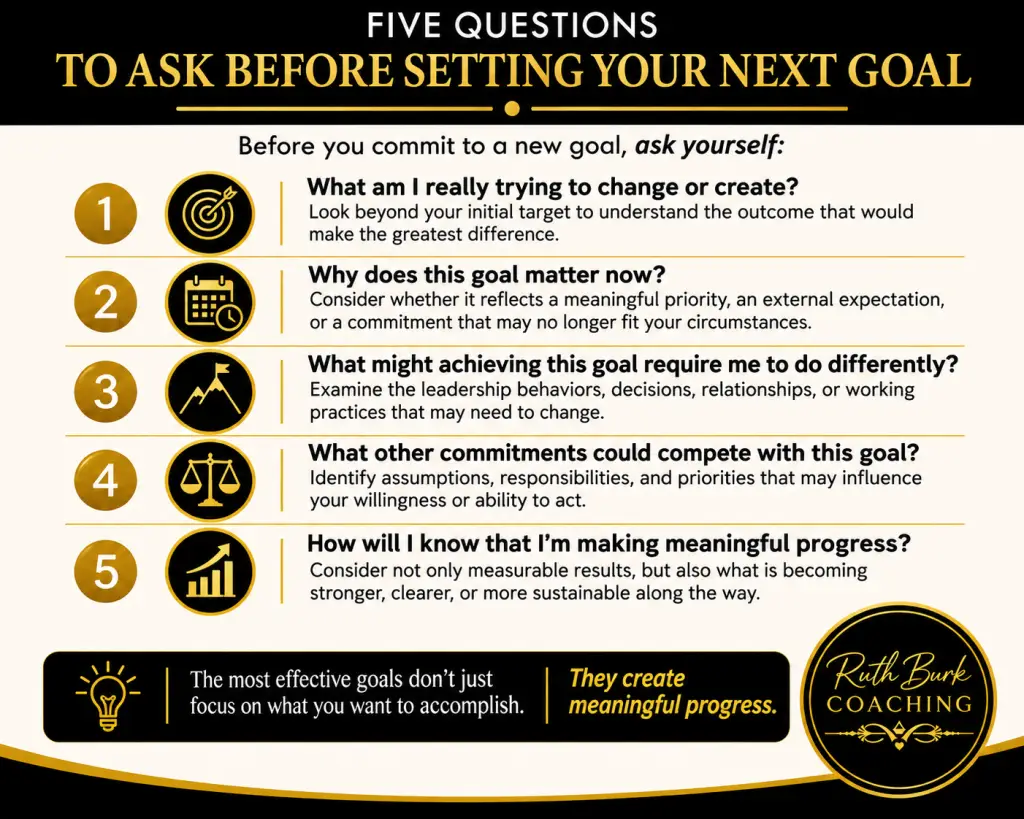
Ready to Approach Your Next Goals With Greater Clarity?
I work with women founders, senior leaders, and organizations to explore the goals, decisions, and leadership practices that shape meaningful progress. Through leadership and business coaching grounded in the Slow Power Leadership Framework®, we examine what matters most, identify what may be limiting progress, and develop intentional approaches to change.
If you’re preparing for the year ahead and want to move beyond setting goals toward creating meaningful, sustainable progress, schedule a complimentary Clarity Call to explore how coaching can support you.