
A team can leave a meeting appearing to agree on a decision and still not be committed to it.
Everyone nods. No one raises another objection. The meeting ends, and the leader assumes the team is ready to move forward. Yet days later, the same decision resurfaces. People interpret the direction differently, execution begins unevenly, or conversations continue privately about whether the team made the right choice. The problem is not always disagreement, but rather the absence of genuine commitment.
In Why Healthy Teams Don’t Avoid Conflict, I explored why productive disagreement strengthens decision-making. Healthy teams are willing to question assumptions, raise concerns, and work through different perspectives before making an important decision. That ability matters because commitment becomes much more difficult when people believe their concerns were never heard or the real disagreement was never addressed.
But productive conflict is not the destination. Eventually, teams have to commit to a decision. That transition from discussion to action is where many otherwise capable teams struggle.
Commitment Does Not Mean Everyone Gets Their Preferred Outcome
Leaders often pursue complete agreement because it feels like the safest path to alignment. If everyone supports the same option, the assumption is that everyone will be committed to carrying it forward.
There is evidence that consensus can contribute to commitment. A Journal of Management study of 68 intact strategic decision-making teams found that greater consensus was associated with stronger commitment to strategic decisions and that commitment, in turn, positively influenced implementation success. The study also produced an interesting qualification: stronger commitment did not necessarily mean faster implementation.
That research is important because it cautions against treating consensus as inherently undesirable. Agreement can be valuable. But agreement and commitment are not identical.
Within The Five Behaviors®, commitment builds on the productive conflict that precedes it. Team members need the opportunity to weigh in, surface different perspectives, and understand what the team is deciding. The objective is not necessarily for every person to prefer the same course of action. It is for the team to reach enough clarity and buy-in to support the decision once it has been made.
For leadership teams, that distinction matters.
A CFO may prefer a more conservative investment. An operations leader may question the proposed timeline. A program director may see implications others have overlooked. Those perspectives should be heard because they may improve the decision. But there comes a point when discussion has served its purpose. The question becomes, Can everyone support the decision the team has made and help execute it successfully?
Being Heard Influences Commitment
Buy-in begins before the decision is announced.
Research published in the Academy of Management Journal provides particularly useful evidence for this relationship. Intact management teams were examined to understand how decision-making procedures influenced commitment, attachment to the group, and trust in the leader. Their findings showed that consideration of team members’ input and their influence in the decision-making process affected perceptions of procedural fairness, which in turn influenced commitment to the decision, attachment to the team, and trust in its leader.
That distinction has important implications for leaders.
People do not necessarily have to get their preferred outcome to remain committed to a decision. But the process through which the decision is made matters. When relevant perspectives are genuinely considered, people have greater reason to believe the decision-making process was fair, even when the final choice differs from the one they advocated.
This does not mean every decision should become democratic. Leadership teams still need clarity about who has input, who makes the decision, and where decision authority ultimately rests. However, having a voice and having the final say are different things. Strong leaders make room for the first without creating ambiguity about the second.
Productive Conflict Can Strengthen What Happens After the Decision
The relationship between conflict and commitment is more nuanced than simply encouraging teams to disagree more.
Research published in The Leadership Quarterly examined how leadership behavior and different forms of conflict affected team members’ commitment to team-generated decisions. The researchers distinguished potentially productive task conflict, where people debate ideas and alternatives, from dysfunctional forms of conflict that can undermine the team’s ability to move forward. Their findings reinforce an important point: the way a team disagrees influences what happens after the disagreement ends.
A team that challenges assumptions, evaluates alternatives, and questions ideas is doing something very different from a team in which disagreement becomes personal, defensive, or relationally destructive. The researchers found that pragmatic leader behavior was associated with greater commitment by restraining dysfunctional forms of conflict during decision-making.
That places an important responsibility on leaders.
Creating space for productive conflict does not mean allowing a discussion to continue indefinitely or permitting disagreement to become personal. Leaders need to help teams examine the issue thoroughly while keeping the conversation focused on the work. Then they need to help the team move from debate to decision.
Clarity Turns Decisions Into Action
Buy-in is only part of commitment. The other part is clarity.
A leadership team can genuinely support a decision and still execute it poorly when people leave the room with different interpretations of what was decided, what happens next, who owns the work, or what should be communicated to the rest of the organization. This is where commitment connects directly to organizational execution.
As I explored in How Business Systems Help Teams Make Better Decisions Without Relying on the Founder, strong teams need more than permission to make decisions. They need clear priorities, decision rights, ownership, and expectations that allow those decisions to move through the organization without continually returning to the founder or senior leader.
Research on strategic decision-making reinforces the connection between commitment and what happens after the meeting. The Journal of Management study found that commitment to a strategic decision positively affected implementation success.
For leaders, that means the last few minutes of an important meeting may be as consequential as the discussion that preceded them.
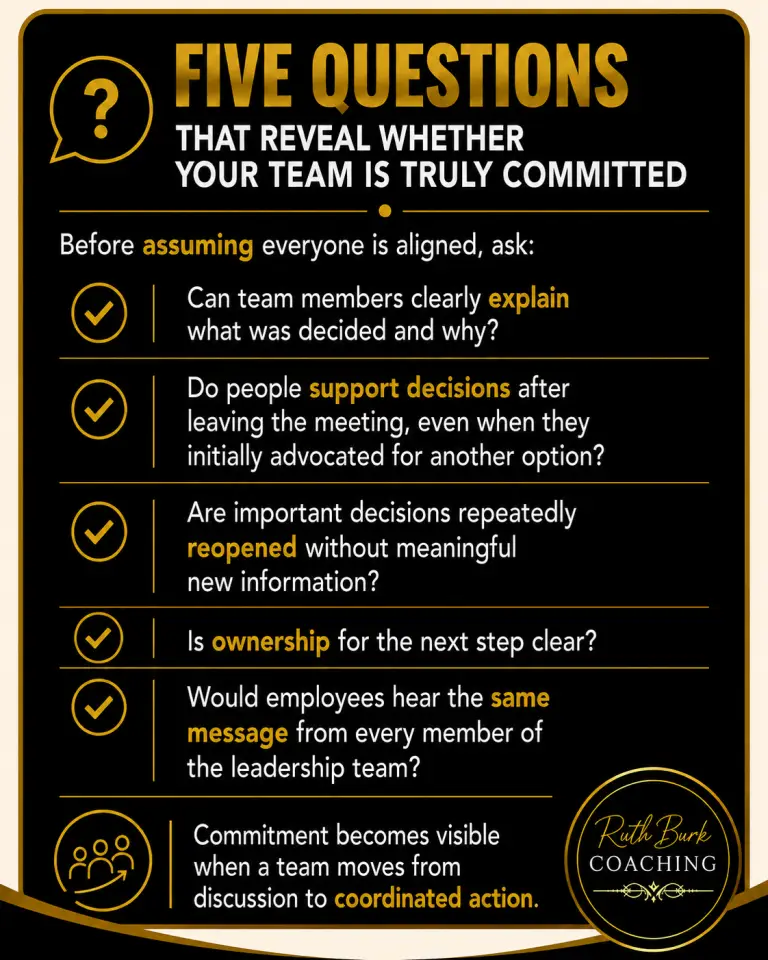
Before people leave, everyone should be able to answer the same basic questions:
- What did we decide?
- Why did we decide it?
- What happens next?
- Who owns it?
- What will we communicate to everyone else?
A decision that means something different to five people is not yet a clear decision.
Repeatedly Revisiting Decisions Has a Cost
There are times when a team should reconsider a decision. New information emerges. Market conditions change. An assumption proves incorrect. A strategy that made sense three months ago no longer fits the environment. Adaptability is not a lack of commitment, but repeatedly reopening decisions because the team never fully worked through the disagreement or established clarity in the first place is something different.
When that becomes a pattern, execution slows. Employees receive inconsistent messages, and priorities become less clear. People may begin waiting to see whether a decision will “stick” before investing significant effort in implementing it.
For founder-led businesses and smaller organizations, there is another consequence: unresolved decisions often return to the founder, CEO, or executive director. The leader becomes responsible for clarifying what the team supposedly already decided, resolving competing interpretations, and pushing execution forward. Instead of increasing leadership capacity, the team reinforces dependence on the person at the top.
That is not simply a meeting problem. It is an organizational capacity problem.
Commitment Requires Leaders to Tolerate Continued Disagreement
There is also an emotional dimension to commitment that deserves attention.
Leaders may say they want honest input, but what happens when someone actually disagrees with them? Do they become defensive? Keep arguing until the other person concedes? Interpret questions as resistance? Or can they allow the team to explore another perspective without needing everyone to arrive at the same conclusion?
This is where emotional intelligence intersects with team effectiveness.
As I explored in The Leadership Behaviors That Emotional Intelligence Makes Possible, emotionally intelligent leaders remain curious during disagreement, listen before responding, and challenge their own assumptions. Those behaviors help create an environment in which people can contribute honestly without believing they must agree with the leader to remain influential.
Leaders also have to tolerate something that can feel uncomfortable: a team member may still disagree after the decision has been made.
Commitment does not necessarily require changing that person’s mind. It requires creating a decision-making process strong enough that people can say, in effect, That wasn’t my preferred choice, but my perspective was considered, I understand the decision, and I will support what we’ve agreed to do.
That is a much more meaningful form of commitment than silence around the conference table.
Commitment Creates the Conditions for Accountability
There is a reason Accountability follows Commitment within The Five Behaviors® model. Holding someone accountable becomes difficult when expectations were never clear in the first place.
Once a team has established a clear direction and members have committed to carrying it forward, everyone has a stronger basis for recognizing when commitments are not being honored. Team members can address missed deadlines, inconsistent follow-through, or behaviors that interfere with shared priorities without immediately waiting for the leader to intervene. This changes accountability from something the leader does to the team into something that increasingly happens within the team.
A colleague can question why an agreed deadline was missed. One department can challenge another when an unmet commitment affects shared priorities. Team members can address behaviors that interfere with the group’s work because there is clarity about what everyone agreed to do.
But that only works when commitment comes first because you cannot meaningfully hold someone accountable to an agreement the team never clearly made.
Measuring Commitment Through Team Coaching
Commitment can feel intangible until a team examines how it actually shows up in the way decisions are made, communicated, and carried forward.
This is one reason I use The Five Behaviors® Team Development assessment as part of team coaching. The assessment gives an intact team a structured way to examine how it is functioning across Trust, Conflict, Commitment, Accountability, and Results. Rather than stopping with an assessment score, coaching helps the team explore what those results look like in its day-to-day work and where they may be affecting performance.
When commitment emerges as an area for development, the conversation becomes very practical:
- How often are decisions revisited after they have been made?
- Do people leave meetings with the same understanding of priorities and next steps?
- Are agreed actions consistently completed?
- Do team members communicate decisions consistently to their own departments?
- How often does the founder, CEO, or executive director have to step back in to clarify a decision the leadership team has already made?
The answers can reveal where a lack of clarity or buy-in is creating friction beyond the leadership team. Repeatedly revisiting decisions consumes leadership time, unclear ownership slows execution, inconsistent communication creates confusion across departments, and weak follow-through makes strategic priorities harder to achieve.
That is where commitment moves beyond a team dynamic and begins to influence organizational effectiveness. When a team has enough clarity and buy-in to move forward once a decision has been made, stronger execution can follow.
Ready to Strengthen Commitment on Your Team?
Strong teams do not require every person to prefer the same decision before moving forward. They create the trust to speak honestly, engage in the productive conflict necessary to consider different perspectives, and establish enough clarity and buy-in to turn decisions into coordinated action.
If your team repeatedly revisits decisions, struggles with follow-through, or leaves meetings with different interpretations of what comes next, team coaching can help identify the patterns behind that friction. Schedule a complimentary Clarity Call to explore how The Five Behaviors® can help your team strengthen commitment and improve how decisions translate into action.