

Artificial intelligence is changing what leaders do every day.
It summarizes meetings, drafts communications, analyzes information, and generates recommendations in seconds. As these capabilities continue advancing, leaders are spending less time gathering information and more time interpreting it, communicating it, and helping others act on it. That shift is changing where leadership creates value.
In Why Emotional Intelligence Is the Leadership Capability AI Can’t Replace, I argued that emotional intelligence strengthens the judgment leaders bring to every important decision. Self-awareness, empathy, relationship management, and emotional regulation have always mattered, but they become even more valuable as technology assumes more analytical work. Emotional intelligence doesn’t compete with artificial intelligence. It complements it by strengthening the distinctly human capabilities organizations continue to need.
Understanding emotional intelligence, however, is only the beginning. The more important question is this:
What does emotionally intelligent leadership actually look like in practice?
Many people think of emotional intelligence as a personality trait or an instinctive ability to connect with others. In reality, emotional intelligence is expressed through everyday leadership behaviors. It influences how leaders respond under pressure, navigate conflict, coach employees, make difficult decisions, and build trust over time.
As an EQ-i 2.0® and EQ 360® certified practitioner, I’ve found that leaders are often less interested in their assessment scores than in what those scores mean for their day-to-day leadership. They want to understand why certain conversations feel difficult, why conflict drains their energy, or why one leadership approach works well with one team but not another. The assessment provides that insight by measuring fifteen emotional intelligence competencies that influence how leaders show up every day.
Those competencies become visible through behavior, and the good news is that behavior can be developed.
Leadership Is Experienced Through Behavior
Organizations rarely experience a leader’s emotional intelligence as a score on an assessment. They experience it through conversations.
Employees notice whether leaders remain calm during uncertainty, listen before responding, give feedback with respect, and remain curious when challenged. Teams learn what leadership looks like not by reading competency models but by observing how leaders behave during everyday interactions.
That distinction matters because leadership is reinforced through repetition. A single thoughtful conversation rarely changes an organizational culture. Consistent behaviors practiced over time do.
This is one of the reasons I use the EQ-i 2.0® in my coaching practice. The assessment moves emotional intelligence beyond theory by helping leaders understand how measurable competencies influence observable behaviors. Rather than simply telling leaders to become more self-aware or empathetic, it provides a framework for identifying the specific capabilities that can strengthen leadership effectiveness.
The following five behaviors are ones I see repeatedly in leaders who consistently build trust, strengthen relationships, and create healthier organizations.
The Pause Before Reacting
Leadership often involves making decisions under pressure.
A difficult customer calls. A project falls behind schedule. An employee delivers unexpected news. A board member challenges a recommendation. In these moments, the instinct to react quickly can feel almost automatic.
Emotionally intelligent leaders create space between the event and their response. That pause may last only a few seconds, but it changes everything. Rather than allowing frustration, anxiety, or defensiveness to dictate their response, they become curious about what is happening, gather additional context, and choose how they want to respond. Their goal isn’t to suppress emotion, but to ensure emotion informs their judgment without controlling it.
This behavior reflects several competencies measured by the EQ-i 2.0®, including Emotional Self-Awareness, Stress Tolerance, and Impulse Control. Together, these competencies influence a leader’s ability to remain composed, think clearly, and respond intentionally during challenging situations. These are not simply interpersonal skills. They shape how leaders exercise judgment when the stakes are high, emotions are elevated, and decisions carry significant consequences.
Harvard Business Review has long emphasized that self-awareness forms the foundation of effective leadership because leaders who understand their own emotional patterns are better equipped to regulate their responses and build stronger relationships with others. That distinction becomes even more important in the AI era. Artificial intelligence may help leaders analyze a situation more quickly. Emotional intelligence helps them determine how to respond in a way that builds trust, strengthens relationships, and reflects sound judgment.
They Listen to Understand Before They Lead
Many leaders believe communication is primarily about providing direction. Howevery, emotionally intelligent leaders understand that effective leadership begins by listening.
Listening creates understanding before action. It helps leaders recognize concerns that haven’t been expressed directly, understand why resistance exists, and identify opportunities that might otherwise remain hidden. Employees who feel heard are also more likely to contribute ideas, raise concerns early, and participate fully in solving problems. Listening is one of the most strategic leadership behaviors.
Within the EQ-i 2.0®, competencies such as Empathy and Interpersonal Relationships influence a leader’s ability to understand another person’s perspective while building trust through genuine connection. Those competencies become particularly important during organizational change, where uncertainty often creates more questions than answers. Leaders who consistently demonstrate these competencies create environments where people feel heard, respected, and more willing to contribute their ideas. Over time, those everyday interactions strengthen communication, collaboration, and trust across the organization.
The Center for Creative Leadership has consistently found that emotionally intelligent leaders strengthen collaboration, communication, and trust by developing these relational capabilities. As organizations become more complex, listening becomes more than a communication skill. It becomes a leadership advantage. When people believe they have been heard, they are often far more willing to hear others.
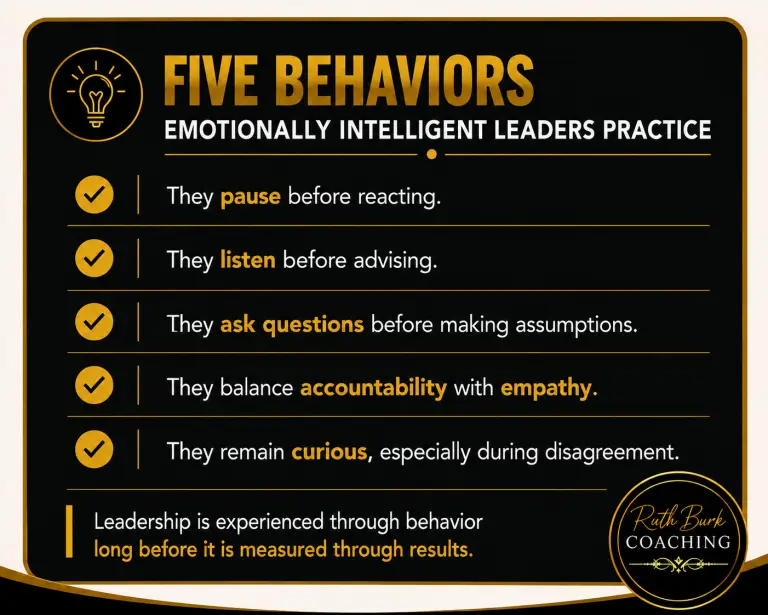
They Ask Questions Before Making Assumptions
Every leader develops assumptions over time. Past experiences shape expectations, successful strategies build confidence, and familiar patterns influence how new situations are interpreted. Experience is valuable, but it can also create blind spots, especially when leaders assume that what worked in the past will work just as well for the challenges they face today.
Emotionally intelligent leaders intentionally challenge their own thinking.
Rather than rushing to conclusions, they become curious. They ask questions before offering answers, seek perspectives different from their own, and remain open to information that contradicts their initial assumptions. That curiosity allows them to make better decisions because it expands the information they consider before acting.
This behavior draws on several competencies measured by the EQ-i 2.0®, including Reality Testing, Flexibility, and Problem Solving. Together, these competencies help leaders separate assumptions from facts, consider different perspectives, and adjust their thinking as new information emerges.
This becomes especially important as artificial intelligence plays a greater role in how leaders solve problems and make decisions. AI can quickly generate multiple solutions to a challenge, but identifying the right solution requires more than information and analysis.
They Balance Accountability with Empathy
One of the most common misconceptions about emotional intelligence is that it leads leaders to avoid difficult conversations or soften expectations.
In reality, emotionally intelligent leaders understand that accountability and empathy are not competing priorities. When practiced together, they strengthen one another.
Accountability without empathy can create defensiveness and disengagement. Empathy without accountability can create confusion, inconsistency, and unclear expectations. Effective leadership requires both.
Whether coaching an underperforming employee, guiding a team through organizational change, or addressing conflict, emotionally intelligent leaders communicate expectations clearly while remaining aware of the emotions and perspectives people bring to the conversation. They are direct without being harsh and supportive without lowering standards.
Within the EQ-i 2.0®, competencies such as Assertiveness, Empathy, and Emotional Expression support this balance, helping leaders communicate honestly and directly while maintaining respect and strengthening relationships.
Employees may not remember every detail of a difficult conversation, but they are far more likely to remember how they were treated during it.
They Remain Curious During Disengagement
Disagreement is inevitable in healthy organizations. Different perspectives can strengthen decision-making by challenging assumptions, surfacing risks, and introducing ideas that might otherwise be overlooked. But disagreement only becomes valuable when leaders remain curious long enough to understand where another perspective is coming from.
Emotionally intelligent leaders resist the urge to defend their position too quickly. Instead, they pause and ask questions:
- What am I missing?
- What does this person see that I don’t?
- What assumptions might I be making?
Curiosity creates enough space between reaction and judgment to consider what else might be true. It allows leaders to remain confident in their own perspective while staying open to information that could change or strengthen it.
Within the EQ-i 2.0®, competencies such as Flexibility, Optimism, and Interpersonal Relationships support this kind of openness. Together, they help leaders navigate differences in perspective, adapt their thinking when needed, and maintain productive relationships even when agreement does not come easily.
This ability is becoming increasingly important. The World Economic Forum’s Future of Jobs Report 2025 identifies analytical thinking, resilience, leadership, curiosity, and lifelong learning among the skills expected to remain important or grow in significance in the years ahead. What these capabilities have in common is a willingness to keep learning, even after years of experience and success.
The most effective leaders are rarely those who believe they have all the answers. They are the ones who continue asking better questions.
Why Measuring Emotional Intelligence Matters
Leadership development often begins with good intentions. Leaders want to communicate more effectively, coach with greater confidence, make better decisions, and build stronger teams. The challenge is rarely a lack of motivation. More often, it is knowing where to focus.
One leader may avoid difficult conversations because conflict feels uncomfortable. Another may communicate confidently but struggle to recognize how their emotions affect others. A third may build strong relationships yet hesitate to hold people accountable when performance falls short.
On the surface, these may seem like very different leadership challenges. Beneath the surface, however, they often point to different emotional intelligence competencies.
That is why I use the EQ-i 2.0® and EQ 360® assessments in my coaching practice. Rather than relying on intuition alone, these research-based assessments provide leaders with structured insight into the emotional intelligence competencies that influence how they lead, relate to others, manage pressure, and make decisions.
The EQ-i 2.0® measures fifteen emotional intelligence competencies, helping leaders identify areas of strength as well as opportunities for growth. The EQ 360® adds another valuable perspective by incorporating feedback from others, offering insight into how a leader’s emotional intelligence is experienced by the people around them.
Together, these assessments create a common language for leadership development that goes beyond personality or communication style. They help leaders better understand not only what they do, but what may be driving those behaviors and where intentional development can make the greatest difference.
But assessment alone does not create better leaders. What matters is what leaders do with the awareness it creates.
When leaders understand how they respond under pressure, express emotions, build relationships, navigate conflict, and make decisions, they can become more intentional about the behaviors they practice every day. Over time, those behaviors can strengthen trust, improve team dynamics, and increase leadership effectiveness.
The goal is not simply to score higher in emotional intelligence, but to become a leader who consistently demonstrates it.
Leadership Is Built One Behavior at a Time
Throughout this series, one idea has remained constant: as technology becomes more capable, the human side of leadership becomes more important, not less.
In The Leadership Decisions AI Should Never Make, I explored why some of the most consequential leadership decisions require human judgment, particularly when trust, relationships, and people are involved. More recently, in Why Emotional Intelligence Is the Leadership Capability AI Can’t Replace, I examined why emotional intelligence strengthens the judgment leaders bring to those moments. This article brings those ideas into practice.
Artificial intelligence will continue to change how organizations analyze information, automate work, solve problems, and operate more efficiently. But no matter how sophisticated the technology becomes, leadership will still be experienced in deeply human ways.
- In a difficult conversation.
- In a moment of disagreement.
- In the decision to listen before responding.
- In how a leader handles pressure, gives feedback, or earns trust.
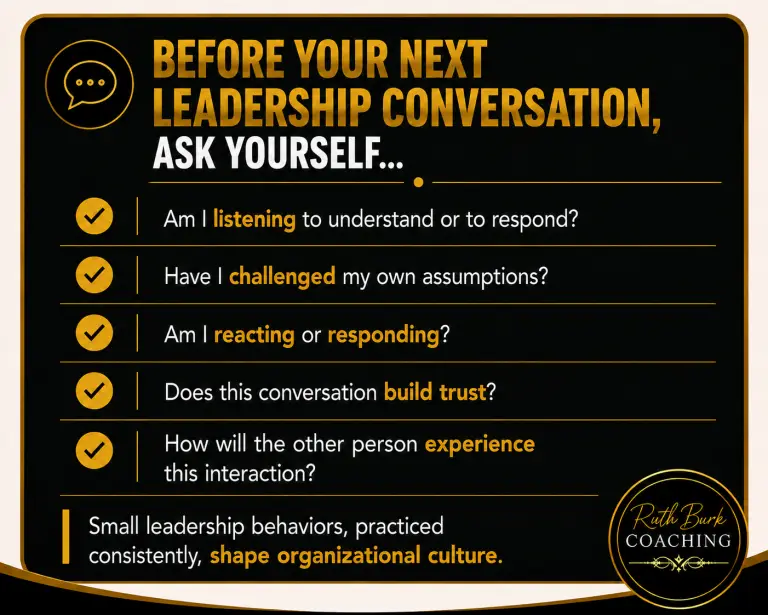
These moments may seem small, but repeated over time, they shape how people experience leadership and, ultimately, the culture of an organization.
The leaders who make the greatest impact turn emotional intelligence into behaviors their teams experience every day.
Ready to Develop the Behaviors That Strengthen Leadership?
Emotional intelligence is more than a leadership concept. It is a measurable set of competencies that influences how leaders communicate, make decisions, respond under pressure, and build trust.
If you’re ready to better understand your leadership strengths, uncover blind spots, and intentionally develop the behaviors that strengthen your effectiveness, schedule a complimentary Clarity Call to learn how the EQ-i 2.0® and EQ 360® assessments can support your leadership development.