

Artificial intelligence is changing how leaders make decisions.
It summarizes meetings, identifies patterns, analyzes performance data, drafts communications, and generates recommendations in seconds. As these capabilities continue advancing, leaders have access to more information than ever before. Many organizations assume this abundance of information will naturally lead to better decisions. Better information, however, doesn’t automatically produce better leadership.
Throughout the Slow Power Journal, I’ve argued that artificial intelligence is changing where leaders create value by making uniquely human capabilities increasingly important. In The Competitive Advantage for Founders That AI Can’t Replace, I explored how community, trust, and relationships become increasingly valuable as technology becomes more accessible. More recently, in The Leadership Decisions AI Should Never Make, I argued that defining organizational direction, developing people, building culture, exercising ethical judgment, and setting long-term strategy remain fundamentally human responsibilities.
Each of those responsibilities depends on something artificial intelligence cannot provide: emotional intelligence.
Whether leaders are setting strategic direction, coaching a struggling employee, navigating conflict, or making difficult ethical decisions, they are constantly interpreting emotions, balancing competing perspectives, and making decisions that affect other people. Artificial intelligence can improve the quality of information available to leaders. It cannot replace the human capabilities required to use that information wisely.
As an EQ-i 2.0® and EQ 360® certified practitioner, I’ve seen firsthand that leadership challenges rarely stem from a lack of intelligence or technical expertise. More often, they arise because leaders struggle to manage emotions under pressure, communicate effectively through uncertainty, or build the trust needed to help others navigate change. Those are precisely the capabilities emotional intelligence helps leaders develop.
As artificial intelligence assumes more responsibility for gathering information and evaluating alternatives, leaders become increasingly responsible for understanding themselves, navigating relationships, and guiding people through complexity. Technology improves analysis. Emotional intelligence strengthens the judgment leaders apply to that analysis.
The future of leadership may depend not only on how well leaders use artificial intelligence, but also on how well they understand themselves.
Better Decisions Begin with Better Self-Awareness
Leadership decisions are never made in a vacuum.
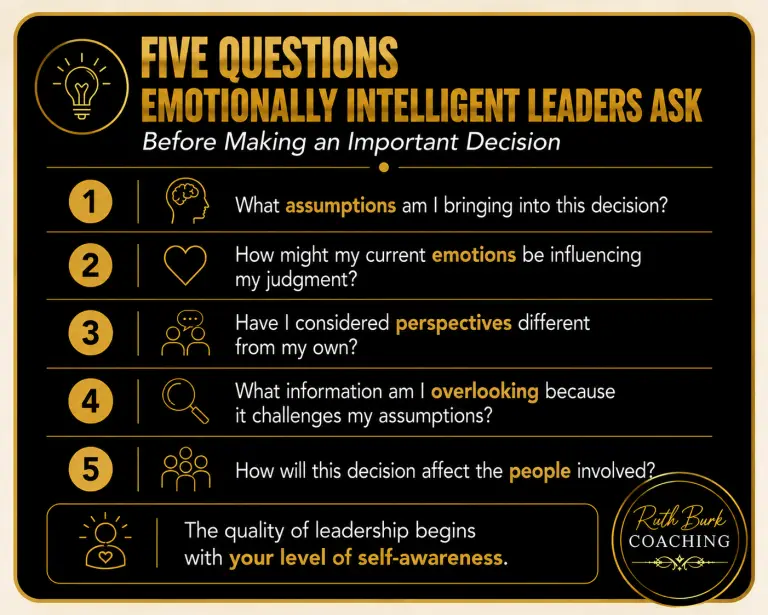
Every decision reflects the experiences, assumptions, emotions, and biases of the person making it. Two executives can review the same financial forecasts, customer insights, or AI-generated recommendations and reach entirely different conclusions. The difference often has less to do with the information available than with the leader interpreting it.
Each leader brings a unique combination of experiences, beliefs, and emotional responses to the decision-making process. These influences often operate quietly, shaping how leaders interpret information, assess risk, and determine what deserves their attention. Without self-awareness, they can quietly influence important decisions affecting teams, customers, and organizations. Self-awareness helps leaders recognize these patterns before they become unconscious drivers of decision-making.
Daniel Goleman’s landmark Harvard Business Review article, What Makes a Leader?, identifies self-awareness as one of the foundational components of emotional intelligence. Leaders who understand their own emotional patterns are better equipped to regulate their reactions, recognize blind spots, respond thoughtfully under pressure, and build stronger relationships with the people they lead. Goleman argues that self-awareness also supports the other dimensions of emotional intelligence because leaders cannot effectively demonstrate empathy, manage relationships, or exercise self-control without first understanding themselves.
As organizations increasingly rely on AI to improve analysis, self-awareness becomes even more valuable because it strengthens the judgment leaders bring to that information. Better technology improves analysis, but self-awareness improves the leader interpreting it.
Emotional Intelligence Strengthens Every Leadership Decision
In The Leadership Decisions AI Should Never Make, I argued that certain leadership responsibilities should remain unmistakably human because they require judgment rather than analysis. Artificial intelligence can improve access to information, evaluate alternatives, and estimate likely outcomes, but it cannot determine organizational purpose, coach future leaders, resolve ethical dilemmas, build trust, or define long-term strategy. Each of those responsibilities depends on emotional intelligence.
Defining organizational direction requires leaders to balance competing priorities while remaining grounded in purpose rather than reacting to short-term pressure. Developing people requires empathy, curiosity, and the ability to recognize potential beyond measurable performance. Building culture depends on how leaders communicate, resolve conflict, recognize contributions, and respond during periods of uncertainty. Ethical leadership requires balancing competing stakeholder interests while remaining aligned with organizational values, while long-term strategy demands resilience, adaptability, and the confidence to make decisions despite incomplete information.
Artificial intelligence can support each of these responsibilities by improving the quality of available information, but it cannot replace the emotional intelligence required to carry them well.
That distinction matters because organizations rarely remember leaders for the reports they reviewed or the software they implemented. They remember how leaders made decisions, how they communicated during difficult moments, and how they helped others navigate uncertainty. Emotional intelligence influences each of those experiences, shaping trust one interaction at a time.
Emotional Intelligence Creates Better Teams
Organizations do not become stronger simply because individual leaders become more emotionally intelligent. They become stronger because emotionally intelligent leadership shapes how teams communicate, collaborate, and respond to challenges.
In How Business Systems Help Teams Make Better Decisions Without Relying on the Founder, I argued that clear business systems distribute judgment by establishing decision frameworks, communication rhythms, and defined ownership. Those systems reduce uncertainty while allowing leaders to focus on higher-value responsibilities. Systems create clarity. Emotional intelligence determines how people experience that clarity.
A well-designed decision framework can establish who owns a decision. Emotional intelligence influences how leaders communicate that decision, respond to questions, and help people move forward when uncertainty remains. A documented process can reduce confusion, but it cannot create trust. A communication rhythm can improve coordination, but it cannot replace empathy during periods of change. The strongest organizations intentionally develop both.
They build systems that create consistency while developing leaders who know how to listen, coach, manage conflict, and guide people through complexity. Together, these capabilities strengthen not only operational performance but also the relationships that allow teams to perform at their best.
The Center for Creative Leadership has consistently found that emotional intelligence contributes to leadership effectiveness by strengthening communication, collaboration, conflict management, and trust. As organizations grow, these capabilities become increasingly important because technical expertise alone is rarely enough to sustain high-performing teams.
Emotional Intelligence Can Be Developed
One of the most common misconceptions about emotional intelligence is that people either possess it naturally or they don’t. Research suggests otherwise.
Unlike personality, emotional intelligence is widely understood as a set of measurable competencies that can be strengthened over time through intentional feedback, coaching, reflection, and practice. That distinction is important because it means leaders are not limited by their natural tendencies. They can intentionally develop the capabilities that strengthen judgment, relationships, and leadership effectiveness.
The EQ-i 2.0®, developed by Multi-Health Systems (MHS), measures emotional intelligence across five interconnected areas:
- Self-Perception
- Self-Expression
- Interpersonal Relationships
- Decision Making
- Stress Management
Together, these competencies provide leaders with a practical framework for understanding how emotions influence leadership behavior. Self-awareness affects judgment. Stress management influences decision quality under pressure. Interpersonal relationships shape collaboration and trust. Decision-making reflects how leaders balance emotions with objective information. Because these competencies can be measured, they can also be intentionally developed.
That matters because organizations rarely struggle due to a lack of technical expertise. More often, they struggle because leaders find it difficult to navigate conflict, communicate clearly during uncertainty, develop future leaders, or manage the emotional demands created by growth and change. Emotional intelligence helps leaders strengthen those capabilities before they become organizational challenges.
As an EQ-i 2.0® and EQ 360® certified practitioner, I’ve found that many leaders are surprised by how often their greatest opportunities for growth involve not technical knowledge, but greater self-awareness, stronger relationships, or more effective responses under pressure. Those insights often become the foundation for meaningful and lasting leadership development.
The Future of Leadership Requires Both Artificial Intelligence and Emotional Intelligence
Artificial intelligence will continue changing how organizations gather information, improve efficiency, and support decision-making. That evolution increases rather than decreases the value of emotional intelligence.
The World Economic Forum’s Future of Jobs Report 2025 identifies leadership, analytical thinking, resilience, systems thinking, curiosity, and lifelong learning among the capabilities expected to grow in importance over the coming years. Collectively, these capabilities point toward a future in which leaders are expected not only to interpret increasingly complex information but also to navigate uncertainty, strengthen relationships, and help organizations adapt as conditions continue to change.
The Yale Center for Emotional Intelligence reaches a similar conclusion from a different perspective. Its research describes emotional intelligence as the ability to recognize, understand, manage, and effectively use emotions in ourselves and others. These capabilities influence learning, decision-making, collaboration, and overall well-being throughout organizations. As artificial intelligence becomes increasingly integrated into daily work, these distinctly human capabilities become even more valuable because they strengthen the relationships and trust technology cannot create on its own.
Throughout this series of articles, I’ve argued that leadership is becoming less about having all the answers and more about creating the conditions where people can do their best work. In The Competitive Advantage for Founders That AI Can’t Replace, I explored why community is becoming one of the few competitive advantages technology cannot replicate. In Why Growing Businesses Outgrow Their Systems, I argued that sustainable growth requires leaders to evolve alongside their organizations. In How Business Systems Help Teams Make Better Decisions Without Relying on the Founder, I showed how clear systems distribute judgment throughout an organization. Most recently, in The Leadership Decisions AI Should Never Make, I argued that some responsibilities should always remain unmistakably human.
Emotional intelligence connects each of those ideas.
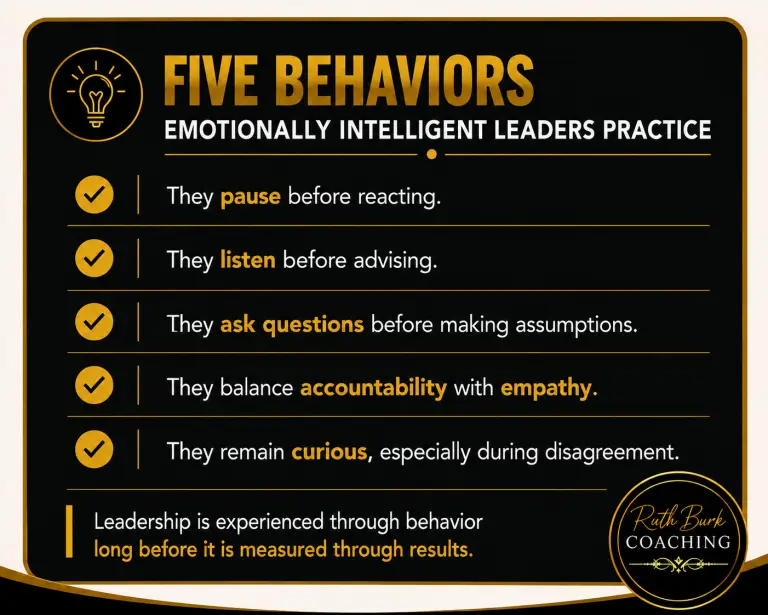
It strengthens the judgment behind difficult decisions. It shapes how leaders build trust, navigate conflict, coach others, and create environments where people feel confident contributing their best work. Artificial intelligence may improve how organizations process information, but emotional intelligence continues to shape how people experience leadership.
The organizations that flourish in the years ahead won’t simply invest in better technology. They’ll invest in leaders capable of combining analytical intelligence with emotional intelligence, creating environments where both people and technology contribute to better decisions, stronger relationships, and more resilient organizations.
Ready to Strengthen the Leadership Capability AI Can't Replace?
Artificial intelligence is transforming how organizations work, but it isn’t reducing the need for emotionally intelligent leadership. If anything, it is increasing it.
If you’re ready to strengthen the self-awareness, emotional intelligence, and leadership capabilities that support better judgment, healthier teams, and more effective decision-making, schedule a complimentary Clarity Call to explore how the EQ-i 2.0® and EQ 360® assessments can help you better understand your leadership strengths, identify opportunities for growth, and develop the capabilities that technology can support but never replace.