
Organizations invest significant time and resources bringing talented people together.
They recruit experienced leaders, hire people with specialized expertise, establish goals, and implement systems designed to help everyone work effectively. Yet putting capable people on the same team does not automatically create a high-performing team. The difference often lies in how those people work together.
In The Leadership Behaviors That Emotional Intelligence Makes Possible, I explored how emotional intelligence becomes visible through everyday leadership behaviors: listening, remaining curious, challenging assumptions, balancing empathy with accountability, and responding thoughtfully under pressure. While these behaviors begin with the leader, their impact extends beyond the individual. They shape how people communicate, contribute, disagree, and work together as a team.
Over time, those signals establish what feels safe within the team. When leaders acknowledge mistakes, others are more likely to do the same. When they listen to challenges, they show that disagreement is welcome. And when they ask for help, they reinforce that expertise does not require having every answer.
These interactions create something teams cannot perform well without:
Trust.
But the kind of trust that strengthens team performance goes deeper than believing your colleagues are competent, dependable, or pleasant to work with. It requires people to become comfortable being honest about what they don’t know, where they need help, and when they disagree.
That is vulnerability-based trust, which Patrick Lencioni identifies as the foundation of a cohesive, high-performing team. His model shows how trust shapes a team’s ability to navigate disagreement, make decisions, hold one another accountable, and ultimately achieve results together.
Trust Is More Than Getting Along
Teams can appear highly functional while still lacking trust.
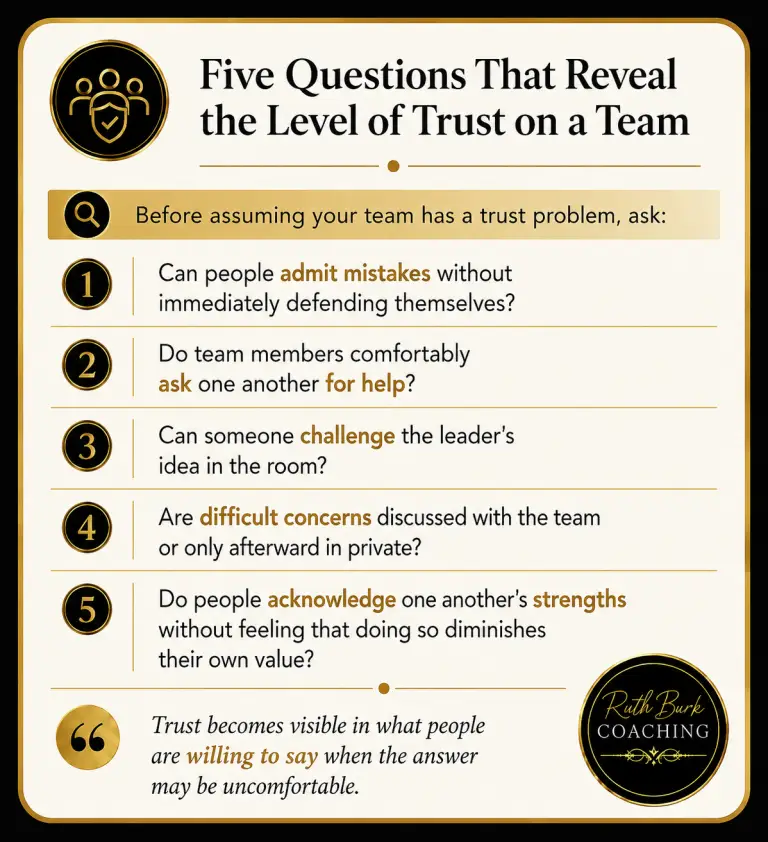
Meetings may be cordial. People may respect one another’s expertise. Projects may move forward without obvious conflict. Everyone may even genuinely like working together. Yet underneath that cooperation, team members may still hesitate to admit mistakes, ask for help, challenge a colleague’s idea, or acknowledge that they don’t understand something.
That distinction matters.
Vulnerability-based trust goes beyond confidence that colleagues are competent or will follow through on what they promise. It is the willingness to be open with teammates without worrying that doing so will diminish your credibility or standing with the team.
On teams with this kind of trust, people can say:
I was wrong.
I don’t know.
I need help.
I disagree.
You understand this better than I do.
Those statements may sound simple, but in many organizations they require considerable courage.
This is why Lencioni places trust at the base of The Five Behaviors® model. Without trust, productive conflict becomes harder. Without productive conflict, genuine commitment suffers. Without commitment, peer accountability becomes more difficult. And without those behaviors, maintaining a focus on collective results becomes harder still.
The model is intentionally sequential: weakness at the foundation affects everything built on top of it.
Trust Makes It Safer to Tell the Truth
One of the most important things trust changes on a team is the quality of information available to it.
When trust is low, people filter. They hesitate before raising concerns. They soften disagreement. They wait to see what the leader thinks before offering a different perspective. They may recognize a problem but decide that saying nothing carries less personal risk than challenging the direction of the group.
The result can look like agreement, but it isn’t necessarily alignment. Sometimes it is simply silence.
When vulnerability-based trust is stronger, people are more willing to surface information the team actually needs. They can acknowledge uncertainty, question assumptions, ask for clarification, and raise concerns before those concerns become larger problems.
This connects directly to the argument I made in How Business Systems Help Teams Make Better Decisions Without Relying on the Founder. Clear decision frameworks can establish who owns a decision and how information should move through an organization. But a decision framework cannot force someone to raise a concern they are afraid to voice.
Systems create the structure for better decisions, while trust enables people to contribute openly within that structure.
Research on psychological safety reinforces the importance of how people work together. In her foundational research, Amy Edmondson describes psychological safety as a shared belief that a team is safe for interpersonal risk-taking. In practice, that means people feel able to ask questions, admit mistakes, raise concerns, and challenge ideas without fear that doing so will damage their standing on the team.
Vulnerability-based trust and psychological safety are not identical concepts, but they point toward a similar organizational reality: teams perform differently when people believe they can speak honestly without being punished for doing so.
Trust Changes How Teams Handle Mistakes
Every team makes mistakes. The more revealing question is what happens next.
On teams with low trust, mistakes can trigger self-protection. People explain why something wasn’t their responsibility, avoid discussing what went wrong, or quietly redirect attention toward someone else’s contribution to the problem. That response makes learning difficult because the team spends more energy managing perception than understanding what happened.
Teams with stronger trust can respond differently. People can acknowledge their contribution to a problem without assuming that doing so will permanently damage their credibility. They can ask what they missed, invite feedback, and focus on what needs to change rather than who needs to be blamed. This is where emotional intelligence and team effectiveness begin to intersect.
As I discussed in Why Emotional Intelligence Is the Leadership Capability AI Can’t Replace, self-awareness helps leaders recognize how their own assumptions, emotions, and reactions influence judgment. At the team level, that same willingness to examine oneself becomes essential to trust. Someone has to be willing to go first, and leaders have an outsized influence here.
When leaders acknowledge uncertainty, admit mistakes, ask for feedback, and recognize other people’s expertise, they communicate that vulnerability is not evidence of incompetence. Being open about what you do not know, where you went wrong, or where you need input is part of how a team learns and improves. That openness does not mean lowering standards or avoiding accountability. In fact, trust makes meaningful accountability possible because people can address problems, challenge one another, and take responsibility without becoming defensive or withdrawing.
Trust Makes Healthy Conflict Possible
Many teams say they want greater collaboration when what they actually need is greater capacity for disagreement.
High-performing teams are not teams without conflict. They are teams that know how to disagree about important issues without allowing disagreement to become personal, political, or destructive.
That distinction is central to The Five Behaviors® model. Once vulnerability-based trust exists, team members are better positioned to engage in productive conflict around ideas. They can challenge assumptions, question strategies, and advocate for different approaches without interpreting every disagreement as a threat to the relationship. Without trust, those same conversations become much harder.
People may avoid conflict entirely because they fear damaging relationships. Others may participate in meetings but save their real opinions for private conversations afterward. Some teams repeatedly revisit decisions because the disagreement that needed to happen before the decision was never fully expressed.
Patrick Lencioni argues that productive conflict should focus on concepts and ideas rather than personal attacks. The Five Behaviors® framework similarly treats conflict as necessary to effective teamwork because honest debate helps teams surface different perspectives and work toward stronger decisions.
But trust alone does not ensure that disagreement will be productive. People also need the ability to navigate conflict without becoming defensive, dismissive, or personal. This is where emotional intelligence becomes especially important. Leaders who remain curious during disagreement, regulate their own reactions, listen to perspectives they do not share, and challenge ideas without diminishing people help create the conditions for healthy conflict. Their response also signals to others that disagreement can be direct without becoming destructive.
Trust makes it possible for people to speak openly. Emotional intelligence helps leaders ensure that what follows strengthens rather than undermines the team.
Why Measuring Team Dynamics Matters
Most teams know when something feels wrong.
They may describe communication as difficult, meetings as unproductive, accountability as inconsistent, or decision-making as frustrating. What they often cannot identify is the pattern connecting those problems. That is one reason I use The Five Behaviors® Team Development methodology in my team coaching work.
As a Five Behaviors® Certified Practitioner, I use the assessment not to label a team as functional or dysfunctional, but to give team members a structured way to understand how they are currently working together. The Team Development assessment examines the team’s experience across five interconnected behaviors:
- Trust
- Conflict
- Commitment
- Accountability
- Results
The assessment also incorporates Everything DiSC®, providing another layer of insight into how individual behavioral styles influence team dynamics. That combination helps teams examine both the collective patterns affecting performance and some of the individual differences influencing how people communicate and work together. The value is creating a common language for conversations teams often struggle to have on their own.
A team may discover, for example, that members are generally comfortable with one another but reluctant to engage in disagreement. Another may debate ideas openly yet struggle to commit once decisions are made. Another may have strong commitment but rely almost entirely on the team leader to enforce accountability.
Those are different team challenges, and they require different conversations. The assessment helps identify where those conversations should begin.
Trust Is a Team Practice
Trust is sometimes treated as something teams either have or don’t have. That makes it sound static, but it isn’t. Trust is strengthened or weakened through repeated interactions.
It grows when people follow through on commitments, acknowledge mistakes, ask for help, listen without becoming defensive, and address concerns directly rather than allowing them to move into private conversations. It weakens when people punish vulnerability, avoid difficult conversations, withhold information, or repeatedly say one thing in meetings and another afterward.
This is why a team assessment alone is not enough. While an assessment can reveal patterns, team coaching helps people change them. The work happens when teams begin practicing different behaviors together, then return to those behaviors when pressure, deadlines, leadership changes, or organizational uncertainty test them.
In Why Growing Businesses Outgrow Their Systems, I argued that sustainable growth requires organizations to build structures that allow leadership and ownership to expand beyond the founder. The same principle applies to teams. Strong teams cannot depend on one leader to create trust, resolve every conflict, secure commitment, enforce every expectation, and deliver every result. Eventually, team effectiveness has to belong to the team.
Ready to Strengthen How Your Team Works Together?
If your leadership team is talented but struggles with communication, conflict, accountability, or consistent follow-through, the challenge may not be individual capability. It may be how the team is working together.
Schedule a complimentary Clarity Call to explore how team coaching using The Five Behaviors® and Everything DiSC® can help your team identify the patterns affecting performance, strengthen trust, navigate conflict more productively, and build the behaviors required for stronger collective results.