

The decisions that consume the most leadership capacity are not always the ones that appear most consequential.
A major strategic choice may clearly warrant careful thought. More difficult to see is the cumulative effect of everything surrounding it: the exception that needs approval, the personnel issue that cannot remain unresolved, the client question requiring a judgment call, the request for resources, or the problem that has moved upward because no one is quite sure who has authority to decide.
None of these decisions necessarily feels excessive on its own. Many are legitimate, and some may take only minutes to resolve. Yet together they create an environment in which leaders continually redirect their attention among decisions with very different stakes, contexts, and consequences.
That matters because leadership judgment is not exercised in isolation. A consequential decision may receive less thoughtful consideration not because a leader lacks experience or capability, but because it is competing with everything else demanding attention at the same time.
This is a more useful way to think about decision fatigue in leadership. The issue is not simply the number of decisions a leader makes. It is what happens when everything begins competing for the same finite leadership attention.
Decision Fatigue Is More Than Having Too Much to Do
A demanding workload and a demanding decision environment are not necessarily the same thing.
A leader can have a full calendar without making many consequential choices. Another can spend relatively little time in meetings while moving repeatedly among questions involving people, strategy, operations, finances, and organizational risk. The challenge in the second environment is not simply volume. It is the continual shift in the kind of judgment required.
The basis for a sound decision can change considerably from one issue to the next. A customer exception may require balancing the value of the relationship against the precedent it creates. A staffing decision can involve capability, fairness, cost, and future organizational needs. An investment decision introduces another set of considerations around opportunity, capacity, risk, and timing.
Moving among these decisions requires leaders to repeatedly reorient themselves to a different context and determine what deserves the greatest weight. That makes decision fatigue different from simply being busy. It is partly a question of what continual demands on attention do to the conditions under which judgment is exercised.
Attention Does Not Automatically Follow Consequence
Ideally, the decisions with the greatest consequences would receive the greatest share of leadership attention. Organizations rarely operate that neatly.
Attention is often captured by what is immediate. A customer is waiting. An employee needs an answer. A project has stalled. A problem has become visible enough that someone expects leadership to intervene. Each creates pressure to respond, even when another less visible issue may carry substantially greater consequences for the organization’s future. The result can be a mismatch between what commands attention and what deserves it.
A strategic question about entering a new market may remain unresolved while a series of operational issues consumes the week. A difficult succession decision can be repeatedly deferred because nothing requires it to be settled today. A growing organizational risk may receive less attention than a highly visible customer escalation simply because one announces itself more forcefully than the other.
This does not mean the immediate issues are unimportant. Leadership often requires responsiveness. The problem emerges when visibility, urgency, or accessibility consistently determines where attention goes.
The question then becomes less about whether a leader is working hard enough and more about whether leadership attention is following organizational consequence.
Some Decisions Are Competing for Attention That Should Never Have Reached You
There is another reason consequential decisions can become crowded out: not everything competing for leadership attention actually requires leadership judgment.
In The Leadership Bottleneck: When Too Many Decisions Depend on You, I explored how organizations can gradually learn to send uncertainty upward. A capable leader repeatedly resolves ambiguous situations, and over time asking the leader becomes easier than deciding elsewhere. The work may have been delegated while judgment remains concentrated.
That pattern has consequences beyond workload.
Every unnecessary escalation occupies some portion of the same attention available for decisions involving strategy, people, resources, risk, or long-term direction. A question that takes five minutes may appear inconsequential, but a steady stream of those questions can fragment the space surrounding work that requires sustained thought.
This changes the leadership question. Rather than asking only, How can I manage all of these decisions more efficiently?, it becomes important to ask:
Which of these decisions should be competing for my attention at all?
That distinction matters because personal productivity cannot fully compensate for poor decision architecture. A leader can become exceptionally efficient at processing questions the organization should have learned to resolve without them.
The Conditions Around a Decision Matter
Decision fatigue is often described as though good judgment works like a battery: make enough decisions, and eventually it runs down. The research suggests the reality is more nuanced.
Recent research has found evidence that decision fatigue can affect how people make choices, but the effect is not consistent across every person or situation. Researchers increasingly point to the surrounding conditions – including the complexity of the decisions, sustained mental demands, stress, and the amount of time spent moving from one decision to another – as important parts of the picture. A recent systematic review examining 82 studies, for example, found evidence consistent with decision fatigue in some settings but not others, reinforcing that there is no simple threshold after which people suddenly become poor decision-makers.
For leaders, that distinction is useful. You do not need to count how many decisions you have made by 3 p.m. What matters more is noticing the environment in which an important decision is being made.
Consider the difference between reviewing a strategic investment after an uninterrupted hour spent examining the implications and addressing the same question between an employee issue, an urgent client request, and three messages asking for approval. The decision itself has not changed. The conditions surrounding your judgment have.
Those conditions can subtly influence what receives weight. When attention has been repeatedly redirected, the familiar option may become easier to accept. A solution that can be implemented quickly can become more appealing than one requiring additional examination. After spending hours responding to immediate issues, it can also be difficult to shift into the longer time horizon a strategic decision requires.
This is why the conventional advice to simply “make fewer decisions” is incomplete. Leaders cannot eliminate many of the decisions inherent in their roles, nor should they. The familiar idea that we begin the day with a fixed reserve of mental energy that gradually runs down as we make decisions has also been challenged by research. In a large preregistered study conducted across 36 laboratories and more than 3,500 participants, researchers did not find evidence for such a straightforward depletion effect in their primary analyses.
The more useful leadership question is:
What conditions am I creating around the decisions that deserve my best judgment?
Sometimes that means protecting uninterrupted time. In other situations, it means recognizing that a decision should wait until additional perspectives are available. And sometimes the recurring demands competing for your attention reveal a larger organizational issue: unclear ownership, unnecessary escalation, or decisions that should never have required your involvement in the first place.
The goal is to recognize that not every decision deserves the same conditions, and the most consequential ones should not simply inherit whatever attention happens to be left.
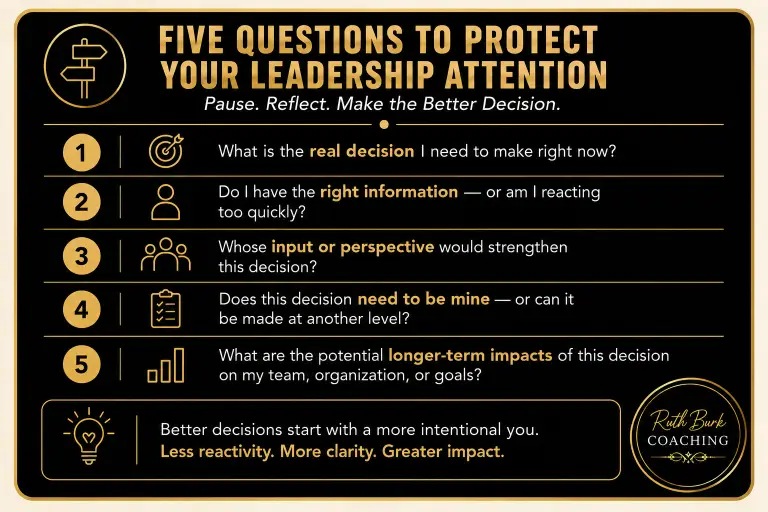
Fragmented Attention Has an Organizational Cost
The cost of fragmented attention is easy to treat as personal. The leader feels distracted, has difficulty finding uninterrupted thinking time, or ends the day with the sense that important work never received enough attention. But the consequences extend beyond the individual leader.
When strategic questions are repeatedly displaced by immediate ones, organizations can become highly responsive without becoming particularly deliberate. Leaders may spend significant time resolving today’s problems while questions about future capability, emerging risk, succession, or strategic direction remain open because none creates the same immediate demand.
The organization can continue functioning this way for a long time. In fact, capable leadership can make the pattern difficult to see because urgent matters continue to get resolved. The larger cost appears in what receives less attention as a result.
This is why protecting leadership attention is not simply a matter of executive well-being or personal productivity. Attention is an organizational resource. Where leaders consistently place it affects what gets examined, what gets resolved, what gets deferred, and ultimately what the organization is able to anticipate before circumstances force a response.
Some Decisions Should Require Less Attention Over Time
Protecting judgment does not mean every decision deserves greater deliberation. In a well-functioning organization, many recurring decisions should require less leadership attention over time because the organization has learned from previous choices.
Decision criteria are one way this happens.
Clear guardrails can establish acceptable risk. Defined decision rights can clarify who has authority. Escalation criteria can distinguish an unusual but manageable situation from one that genuinely requires leadership involvement. Principles established through previous decisions can give people a basis for exercising judgment even when the exact circumstances have never occurred before. The result is less unnecessary reinvention.
In When Priorities Compete: The Judgment Behind Better Leadership Decisions, I explored how decision criteria make the reasoning underneath consequential choices more visible. They do not replace judgment; they reveal what leadership is weighting and why.
For recurring decisions, those principles can serve another purpose. Once people understand how leadership has approached similar choices, including the trade-offs it will accept, the risks it will tolerate, and the outcomes it is protecting, they have a stronger basis for making the next decision without reconstructing the reasoning from the beginning. Some of yesterday’s judgment becomes part of tomorrow’s operating environment.
That is an important form of leadership leverage. The organization learns from a decision rather than simply receiving an answer.
Protecting Leadership Attention Requires More Than Protecting Time
Leaders are often encouraged to block time for strategic thinking. That may seem helpful, but an open hour on a calendar does not necessarily create strategic attention.
A leader can enter that hour carrying unresolved questions from the morning, anticipating decisions waiting afterward, or mentally moving among several issues that have not yet reached closure. The calendar technically contains space while attention remains fragmented. Protecting leadership attention therefore requires examining both time and decision architecture.
Look at what repeatedly occupies your attention. Some issues may need clearer decision criteria. Others may require consultation but not approval. Certain decisions belong closer to the people with the relevant information, while a smaller number are consequential enough that leadership should deliberately protect the time and space required to consider them.
This is a different objective from simply becoming more efficient. It is about aligning leadership attention with decision consequence.
As responsibility grows, that alignment becomes increasingly important. Leadership value comes partly from recognizing patterns, integrating competing forms of information, anticipating second-order effects, and exercising judgment where choices cannot be resolved through routine processes alone. Using that capability indiscriminately can leave less of it available where it matters most.
AI Can Make the Competition for Attention More Complicated
AI should, in theory, make some decisions easier. Leaders can synthesize large amounts of information, compare scenarios, generate alternatives, surface patterns, and test assumptions far more quickly. Used well, these capabilities can reduce some of the effort required to understand a decision. But easier analysis does not necessarily create greater clarity about what deserves attention.
When information can be synthesized quickly, leaders can request another analysis before choosing. A question that once would have proceeded with the information available can remain open because the cost of examining one more possibility has fallen dramatically. The organization can become increasingly sophisticated at generating possibilities without becoming more disciplined about determining which possibilities matter.
As I explored in The Leadership Decisions AI Should Never Make, technology can improve the information surrounding a choice without assuming responsibility for its consequences. Leaders still have to determine what deserves weight, which trade-offs are acceptable, and when additional analysis is unlikely to change the judgment.
As information becomes easier to generate, attention may become more valuable precisely because there are more things capable of claiming it.
The Goal Is Not to Give Everything Equal Attention
Leadership will always involve periods when many legitimate demands converge. Growth, transformation, crisis, and uncertainty can require greater involvement for a time. The more important question is whether those demands are receiving attention because of their consequence or simply because of their immediacy.
Some decisions deserve sustained leadership attention because they involve strategic direction, enterprise risk, or consequences that extend across the organization. Others can be governed by principles already established, decided closer to the relevant information, or resolved without another layer of approval. Clarity comes from knowing the difference.
Decision fatigue, viewed this way, requires greater discipline about what is allowed to compete for leadership attention in the first place. The goal is to ensure that what matters most does not continually lose attention to what demands it most loudly.
Ready to Strengthen Your Leadership Judgment?
In Clarity Catalyst™, I work with leaders using their actual decisions as the curriculum. Rather than treating decision-making as an abstract leadership competency, we examine which decisions are consuming attention, which patterns recur, what criteria are governing consequential choices, and where ownership may need to shift.
The objective is to become more intentional about where your judgment creates the greatest value and to develop a clearer architecture around the decisions surrounding your role. The work culminates in a personalized 90-Day Leadership Focus & Direction Plan that translates those insights into decision criteria, leadership priorities, practices, and success indicators.
If you are ready to strengthen how you exercise judgment while protecting attention for the decisions that genuinely require it, schedule a complimentary Clarity Call.